

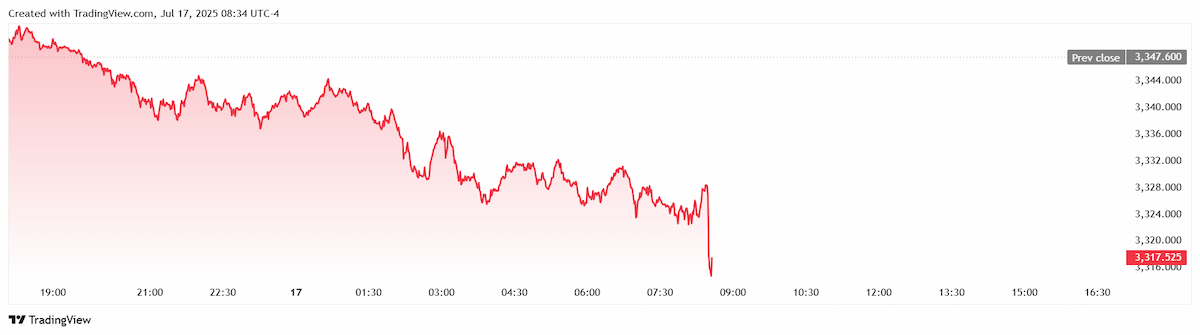
(Kitco News) – The gold market is trading near session lows on Thursday morning after the Philadelphia Federal Reserve's manufacturing sector survey rose back into expansionary territory this month.
The regional central bank said its manufacturing business outlook for July came in at 15.9 after a reading of -4 in both May and June. The data was much better than expected, as economists were looking for a reading of -1 this month.
“Manufacturing activity in the region expanded overall this month, according to the firms responding to the July Manufacturing Business Outlook Survey,” the report said. “The survey’s indicator for general activity returned to positive territory, and the indexes for new orders and shipments both increased this month. All three indexes recorded their highest readings since February. The employment index turned positive, suggesting overall increases in employment. Both price indexes rose after declining last month and continue to suggest overall price increases. The future activity indicators suggest that the firms continue to expect growth over the next six months.”
Gold sold off sharply in the minutes following the manufacturing data release, with spot gold falling to a session low $3,312.66 and last trading at $3,317.86 per ounce for a loss of 0.89% on the day.
The key components of the index improved in July. “Nearly 32 percent of the firms reported increases in general activity this month (up from 25 percent last month), while 16 percent reported decreases (down from 28 percent); 49 percent reported no change (up from 44 percent),” the Philly Fed noted. “The index for new orders increased 16 points to 18.4 this month, and the current shipments index increased from 8.3 to 23.7, also their highest readings since February.”
The employment picture also improved significantly in July. “The firms reported overall increases in employment, as the employment index rose 20 points to 10.3 and mostly recovered its decline from last month,” the report said. “Most firms (70 percent) reported no change in employment, 17 percent reported increases, and 7 percent reported decreases. The average workweek index inched up to 0.4.”
The Philly Fed report did show prices continuing to rise on balance, however.
“The prices paid index rose 17 points from 41.4 to 58.8, largely undoing its fall in June,” the report noted. “Almost 61 percent of the firms reported increases in input prices, while 2 percent reported decreases; 31 percent reported no change. The current prices received index increased 5 points to 34.8. Almost 35 percent of the firms reported increases in the prices of their own goods, none reported decreases, and 58 percent reported no change.”
The survey’s broad indicators for future activity mostly improved as well.
“The diffusion index for future general activity ticked up 3 point to 21.5 in July, after declining 29 points in June,” the report said. “Nearly 41 percent of the firms expect an increase in activity over the next six months, exceeding the 20 percent that expect a decrease; 30 percent expect no change. The future new orders index increased 8 points to 30.0, and the future shipments index decreased 4 points to 23.6. The firms still expect overall increases in employment over the next six months, but the future employment index ticked down 5 points to 20.1. Almost 26 percent of the firms expect increases, while 6 percent expect decreases in future employment; more than 67 percent of the firms expect no change. The index for future capital expenditures increased 3 points to 17.1. Almost 73 percent of the firms expect no change in capital spending.”
