
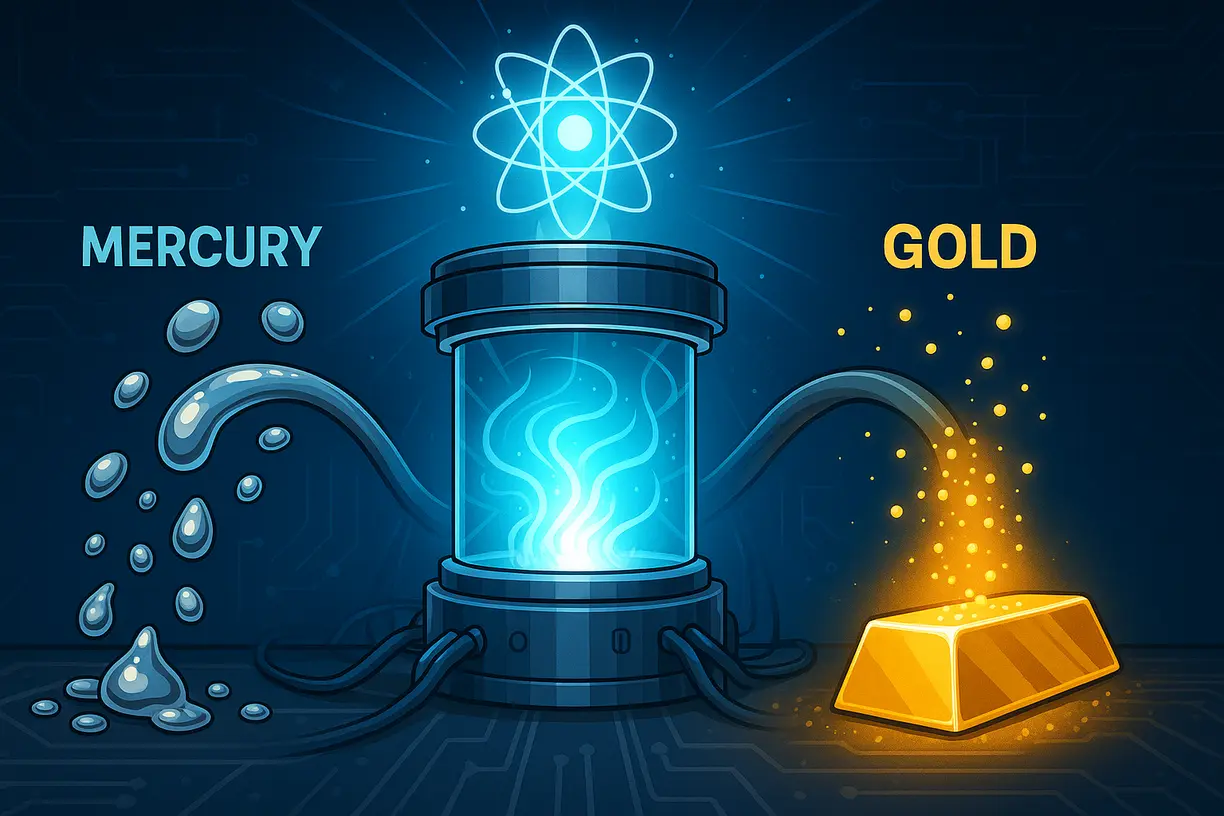
(Kitco News) - For thousands of years, alchemists dreamed of turning lead into gold. Now, a San Francisco-based startup says it has achieved a modern version of that dream—using nuclear fusion to transmute mercury into gold.
In a research paper published in mid-July, Marathon Fusion said it can transform mercury into gold through the same fusion process it uses to generate energy.
“Using our approach, power plants can generate five thousand kilograms of gold per year, per gigawatt of electricity generation (~2.5 GWth), without any compromise to fuel self-sufficiency or power output,” the company stated on its website. “Unlike previous attempts, our method is massively scalable, pragmatically achievable, and economically irresistible.”
Using the company’s calculations, this process could create more than $500 million in gold.
According to the paper, the company proposes that neutrons released in fusion reactions can produce gold through a process known as nuclear transmutation. The team believes their method could fundamentally change the economics of nuclear power.
“Beyond its symbolic significance—solving the alchemist’s age-old quest using 21st-century nuclear engineering—the concept redefines fusion’s mission: from a stand-alone power technology to an integrated engine for valuable commodities and clean energy,” the paper states.
“On the economic front, the sale of transmuted gold generates a revenue stream large enough to offset, and in many scenarios fully recover, capital and operating costs. This supplementary income sharply lowers the effective cost of the electricity produced and strengthens the business case for early deployment.”
Nuclear transmutation involves altering an element's atomic structure by bombarding it with particles—in this case, neutrons from fusion reactions.
Founded in 2023 by Adam Rutkowski, a former Propulsion Engineer at SpaceX and PhD candidate in Plasma Physics at Princeton University, and Kyle Schiller, a former science policy fellow at Schmidt Futures, Marathon Fusion has already made waves. According to the Financial Times, the company has raised $5.9 million in investment and approximately $4 million in U.S. government grants to date.
However, there’s one caveat: the gold produced through this method would be radioactive. According to the paper, the gold would require storage for seven to seventeen years to “cool down.”
Still, the company doesn’t view this as a major economic hurdle.
“At worst, it means that the product will initially have somewhat less value than pure¹⁹⁷Au, and so some discount should be applied to the value of freshly produced gold,” the researchers noted.
“As such, the optimal cooldown time can ultimately be viewed as an economic tradeoff between the cost of additional isotopic purification of feedstock mercury and the cost of delaying gold transport or sale.”
Although the paper has not yet been peer-reviewed, the research is already drawing attention.
“The discovery of scalable gold transmutation by leveraging fusion neutrons could fundamentally shift the techno-economic landscape. Marathon Fusion’s breakthrough—commercial-scale gold synthesis via nuclear reactions—redefines fusion economics and could unlock the capital needed for next-generation power plants,” said Dr. Ahmed Diallo, Principal Research Physicist and Distinguished Research Fellow at Princeton Plasma Physics Laboratory (PPPL). Diallo is also a scientific advisor to Marathon Fusion.
Meanwhile, ongoing climate concerns and the accelerating electrification of the global economy are fueling a renewed push for clean, renewable energy. According to the Fusion Industry Association (FIA), fusion companies have raised a total of $2.64 billion over the past 12 months.
