

(Kitco News) - Gold prices traded close to session lows following the release of better-than-expected labor market data after the number of Americans filing new claims for unemployment benefits was below economists’ forecasts.
Initial claims for state unemployment benefits came in at seasonally adjusted 224,000 for the week ending August 9, the Labor Department announced on Thursday. The number was lower than expectations, as consensus estimates forecasted a reading of 228,000 claims. The previous week’s figure was revised up to 227,000.
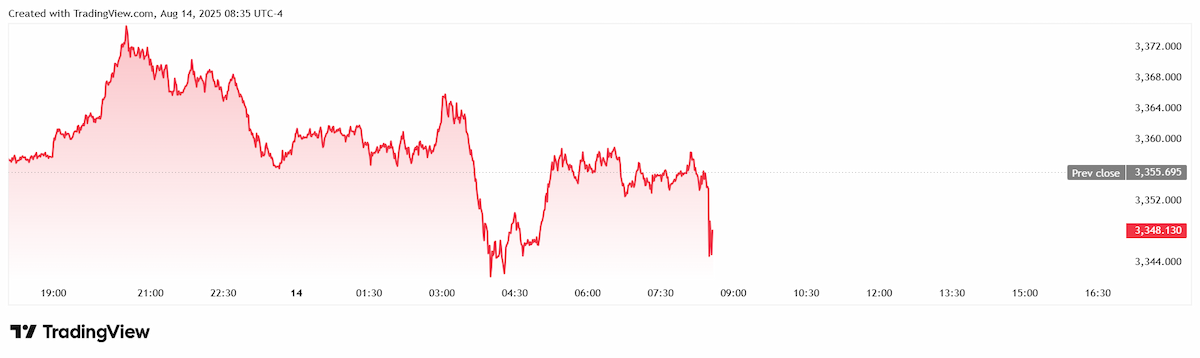
Spot gold fell back near session lows following the 8:30 am EDT data, and last traded at $3,347.91 per ounce for a loss of 0.22% on the session.
Meanwhile, the four-week moving average for new claims – often viewed as a more reliable measure of the labor market since it flattens week-to-week volatility – came in at 221,750 against expectations for a 223,000 reading, and following the previous week's revised average of 221,000.
Continuing jobless claims, which represent the number of people already receiving benefits, were at 1.953 million during the week ending August 2, lower than the expected 1.960 million reading and the previous week’s downwardly revised 1.968 million level.
Bill Adams, Chief Economist for Comerica Bank, told Kitco News that the latest jobs data send conflicting messages, some of which challenge the market consensus on rate cuts.
"Payrolls growth slowed to an anemic 35,000 three-month pace in the July jobs report after big downward revisions to May and June," he wrote. "Despite this, the unemployment rate has been about flat for a year, in part because fewer workers are participating in the job market. Immigration policy changes have caused a decline in the foreign-born workforce, and the pace of older workers exiting the labor force due to retirement or disability has picked up this year. That has slowed growth of the labor force and kept it more or less in line with growth of labor demand. We’ll have to see which of these crosscutting forces dominates in the August jobs report, to be published on September 5."
"In addition, there will likely be a big downward revision to job growth in 2024 and early 2025 when the Bureau of Labor Statistics publishes the preliminary benchmark revision on September 9, which will revise employment growth in the year between March 2024 and March 2025," he added. "Comerica forecasts for the preliminary benchmark revision to lower the level of employment in March 2025 by 750,000 to 800,000. However, the revision won’t tell us anything new about employment growth since March 2025, which should be more important to the Fed."
"The most important factor for the Fed should be whether job growth is keeping up with people entering the workforce," Adams said. "The best measure of that is the unemployment rate, which has held roughly steady in the last year. If the unemployment rate is unchanged or lower in the August jobs report, the chance of the Fed holding rates steady at that decision are much higher than currently reflected in financial markets, which have swung to price in a near-certainty of a rate cut in September. But if the unemployment rate rises, the Fed will probably cut."
