

(Kitco News) – India’s pension regulator is considering removing restrictions on some types of investments – including gold-backed exchange-traded funds (ETFs), Bloomberg reported on Tuesday.
Citing government and industry insiders, the report said that retirement fund managers met multiple times with senior officials from the Pension Fund Regulatory and Development Authority in late July to request permission to invest in gold ETFs. The sources said the regulator is considering the proposal and has even sent draft language on gold investments to the funds for their feedback.
The fund managers are pushing for new ways to increase returns on the country’s rapidly growing pool of retirement savings. The insiders added that the pension funds, which collectively manage about $177 billion, also requested the easing of the rules governing real estate investment trusts and infrastructure trusts in their funds. Under India’s current regulatory regime, gold, real estate, and infrastructure funds are all treated as alternative assets, meaning they can only represent 5% of a pension fund’s total investments.
The report noted that the total value of assets held in the country’s pension funds have more than tripled since the pandemic, driven by India’s economic growth and increasing participation in the financial system.
“In the last few months, managers have asked through an industry group for easier rules on the tenor and rating of securities they can buy, though the regulator hasn’t yet decided on the changes the pensions are seeking,” the report said.
A senior official at the PFRDA declined Bloomberg’s request to comment on the matter.
“The appeal of gold investment for the pensions is clear this year - some of India’s largest gold ETFs - such as Nippon India ETF Gold, SBI ETF Gold and HDFC Gold ETF have logged price increases of close to 30% so far in 2025,” the report stated, citing Bloomberg data. “Investments under the so-called National Pension System are organized into four buckets: equities, corporate bonds, government bonds and alternative investment funds, which include instruments such as REITs and infrastructure investment trusts, or InVITs, as well as gold-backed ETFs.”
The lifting of the 5% limit on gold ETFs in pensions could supercharge the country’s already burgeoning gold investment sector. According to the latest data from World Gold Council India Research Head Kavita Chacko, Indian gold ETFs marked the third consecutive month of net inflows in July.
“Global policy-related uncertainties and geopolitical tensions have been major drivers of this trend,” she said. “But, the pace of net inflows slowed, declining to INR12.6bn (US$146mn) in July, down 41% from the previous month. This was broadly in line with our initial estimate and nearly 34% higher than the 2024 monthly average of INR 9.4bn.”
Chacko said this positive momentum has carried over into August, with initial data for the first two weeks showing higher inflows.
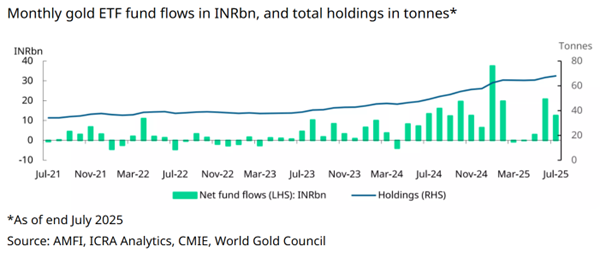
ETF holdings also continued their recent string of strong gains last month.
“At the end of July, Indian gold ETFs’ cumulative assets under management (AUM) stood at INR676bn (US$7.85bn), a 96% y/y increase,” she wrote. “Total gold holdings rose to 68t, with 1.2t added during the month.”
“Investor interest in gold ETFs continues to strengthen as indicated by the steady growth in new accounts (folios); 215k new folios were added in July, bringing the total to 7.86mn, a 42% y/y increase,” she added. “One new gold ETF was also launched in July, bringing the total number of gold ETFs listed in India to 21.”
