

(Kitco News) – Gold prices spiked then sold off sharply after the preliminary revisions to U.S. employment subtracted nearly one million jobs – three times lower than the 10-year average and the worst print on record.
The preliminary estimate of the Current Employment Statistics (CES) national benchmark revision to total nonfarm employment for March 2025 is -911,000 (-0.6 percent), the U.S. Bureau of Labor Statistics (BLS) reported today.
The revision is 300% worse than the average over the last decade, the BLS said. “The annual benchmark revisions over the last 10 years have an absolute average of 0.2 percent of total nonfarm employment,” they wrote. Before today, 2009 saw the largest downward revision with 902,000, but today’s number is now the worst in the series’ history.
Gold prices saw significant volatility around the employment revision release, which is often a non-event, but which has added importance this year following the massive downward revisions over the previous quarter.
Spot gold spiked to a session high of $3,674.69 in the moments after the 10 am EDT release, but fell all the way to $3,643 less than ten minutes later.
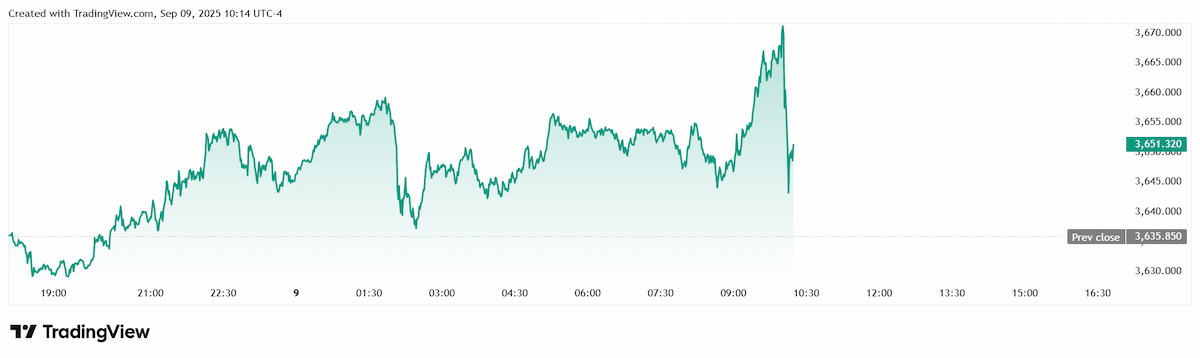
Spot gold last traded at $3,651.42 per ounce, and remains up 0.43% on the daily chart.
Each year, CES employment estimates are benchmarked to comprehensive counts of employment from the Quarterly Census of Employment and Wages (QCEW). These numbers are derived primarily from state unemployment insurance (UI) tax records.
“The preliminary benchmark revision reflects the difference between two independently derived employment counts, each subject to their own sources of error,” they said. “It serves as a preliminary measure of the total error in CES employment estimates from March 2024 to March 2025.”
The BLS said that preliminary research indicates that the overestimation of employment growth was “likely the result of two sources—response error and nonresponse error.”
“First, businesses reported less employment to the QCEW than they reported to the CES survey (response error),” they wrote. “Second, businesses who were selected for the CES survey but did not respond reported less employment to the QCEW than those businesses who did respond to the CES survey (nonresponse error).”
The final benchmark revision will be incorporated into official estimates with the publication of the January 2026 Employment Situation news release in February 2026.
Chris Zaccarelli, Chief Investment Officer for Northlight Asset Management, told Kitco News that the revisions could hurt the broad market rally.
"The jobs picture keeps deteriorating, and while that should make it easier for the Fed to cut rates this fall, it could also throw some cold water on the recent rally," he said. "Worse still, if the CPI shows a worsening trend of higher inflation on Thursday, then the market will begin worrying about stagflation."
"The bull market has been extremely resilient this year, but we could be approaching an inflection point where it is tested again."
