
(Kitco News) – A week dominated by central bank rate decisions delivered plenty of highs and lows for precious metals markets – and decent gains for gold – but it also may have placed the yellow metal at a crossroads as rate cut optimism gives way once again to data dependence.
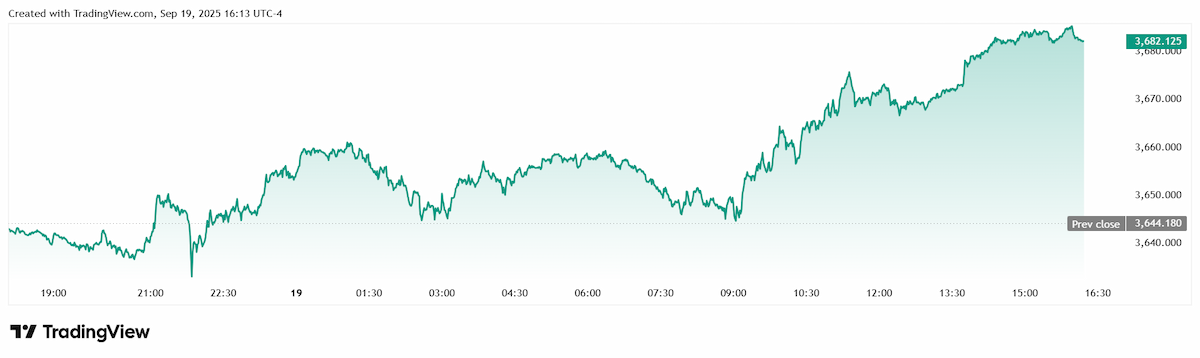
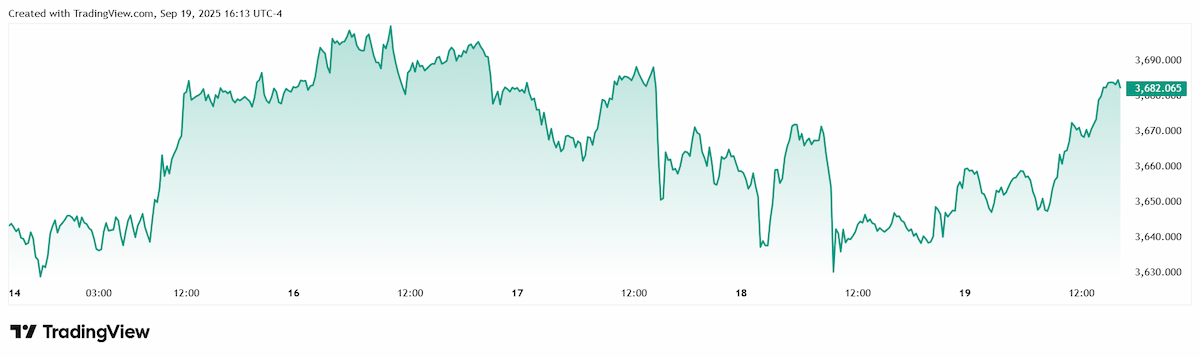
Spot gold kicked off the week trading at $3,670 per ounce, and after a quick retest of support near $3,630, the yellow metal trended sideways until North American traders woke up Monday morning and drove the price from $3,638 at 8:15 am Eastern all the way to $3,684 just four hours later.
This established a new elevated range that saw spot gold dip no lower than $3,675 per ounce on its way to a new all-time high of $3,707 at 10:00 a.m. Tuesday morning.
What followed was the first sharp drop for gold prices, albeit only down to $3,680 per ounce, but the Asian and European sessions saw spot drop as low as $3,660 per ounce by 6:45 a.m. Wednesday morning.
Once again, the American trading session bought gold all the way back up to the edge of $3,690 per ounce ahead of the highly anticipated Fed rate decision at 2:00 p.m. As is often the case, traders who bought the rumor of a 25-basis-point cut immediately sold the news, driving gold all the way down to support at $3,650 just 45 minutes after the announcement, and to an overnight low of $3,637 per ounce.
Now the roles were reversed, with European traders driving gold back up to $3,671 before North American traders took it all the way down to the weekly low just below $3,630 per ounce at Thursday’s market open.
But most of the drama had been squeezed from precious metals markets at this point, and Thursday and Friday saw gold move steadily higher, with a final push just shy of $3,690 per ounce heading into the weekly close.
The latest Kitco News Weekly Gold Survey showed Wall Street sentiment returning to a more neutral bias following the Fed’s rate cut, while Main Street investors also pulled back on their bullish sentiment.
“I am Neutral on gold for the coming week,” said Colin Cieszynski, chief market strategist at SIA Wealth Management. “Gold has had a big run lately and appears due for a rest. We are getting toward the end of the quarter and with the Fed decision over with, news flow slows down for a couple of weeks, setting up a time for consolidation.”
“Up,” said Rich Checkan, president and COO of Asset Strategies International. “Chairman Powell and the FOMC did what we expected. Lower rates make the alternative to gold less attractive. That, coupled with increased saber rattling in Ukraine, Poland, Gaza, and the Caribbean, suggests gold and silver will surge after a short-lived bout of profit-taking.”
Philippe Gijsels, Chief Strategy Officer at BNP Paribas Fortis, is neutral on gold’s price action for the coming week. He said that gold could muddle around $3,600 for now, but it will remain well-supported as he expects the next rate cut is just around the corner.
“Higher,” said Adam Button, head of currency strategy at Forexlive.com. “The more hawkish Fed was a test, and the pullback was minimal. There are plenty of buyers waiting for any dip.”
“Up,” said James Stanley, senior market strategist at Forex.com. “The Fed just cut rates with inflation right around 3% by most metrics. While they may not have sounded as dovish as what markets were looking for, specifically for next year and later, I don’t think this is a central bank that’s anywhere near a hawkish turn. And I look at deeper pullbacks in gold as an opportunity for bulls.”
Sean Lusk, co-director of commercial hedging at Walsh Trading, said markets got more or less what they expected from the Fed, and he could see gold prices breaking either way going forward.
“I didn't think they were going to do 50 [basis points], but maybe they get there by year-end,” he said. “Probably you're going to a more aggressive pace next year if some transition happens within the Fed, but it's all about the data. You’ve got to see another round of jobs data to see if some stuff rebounds back. There was some inflation concerns they cited for not doing 50; they’ll see if that's warranted further out.”
Lusk said the balance of risk for gold is becoming more even. “You still have some geopolitical concerns, but you also have the potential that maybe some of these trade issues get resolved, or at least there's less uncertainty and more certainty that enters into the market and is seen as supportive of the dollar, which would pressure prices. But the dollar rally that we've seen the last couple of days may be short-lived.”
He added that the biggest wild card he’s watching is progress on the trade deals, which have the potential to sap gold’s momentum.
“I think if you get some certainties with trade with China, India, Taiwan, Canada, Mexico, the USMCA, if you get more of those things agreed upon, then maybe we get a bit of a selloff here,” he said. “We're trading, at this moment, 40% higher on the year.”
But on the other hand, Lusk acknowledged that gold has been bucking historical trends and overbought metrics for some time now.
“For the last three years, you've had equities and gold running together,” he said. “That's a long stretch, probably way longer than anyone predicted [they would] have that relationship, joined at the hip to the upside.
Lusk pointed out that much of gold’s supportive drivers date back to the world’s response to the Covid-19 pandemic, when governments cut rates and printed money to kickstart economic activity coming out of the shutdown.
“Now you’ve got all these other countries that want to support their currencies,” he said. “The only way to really do it tangibly is to increase their holdings of tangible assets like gold and other metals. And now you have the trade war going on, where we have tariffs on some of these countries that produce those metals.”
“How can you get any more bullish than this?” he asked. “You’ve got a war in the Middle East, a war in Eastern Europe, all this uncertainty. I couldn't think of a more perfect storm.”
“So how does it unwind itself? I guess you can see a 20% pullback down to $3,200 by year-end,” he speculated. “We'll see. This thing is so overcooked to the upside.”
“You’ve got to remember, it's not a rally since April. It's a rally from three years ago.”
But if there’s no significant progress on the trade front, and inflation continues to tick up, then gold could rally higher still
“If the uncertainty sticks around, this thing could blow up to $3,960, which is 50% higher on the year,” he said. “Then they're going to have a massive sell-off.”
“There could be one more scream here to the upside, where they push silver another 5% higher on the year, up to the mid-$40s, and gold up to $4,000,” Lusk said. “But then I'd be taking profits off that level.”
This week, 15 analysts participated in the Kitco News Gold Survey, with Wall Street returning to a more balanced outlook following the Fed rate decision. Six experts, or 40%, expect to see gold prices rise during the week ahead, while three others, or 20%, predicted a price decline. The remaining six analysts, representing 40% of the total, see the yellow metal trading sideways next week.
Meanwhile, 285 votes were cast in Kitco’s online poll, with Main Street investors also cooling their jets post-Fed. 166 retail traders, or 58%, looked for gold prices to rise higher next week, while another 69, or 24%, predicted the yellow metal would lose ground. The remaining 50 investors, representing 18% of the total, expected prices to consolidate during the week ahead.

After a central-bank-centric week, next week features a diverse set of impactful inflation, industrial, and housing indicators, along with an opportunity to hear from Trump’s latest Fed appointee.
Monday will offer a smorgasbord of central bank speakers fresh off their latest rate decisions, including the Bank of England’s Bailey and Pill, the Bank of Canada’s Rogers and Kozicki, and the U.S. Fed’s Williams, Musalem, Barkin, and Hammack. But markets will pay closest attention to comments from new FOMC member Stephen Miran when he speaks at the Economic Club of New York at noon, as he has made no secret of his view that the central bank should cut deeper and faster than they have to date.
Tuesday morning will see the release of U.S. S&P Flash PMI for September, along with the first comments from Fed Chair Powell since the latest FOMC meeting, followed by New Home Sales on Wednesday.
On Thursday, markets will receive the Swiss National Bank’s monetary policy decision, along with final U.S. Q2 GDP, Durable Goods, weekly jobless claims, and Existing Home Sales.
The week wraps up with Friday morning’s U.S. PCE report for August, along with September’s revised UofM Consumer Sentiment survey.
“Gold set a record high in the middle of last week near $3707, when the Fed cut interest rates for the first time this year,” said Marc Chandler, managing director at Bannockburn Global Forex. “US rates and the dollar rose as Chair Powell’s framing was somewhat less than the concern about the deterioration of the labor market would have suggested. I look for a consolidative/corrective week ahead with gold slipping toward $3580.”
Adrian Day, president of Adrian Day Asset Management, sees the 25-basis-point cut as a reasonable compromise from an increasingly divided Federal Reserve.
“The conflict on the Fed is becoming more apparent, but it existed before Miran came on board,” he said. “There were some very dovish people – maybe just jockeying for Powell's position next year – but there were also some hawkish people, so a quarter of a point is like a compromise. And I think for Powell himself, he sees the risks in both inflation and now – finally, very belatedly – in unemployment, so a quarter of a point, as Powell himself said when asked a question, was like an insurance cut, but it doesn't necessarily indicate more cuts ahead.”
As far as forward guidance, Day said he thinks the market took the cut and the dot plots seriously, but may be starting to tune out Powell as his term as chair approaches its end.
“I thought they would cut a quarter and then Powell would try to sound relatively hawkish on inflation,” he said. “I think the market pays less attention to what Powell says now than they did six months and 12 months ago, partly because he's only got several months left, partly because Trump is putting pressure on and adding people – maybe if Cook goes, he'll have another one to add – but also because over the years we've heard the same stuff from Powell, and he was just clearly wrong on how solid the employment situation was. So I think the market is just paying a little less attention for all those reasons.”
Day said there’s a very real possibility the Fed still sees the employment weakness as a short-term dip, and they believe they may not need to cut again anytime soon. “In which case, both the stock market and the gold market would be disappointed,” he said.
But he also emphasized that the gold market has become a lot larger and more diverse, and Fed rate policy is not the be-all, end-all driver for bullion prices.
“With gold, there are so many players now who are not focused on the U.S. economy, let alone specifically U.S. rates, so central banks are either going to continue buying or stop buying on factors totally independent of what the Fed does,” Day said. “Similarly, I don't think people in Beijing and Shanghai that are buying physical gold to protect their savings are really looking at what the Fed's doing. I would say that what the Fed does for the rest of the year, and what we expect the Fed to do for the rest of the year, is really only a relatively small part of what's going to affect gold for the rest of the year.”
“Having said that, we have October, November, and December meetings, don't we?” he added. “So I wouldn't be surprised if, absent extreme data, they try not to cut in October to show that they're really serious about inflation, and that might cause some disappointment on the U.S. side.”
Day said that if further cuts are delayed for even one or two months, the gold market would need to reprice itself. “The Fed Fund's future is 94% for a cut in October,” he noted. “So when you add that to these projections of $4,000 by the end of the year, the market has a reasonably big chance of being disappointed.”
For next week, Day expects gold prices to trade around their current levels.
“While I see no reasons for gold to fall meaningfully, it has moved significantly above trend in the last month, trading above all moving averages, so it is due for a pause,” he said. “Now that the Federal Reserve has delivered what was already discounted in the market, we may see that pause.”
Alex Kuptsikevich, senior market analyst at FxPro, expects gold prices to decline next week.
“Gold hit three dozen record highs in 2025 and exceeded $3700 per ounce for the first time in history,” he said. “The precious metal surpassed its inflation-adjusted record set in 1980 and has risen by more than 40% since the beginning of January. This has rarely happened, even during times of global economic crisis and pandemic. Only in 1979, against the backdrop of turmoil in the energy markets and stagflation in the US, was the increase greater than +140%.”
Kuptsikevich noted that central banks are continuing to buy gold as part of the process of de-dollarization and diversification of their foreign exchange reserves.
“ETF stocks have grown by 43% since the beginning of the year,” he said. “In terms of value, they have reached a record high. Precious metals are benefiting from a favourable background of falling Treasury yields and a weakening US dollar due to the Fed's renewed cycle of monetary expansion. At the same time, however, we note that following the Fed's decision, the dollar began to rise, and gold began to fall, closing the week near its starting level of $3,650, in contrast to new record highs for stock indices.”
Kuptsikevich said markets are selling gold and buying dollars to buy U.S. stocks, but he thinks this will be temporary. “If this is not the beginning of a new wave of dollar strengthening against fundamental factors, then gold may return to growth in the coming weeks after some shakeout,” he wrote. “At the same time, in the short term, the balance of risks is still on the downside. This is not least due to new hopes for a settlement of tariff disputes with China and India, which gold has always offset with declines.”
Analysts at CPM Group issued another buy recommendation for gold on Thursday, with an initial target price of $3,710 by September 30 and a stop loss at $3,650.
They pointed out that gold futures fell sharply soon after reaching a new record high of $3,744 following the Federal Reserve’s rate cut and commentary about the U.S. economy.
“As has been noted in previous CPM reports, economic conditions are softening but not contracting markedly,” they said. “A good deal of strength remains in the U.S. economy, as well as globally. Market forecasters suggest a continued rate cut environment heading into early 2026, which implies they expect continued deterioration in economic conditions. This should all be positive for gold prices, but other factors need to be taken into account, including financial and political conditions.”
The analysts also noted that stock indices and other asset classes are at or near record highs. “It would not be surprising to see a sell-off across markets in the following weeks and or months. This includes gold,” they warned. “October is typically a month when equity indices, along with other assets, retreat after having typically risen in September. While many factors supportive of gold prices remain in place, there is scope for a sell-off.”
“A break below $3,650 and other support levels below this could result in a sell-off in gold that could push prices as low as $3,400,” CPM analysts said. “A sell-off of such could be taken advantage of if timed appropriately. Gold would still be expected to remain in an uptrend, however, following any sizeable retreat.”
Michael Moor, founder of Moor Analytics, believes the most likely path for gold next week is lower.
“Down, unless we break back above 37109 (+4 tics per/hour starting at 12:20pm EST),” he said. “If we break decently back above, look for a run toward 37440 (+) to test macro exhaustion again.”
“In a Higher time frame: I cautioned on 8/16/18, the break above $1,179.7-$1,183 warned of renewed strength. We have seen $2,560.3. This is ON HOLD,” Moor said. “On a Medium time frame: The break above 31482 warned of strength for days—we rallied $595.8. The trade above 32214 projects this upward $100 (+)—we rallied $522.6. The above are ON HOLD.”
“On a Lower time frame: The trade above 33411 (-9 tics per/hour) has brought in $402.9 of strength,” he said. “The trade above 33850 (+4 tics per/hour) has brought in $359.0 of strength. The trade above 34186 (-.6 of a tic per/hour) has brought in $325.4 of strength. The break back above 35640 (+.8 of a tic per/hour) has brought in $180.0 of strength. The trade above 36658 (-8 per/hour) projects this upward $27 minimum—we have attained $78.2. These are ON HOLD.”
“We have held possible macro exhaustion in the 37488-8459 area with a 37440 high and have rolled over $83.5,” Moor added. “The break below 36974 (+4 per/hour) now warns of decent pressure for $35 (+)—we have attained $36.9.”
And Kitco senior analyst Jim Wyckoff believes gold will return to range trading next week after the recent fireworks. “Sideways and choppy as the gold market moves into a consolidation phase.”
At the time of writing, spot gold last traded at $3,682.12 per ounce for a gain of 1.04% on the day and 1.28% on the week.