
(Kitco News) – Central banks have pulled back from their torrid pace of gold purchases from earlier this year, while the latest data show U.S. solar capacity could actually drop in 2025, according to precious metals analysts at Heraeus.
In their latest precious metals update, the analysts wrote that it was no surprise when gold prices dipped following the Fed’s 25-bps rate cut on Wednesday.
“The official statement noted that the labour market was weakening while inflation remained elevated,” they said. “In fact, the US jobs market has been weaker than initially reported for over a year, as the Bureau of Labor Statistics (BLS) has revised down non-farm payroll gains by 991,000 for the 12 months to March 2025. More recent monthly data revisions were also to the downside.”
They noted that CPI also came in 3.1% year-over-year in July, still well above the 2% target. “In theory, that leaves the Fed with a dilemma as inflation warrants maintaining higher rates than the jobs market,” the analysts said. “In practice, the Fed usually errs on the side of cutting rates when the employment situation worsens. The market now firmly expects two further 25 bp interest rate cuts this year, one at each of the two remaining Fed meetings.”
Heraeus pointed out that central bank gold purchases – a key source of support for the price rally – actually stalled in July.
“Although several central banks added gold to their reserves in July, including the People’s Bank of China, the National Bank of Kazakhstan and the Turkish central bank, a sale of 11 tonnes by the Indonesian central bank meant the net change in holdings was essentially zero,” the analysts wrote. “In the first half of the year, central banks added 415 tonnes to their reserves, a substantial amount, although it was a slowdown from the record levels of the last three years when over 1,000 tonnes were added annually.”
They assessed the gold price as overbought leading into the FOMC meeting after rising over 10% in the last five weeks. “That raises the chance of a period of consolidation so the price could trade sideways to lower for a while,” they said.
Spot gold is bucking expectations to set new highs on Monday after trading as high as $3,728.49 per ounce around 7 am.
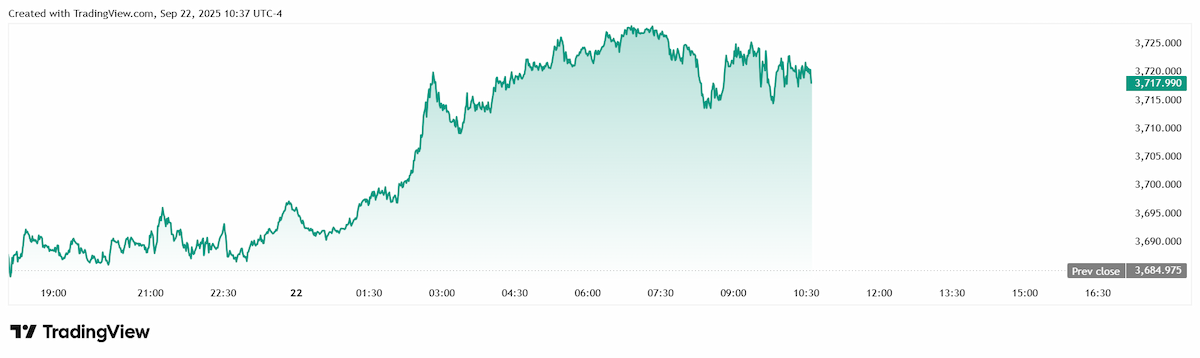
Spot gold last traded at $3,717.83 per ounce for a gain of 0.89% on the session.
Turning to silver, Heraeus said the outlook for U.S. solar installations is getting murkier.
“The EIA recently forecast that US utility-scale solar installations would hit a record this year, which would lift silver demand in the region, although changes to China’s regulations might mean global installations could be flat this year,” they said. “Now the Solar Energy Industries Association is predicting that in its low case the US solar industry could reduce its installations by 44 GW, representing a drop in capacity of 18%, between 2026 and 2030. This is based on subsidies being rolled back in the One Big Beautiful Bill Act, which would clearly be negative for photovoltaic silver demand.”
The analysts point out, however, that fiscal and monetary policies are having more of an impact on the silver price than solar demand at present. “Falling interest rates may be supportive of precious metal prices in the medium term, particularly if inflation holds up and real interest rates turn negative, but as silver was also overbought it could consolidate for a while like gold,” they wrote.
Silver prices are also seeing considerable strength to start the week, currently holding comfortably above $43 per ounce after trading as high as $43.806 just before 7:30 am EDT on Monday morning.
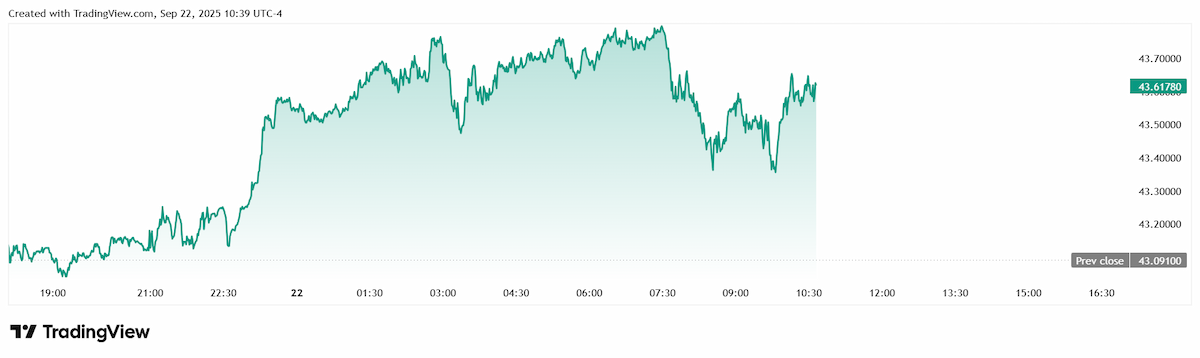
At the time of writing, spot silver last traded at $43.617 per ounce and is up 1.22% on the daily chart.
