
(Kitco News) – To protect stock and bond portfolios against unexpected financial market tail risks, investors should consider diversifying through commodities like gold, according to Goldman Sachs Research led by analyst Lina Thomas.
“Equity-bond portfolios aren’t well protected against stagnant economic growth and elevated inflation in two situations in particular: when global policy uncertainty is elevated (e.g., markets debating the central bank’s ability to contain inflation) and when the economy is hit by a supply shock (such as a sudden interruption in energy supplies),” the report noted. “For example, gold prices jumped in the 1970s as pronounced spending by the US government and reduced central bank credibility stoked inflation.”
“Gold surged as investors sought value outside the system,” Thomas wrote in the report.
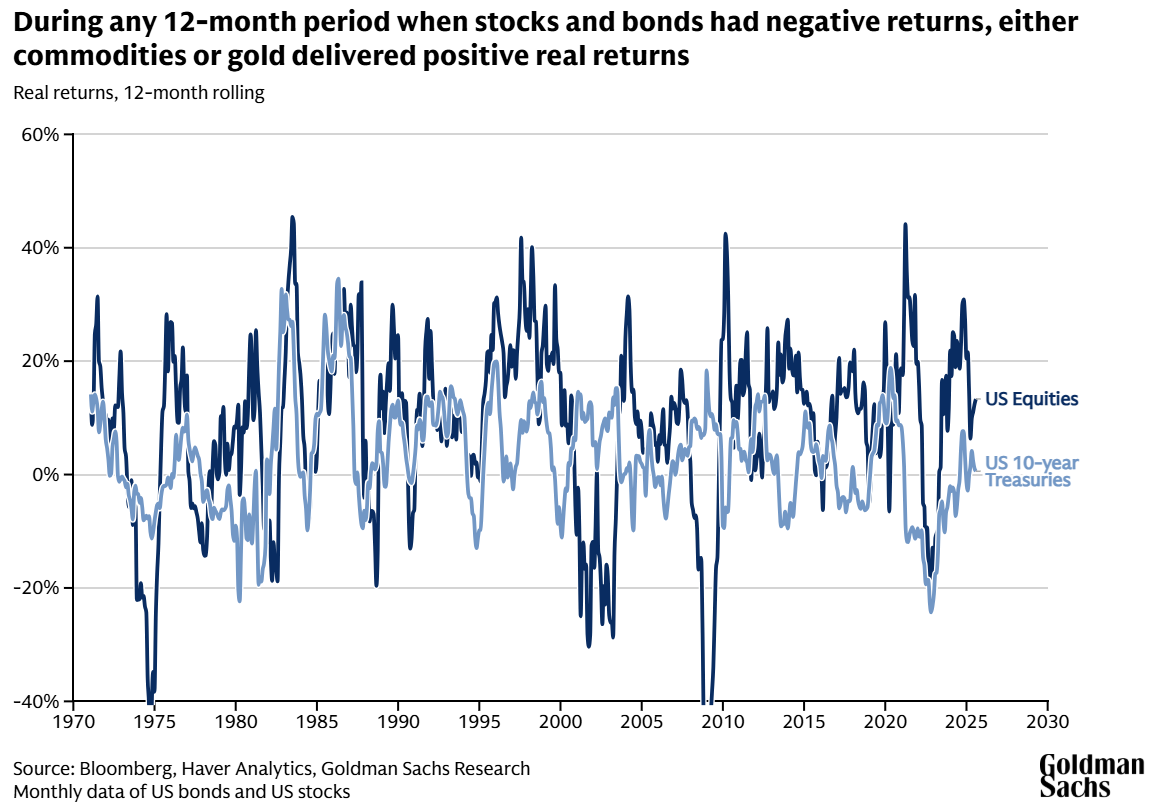
Commodities were also among the few assets that rose in inflation-adjusted terms when Russian gas to Europe was cut off in 2022. Goldman Sachs Research noted that in any 12 months during which both stocks and bonds delivered negative real returns, either commodities or gold delivered positive performance.
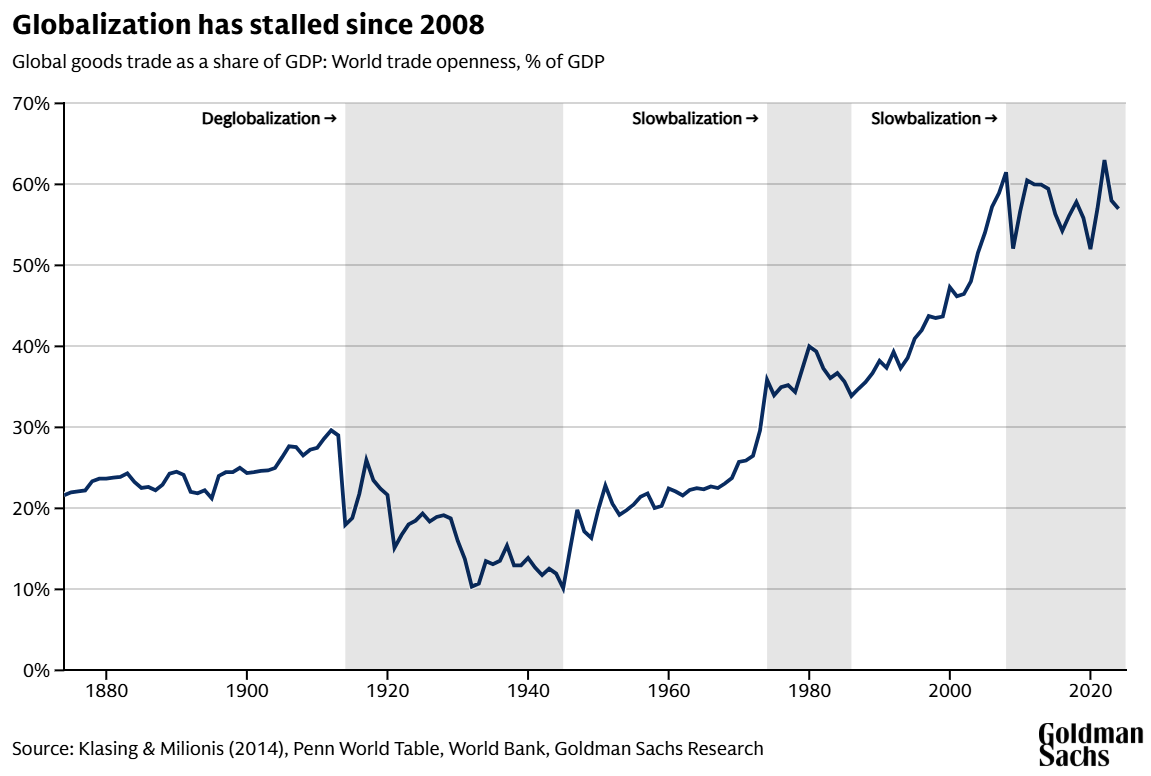
Commodities can also protect portfolios against trade volatility, with Thomas pointing out that commodity supplies are becoming more concentrated, and countries are using their control over resources as geopolitical leverage.
Goldman Sachs Research believes commodities will fulfill a more strategic role going forward, with government control fluctuating in a four-step cycle:
First, governments “insulate supply chains by reshoring production through tariffs, subsidies, and investment—replacing imports where possible and stockpiling commodities where it’s not,” they suggested. Then, “once domestic supply expands and is secured, surplus production is exported.”
Thirdly, as global commodity prices fall, “higher-cost producers exit, and supply concentrates among fewer producers,” they said. And finally, as supply consolidates, “dominant producers are able to use it as geopolitical and economic leverage via tools such as export restrictions—raising disruption risk and eventually prompting other countries to again insulate their supply chains.”
The report noted several examples of commodity and resource concentration occurring today. “The US is likely to provide more than a third of the global supply of liquified natural gas (LNG) by 2030, and the country has linked those exports to tariff negotiations,” Goldman Sachs Research said. “Europe, in particular, has shifted toward US LNG and away from Russian gas since 2022. The share of gas supplies provided by the US in Europe and Asia is expected to climb further.”
They also pointed out that China controls more than 90% of the refining capacity for rare earth minerals, saying that these elements “are essential in the race to develop artificial intelligence (AI).”
“The growing use of commodities as leverage may reinforce the diversification benefits of commodities in portfolios,” Thomas said.
Goldman Sachs Research warned that not all commodities are equal when it comes to hedging for portfolios, however. “Determining their effectiveness requires understanding if a particular commodity is likely to be part of a critical supply disruption and whether that disruption is inflationary,” they said. “Two criteria must be considered: the commodity’s direct or indirect weight in the inflation basket, and the share of supply being disrupted.”
Energy meets the first criterion, they said, because disruptions can rapidly impact economies and financial markets. “The direct weight in the inflation basket of industrial metals and rare earth minerals ranks lower, though their influence has been rising as the energy mix shifts from fossil fuels to renewables that use these commodities,” the analysts said. “Industrial metals and rare earths stand out because refining is highly concentrated in China. As a result, even with only an indirect impact on inflation—such as the cost of electric vehicle batteries—a disruption could have an outsized effect.”
