
(Kitco News) – The Federal Open Market Committee (FOMC) saw a weakening labor market as taking precedence over still-high and rising inflation, but expressed concerns that cutting too quickly could cause inflation expectations to become unanchored, according to the minutes of the Federal Reserve’s Sept. 16-17 meeting released Wednesday afternoon.
“In their discussions of monetary policy for this meeting, members agreed that recent indicators suggested that growth of economic activity had moderated in the first half of the year,” the minutes stated “To reflect developments in the labor market, they agreed to no longer characterize labor market conditions as solid and instead state that job gains had slowed and that the unemployment rate had edged up but remained low.”
Members also agreed that inflation remained “somewhat elevated,” and agreed to add an acknowledgement in the statement that inflation had moved up. “They agreed that the Committee was attentive to the risks to both sides of its dual mandate and to add that downside risks to employment had risen to reflect their concerns about the labor market,” the minutes said. “In support of the Committee's goals and in light of the shift in the balance of risks, almost all members agreed to lower the target range for the federal funds rate 1/4 percentage point to 4 to 4-1/4 percent.”
The sole dissenter for the 25-basis-point reduction was newly appointed FOMC member Stephen Miran, who instead argued for a 50-basis-point cut.
“Governor Miran preferred to lower the target range for the federal funds rate by 1/2 percentage point at this meeting in light of further softening in the labor market over the first half of the year and underlying inflation that in his view was meaningfully closer to 2 percent than was apparent in the data,” the minutes stated. “Governor Miran also expressed the view that additional policy easing was also appropriate to reflect that the neutral rate of interest had fallen due to factors such as increased tariff revenues that had raised net national savings and changes in immigration policy that had reduced population growth.”
In their discussions on risks to the outlook for monetary policy, “participants generally judged that upside risks to inflation remained elevated and that downside risks to employment were elevated and had increased.”
“Participants noted that, in these circumstances, if policy were eased too much or too soon and inflation continued to be elevated, then longer-term inflation expectations could become unanchored and make restoring price stability even more challenging,” the minutes noted. “By contrast, if policy rates were kept too high for too long, then unemployment could rise unnecessarily, and the economy could slow sharply.”
Jeffrey Roach, Chief Economist for LPL Financial, said Miran's argument in favor of deeper rate cuts is reasonable if you believe the CBO’s estimate of the long-run unemployment rate.
"Futures markets may turn out to be more accurate than the FOMC’s collective projections, especially if inflation consistently declines in 2026," he said. "Investors should expect two more cuts this year but a pause at the January 2026 meeting."

Spot gold continued to hold comfortably above the $4,000 per ounce level on Wednesday, trading as high as $4,059.35 just before 1 pm EDT and dipping to multiple successful retests of support near $4,030.
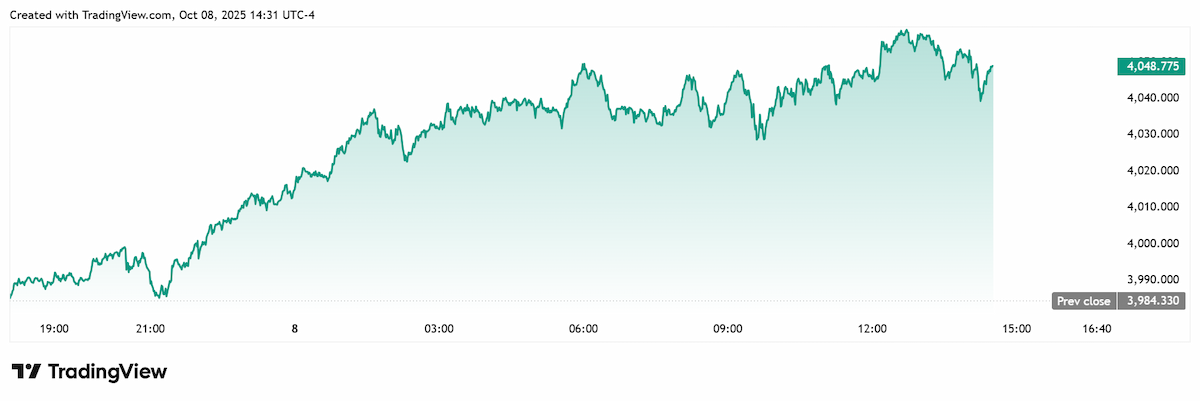
Spot gold last traded at $4,048.85 for a gain of 1.62% on the session.
