
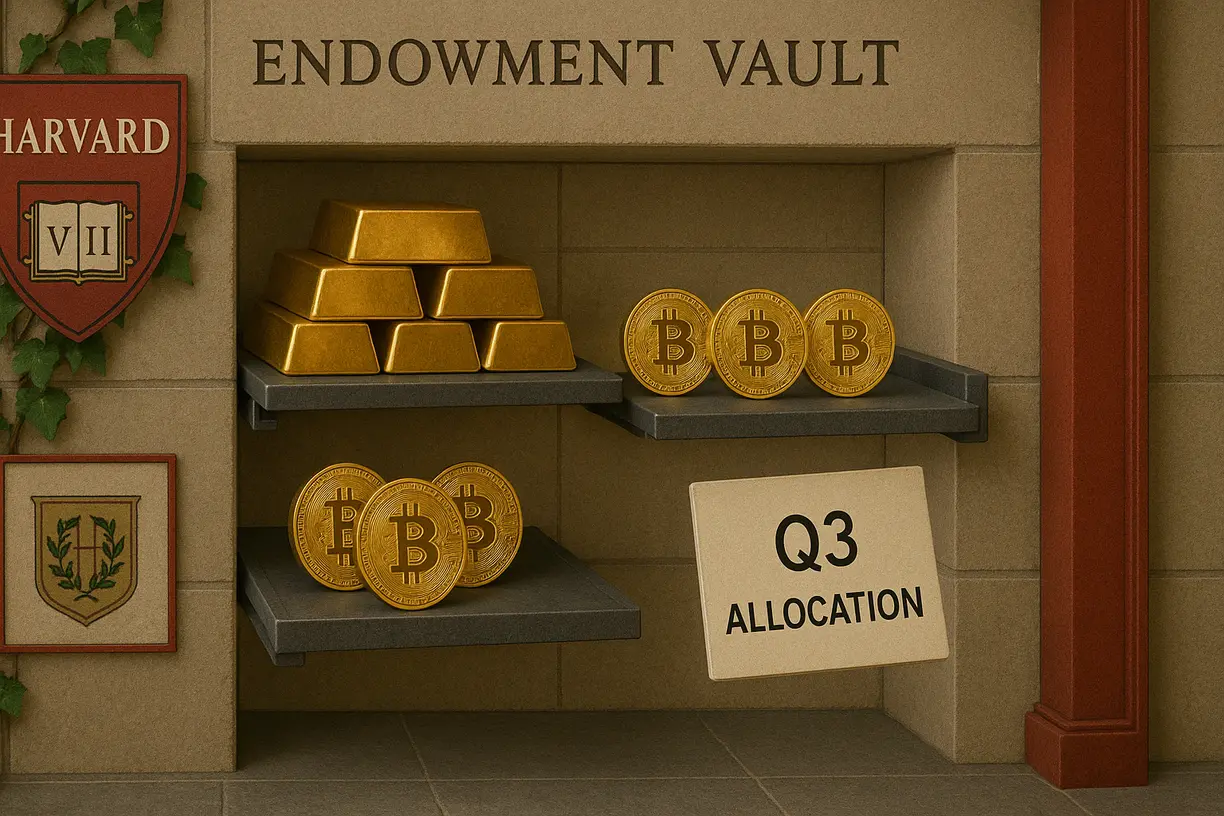
(Kitco News) - The world’s largest endowment fund continued to push deeper into alternative assets, increasing its exposure to Bitcoin and gold during the third quarter.
According to third-quarter 13F filing published last month, the Harvard Management Company (HMC) increased its exposure to the iShares Bitcoin Trust ETF to 6.813 million shares, valued at $442.88 million.
HMC also increased its position in SPDR Gold Shares (NYSE: GLD) to 661,391 shares, valued at $235.1 million.
HMC’s Bitcoin holdings now represent 21% of its disclosed U.S. equity holdings, making it the largest single position in the 13F portfolio. At the same time, its Bitcoin allocation now doubles its gold ETF exposure.
This is the second consecutive quarter that Harvard has increased its exposure to gold and Bitcoin.
HMC’s growing interest in alternative assets comes as gold prices continue to trade around $4,188 an ounce, up nearly 60% so far this year. Meanwhile, Bitcoin is down 2% in what has been an extremely volatile year.
In a recent interview with Kitco News, Eric Strand, founder of the boutique precious metals firm AuAg Funds, said that the professional investment sector holds significant growth potential for alternative assets like gold.
Strand noted that endowment funds, pension funds, and family offices hold only 2% of their total assets in gold. He added that alternative assets are becoming increasingly attractive as rising inflation and growing government deficits create more risks for bonds.
“Even above $4,000 an ounce gold has room to move higher because it is still underowned,” he said. “There is still time to get into gold.”
In a recent interview with Kitco News, Thorsten Polleit, Honorary Professor of Economics at the University of Bayreuth and publisher of the BOOM & BUST REPORT, said that he also sees an imminent rotation into gold and out of bond markets.
“The highest risk right now is not owning any gold,” he said.
Not only is inflation eating away at the value of long-term bonds, but Polleit added that yields will have to move lower as central banks around the world, led by the Federal Reserve, continue to cut interest rates.
