
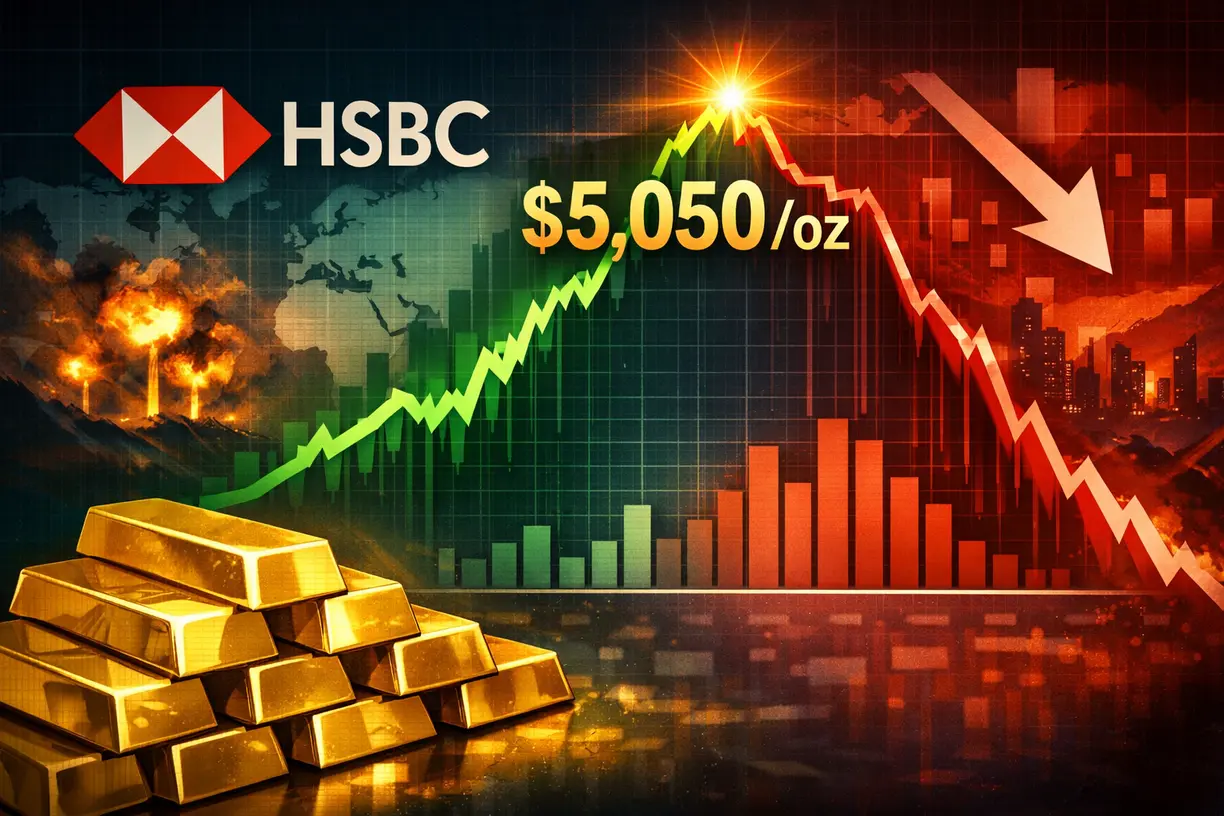
(Kitco News) – Mounting geopolitical risks and rising debt could push gold prices as high as $5,050 per ounce in the first half of 2026, but this could also mean a more significant pullback in the second half, according to analysts at HSBC.
“We see a wide range of $5,050 - $3,950/oz for 2026 and an end-year price of $4,450/oz,” the analysts said in a note published Thursday.
But while the $5,050 forecast was above its previous call of $5,000, the bank also lowered its average gold price forecast for 2026 from $4,600 to $4,587 per ounce, citing the possibility that rising prices could trigger a correction later in the year.
The analysts added that the correction could be deeper if geopolitical risks subside, or if the U.S. Federal Reserve halts interest rate cuts, and said the gold trade is likely to be highly volatile in 2026.
HSBC also raised its average price forecast for 2027 to $4,625 from $3,950, and its 2028 forecast to $4,700 from $3,630, and offered a 2029 average price forecast of $4,775.
In late November, HSBC currencies and commodities strategist Rodolphe Bohn said he sees gold maintaining its upward trajectory amid strong demand from central banks and retail investors.
In HSBC’s Think Future 2026 outlook publication, Bohn said that even with its impressive performance year-to-date and more recent volatility, the bank maintains a positive outlook for gold in the months ahead.
“We believe that investors can benefit from diversifying their exposure to global assets, particularly foreign exchange, through gold,” he wrote. “It offers resilience during periods of significant turbulence and holds potential for further appreciation.”
Bohn noted that gold was enjoying of one of its most successful years on record in 2025. “This exceptional growth is primarily attributable to rising global uncertainty and concerns about USD debasement,” he said. “Despite improved global sentiment and rising global equities, current market conditions continue to provide a supportive backdrop for gold prices.”
“We believe that gold will continue to benefit from strong central bank demand, ongoing concerns over a weaker US dollar, and sustained interest in gold-backed ETFs,” he added. “In this context, gold remains a crucial diversifier within a portfolio, helping customers navigate persistent global uncertainties.”
Bohn did acknowledge downside risks to HSBC’s positive outlook “if the Fed unexpectedly adopts a more hawkish stance or if the global economic environment improves, despite the current positive correlation.”
“Overall, given the anticipated weakness in the US dollar and further global easing, particularly from the Fed, there’s a basis for gold prices to rise, albeit at a slower pace than previously experienced.”
