
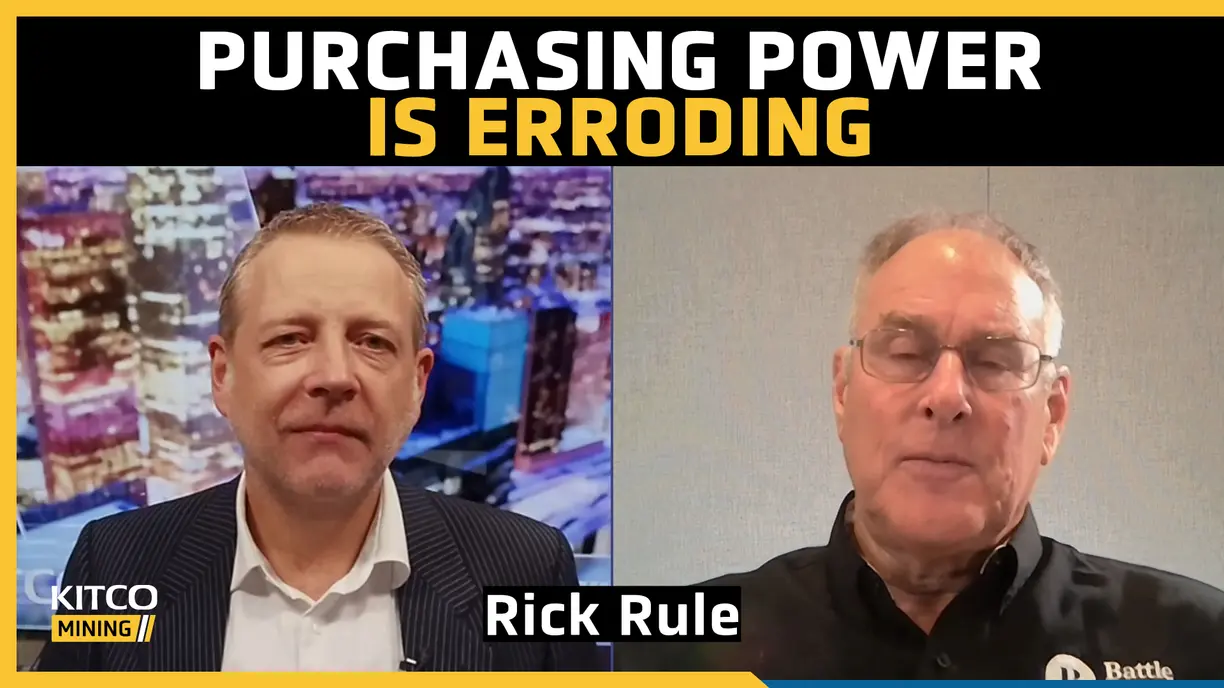
(Kitco News) Gold’s strength reflects a long-term erosion in purchasing power rather than a short-term market cycle, according to veteran investor Rick Rule, President and CEO of Rule Investment Media.
Speaking with Kitco Mining’s Digging Deep, Rule said the forces supporting precious metals have been building for decades, driven by negative real interest rates and what he described as expanding government liabilities. “I would suggest to you that a gold bull market and conversely a bond bear market have been underway since the year 2000,” Rule said.
Rule notes that gold is often misunderstood because investors focus on nominal prices rather than real value. He argued that many assets commonly viewed as expensive appear far cheaper when measured against gold. “If you thought about them in gold terms, you’ll decide that they’re very cheap,” Rule said, pointing to housing, healthcare, and everyday goods as examples. Gold functions less as a speculative trade and more as a reference point for the real value of money over time, according to Rule.
While recent price gains have drawn renewed attention to the metal, Rule said the move reflects a delayed adjustment rather than a new trend. “The move that you saw in 2024 and 2025 was, I suspect, a catch-up,” he said, adding that gold had failed for years to reflect the steady deterioration of fiat currencies.
A central pillar of Rule’s outlook is the scale of U.S. government obligations, pointing to both funded debt and unfunded commitments as structural constraints on policymakers. “The net present value of unfunded entitlement liabilities exceeds $120 trillion,” Rule said, referring to Medicare, Medicaid, Social Security, and federal pensions. When combined with federal debt, he believes total liabilities leave little margin relative to aggregate private net worth.
Rather than defaulting, Rule said he believes governments are more likely to manage those obligations through inflation. “My suspicion is the way that we pretend to honor our obligations is that over 10 years, we inflate away the net present value of the liability,” he said. Rule compared the current environment to the 1970s and argued that gold historically has risen in nominal terms as the purchasing power of the U.S. dollar erodes.
Those macro pressures, Rule said, are beginning to surface in the mining sector, where earnings and cash flow could surprise as market expectations lag reality. He notes that many analyst models continue to rely on price assumptions that trail realized pricing, even as margins improve. “Equity prices reflect the net present value of cash-generating assets,” Rule said, adding that margin expansion can have an outsized impact on valuations over time.
Rule said risk control plays a central role in his investment decisions, especially in volatile sectors. “If you limited your downside, your upside would take care of itself,” he noted.
Those same valuation dynamics are also influencing how he allocates capital within precious metals, with Rule explaining his recent decision to reduce exposure to physical silver and reallocate capital into silver equities. He said physical silver had given him “everything I wanted.” By contrast, he argued that equities offer greater potential leverage if prices remain elevated. “The silver stocks generally in prior bull markets have generated two to two and a half times leverage over the silver price,” he said.
Looking across the industry, Rule said capital allocation will become increasingly important as mining companies face rising costs and the need to rebuild development pipelines after years of underinvestment. He added that royalty and streaming companies may prioritize growth opportunities over dividends, citing what he described as a “golden age of deployment” as base metal producers seek alternative sources of financing.
Rule said negative real interest rates, ongoing erosion in purchasing power, and years of underinvestment that now require renewed capital spending remain defining features of the current environment. While volatility is inevitable, he believes the forces supporting precious metals reflect structural conditions rather than a temporary trade.
Watch the full interview on Kitco Mining’s YouTube channel for Rick Rule’s complete analysis of purchasing power, government liabilities, silver strategy, and what the evolving macro environment means for gold and mining equities.