
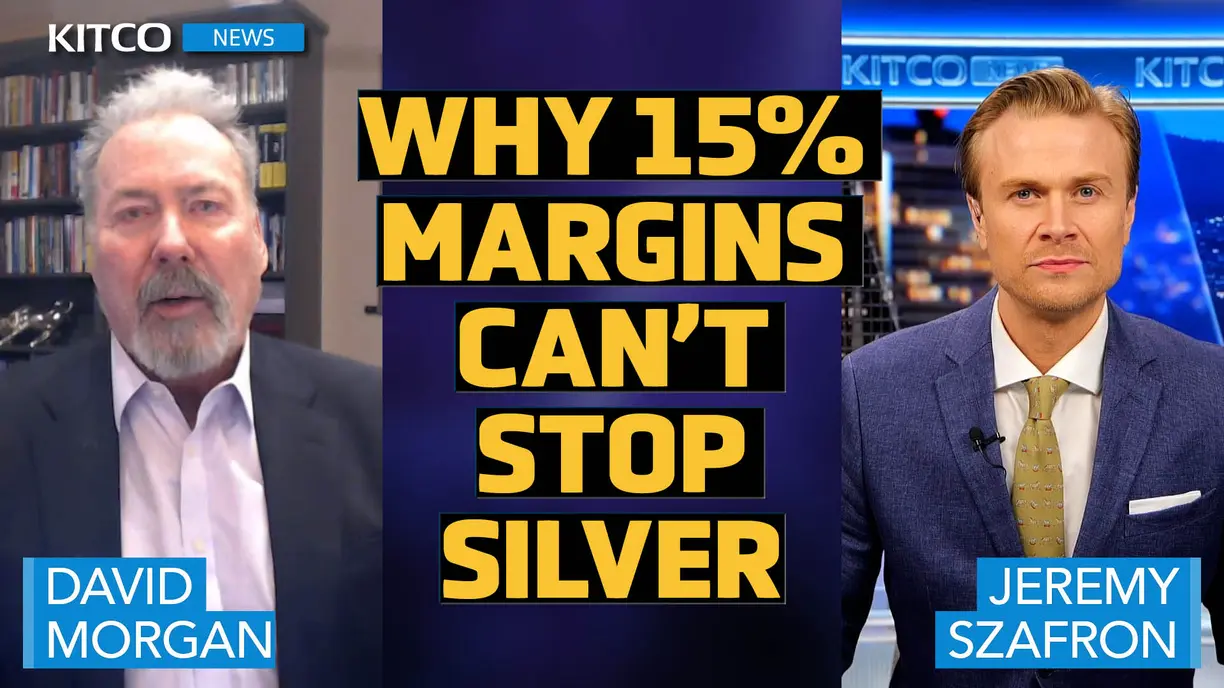
(Kitco News) - Significant withdrawals from Western silver vaults are signaling a structural shift in the global market as physical demand begins to exert dominance over paper-based pricing mechanisms.
Official depository statistics from the Commodity Exchange, Inc. (COMEX) for Feb. 11, 2026, show a single-day negative adjustment of 3,256,882 ounces in the Registered silver category. Total registered stocks have now dropped below the 100 million ounce threshold to 98,138,005 ounces. Additionally, more than 4.7 million ounces were physically withdrawn from the Eligible category, representing a net total withdrawal from the system of 4.7 million ounces in a 24-hour period.
David Morgan, publisher of The Morgan Report, suggests these movements indicate that the plumbing of the global silver market is facing a period of intense localized strain.
"The physical market is taking control over whatever the paper price is," Morgan said.
The divergence is most apparent in the sustained premium on the Shanghai silver benchmark, which is currently fixing at roughly $10 above Western spot prices. While typical arbitrage would compress such a gap, Morgan identifies capital controls and shipping logistics as significant barriers to a frictionless global market.
"Obviously, if you're willing to pay more than the benchmark price in New York, it's going to be flown over to China," Morgan said. "But the spread hasn't closed... Something's up."
Morgan attributes the tension to the differing roles of global exchanges. While the COMEX is primarily a derivatives market, the Shanghai market is increasingly dictated by industrial users who require the metal for production.
"It's certainly a futures market, but not to the extent London and New York are, which means a lot of that silver that's in inventory or on exchange is going to be taken by somebody for purposes of either investment or industry," Morgan said.

The tightening is further influenced by the CME Group’s recent shift in margin requirements to a percentage of notional value, which automatically increases costs as prices rise. Morgan argues that this process acts as a natural break on speculative rallies, flushing out highly leveraged participants and moving the system toward a cash-only structure.
"The higher margin goes, the more we're forcing a cash-only market," Morgan said.
Global demand signals from the East remain a primary driver of the inventory drain. Reports show that India added 40 million ounces of silver into exchange-traded funds (ETFs) over a two-month period. Furthermore, the Shanghai Futures Exchange is set to enforce stricter hedging quotas starting March 1, requiring participants to prove physical business ties for their positions.
Morgan believes these factors indicate the market has entered its final phase.
"I think we could see the ultimate peak in gold and silver in the next year or two," Morgan said, noting that historically, 90 percent of a bull market's move happens in the final 10 percent of its duration.
While silver captures current attention, Morgan highlighted a historical value opportunity in platinum, which is currently at a 25-year low relative to the cost of silver. He suggests that investors looking for stability should focus on physical holdings as insurance against broader systemic volatility.
"You don't need to be overly exposed, that's for sure," Morgan said. "It's a price you pay for stability and insurance that you know if something really goes wrong, you're covered."