
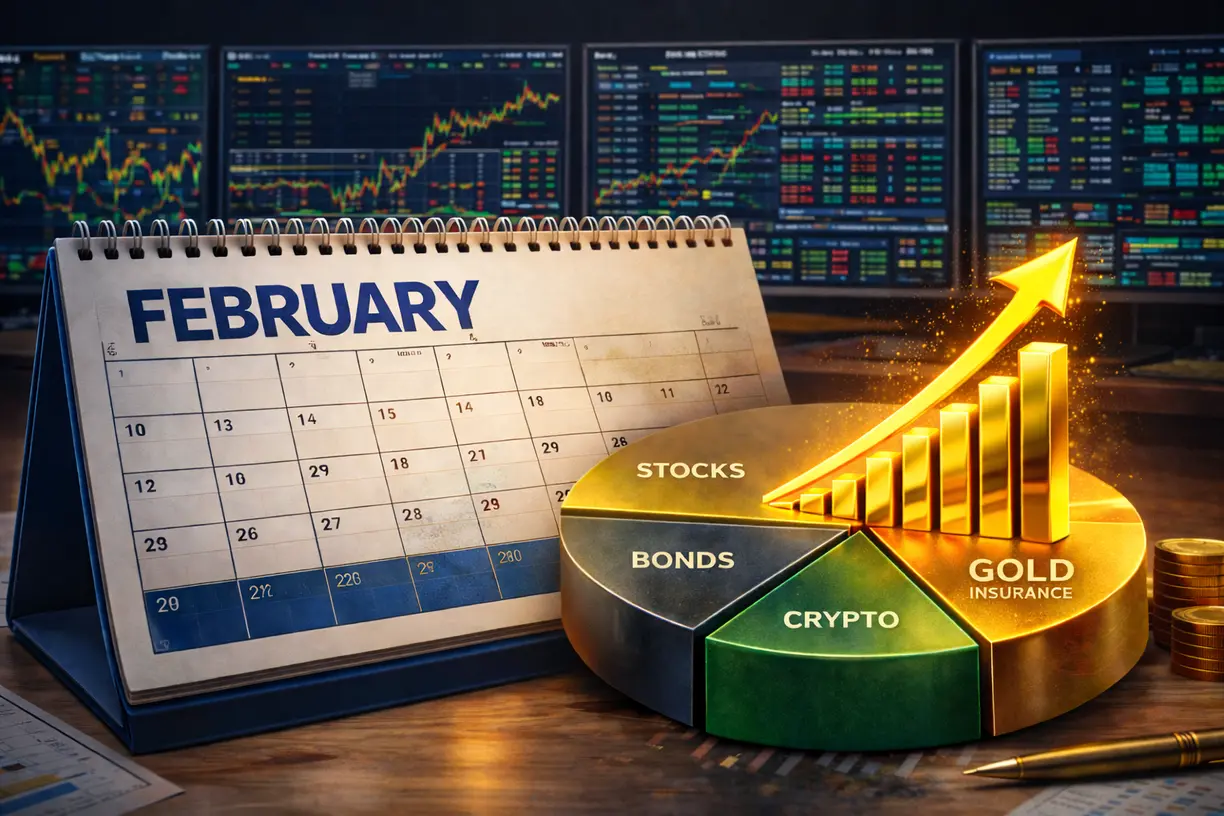
(Kitco News) - Gold prices have once again reclaimed lost ground above $5,200 an ounce ahead of the weekend, as geopolitical uncertainty in the Middle East continues to drive safe-haven demand.
Analysts have said that because of the looming threat of military strikes on Iran, investors want to have some insurance in their portfolios.
“You just have to take a look at what is happening with equities and gold right now. It’s pretty easy to decide which asset you want to own right now,” said Phillip Streible, Chief Market Strategist at Blue Line Futures.
Streible noted that the S&P 500 is ending the week with a loss, as the index has been unable to break resistance at 7,000. The broader equity index is currently trading at 6,858 points, down nearly 1% for the week.
Meanwhile, spot gold last traded at $5,232.50 an ounce, up more than 2% from last Friday. Silver is attracting even more bullish momentum. Spot silver last traded at $93.39 an ounce, up more than 10% on the week.
Streible added that gold’s sharp recovery this month demonstrates how investor sentiment regarding the yellow metal has changed.
“You are seeing the strong benefits of holding gold as you see solid gains and portfolio diversification as equities fall,” he said. “The recent price action in financial markets continues to solidify gold's role in a portfolio.”
Although gold and silver are still well below January’s highs, the precious metals have jumped sharply from their lows. Gold prices are up 19% from their lows near $4,400 an ounce. At the same time, silver prices are up more than 45% from their lows.
Aaron Hill, Chief Market Analyst at FP Markets, said in a commentary shared with Kitco News that although he is bullish on gold, he doesn’t see a breakout to new highs anytime soon.
“Gold’s strong monthly recovery after January’s volatility signals that the broader uptrend remains structurally intact, with safe-haven demand and softer rate expectations underpinning price action; however, in the near term, it looks more like controlled consolidation than runaway momentum,” he said. “I’m watching resistance around recent highs and key support from the latest pullback — a clean break higher would confirm continuation, while a drop through support would suggest deeper digestion.”
Although gold continues to find solid support as a hedge against geopolitical uncertainty, it also remains sensitive to U.S. monetary policy. On Friday, the U.S. Labor Department said that in the last 12 months, headline wholesale inflation increased 2.9%; economists were looking for a 2.6% increase. Analysts have said that this could create some headwinds for gold, because rising inflation could force the Federal Reserve to keep interest rates unchanged longer than expected this year.
Hill said that he could see gold prices continue to consolidate in this environment.
“Until the Federal Reserve provides clearer guidance, expect range-bound trade, with PPI acting as a short-term catalyst: softer inflation fuels upside via lower real yields, while hotter data could trigger temporary pressure but is unlikely to derail the bigger bullish trend unless it materially shifts rate expectations,” he said.
Michele Schneider, Chief Market Strategist at MarketGauge, said that while she sees some upside for gold and silver, the risk/reward outlook is not great. She said that she expects gold to find solid resistance at $5,400 an ounce, and said that silver might not have enough momentum to push above $100 an ounce.
She added that she is concerned that because of gold’s elevated price levels, investors might be looking at other safe-haven assets, specifically bonds.
She pointed out that even with stubborn inflation, yields have fallen sharply ahead of the weekend. Ten-year yields have dropped to 3.95%, the lowest level since October.
“Rising bond prices could be a signal that investors are worried about a recession, and I don’t know if gold will do as well in a recession,” she said. “Bonds could be new competition for gold that holds back the market.”
Despite some cautious sentiment creeping into the gold market, analysts have said that with so much uncertainty surging through the global economy and financial markets, gold remains well supported.
Naeem Aslam, Chief Investment Officer at Zaye Capital Markets, said that while he is bullish on gold, investors should expect to see some significant volatility next week as the economic calendar fills up.
Although Friday’s nonfarm payrolls report will be the main event next week, markets will also receive important manufacturing data, private-sector employment numbers, and retail sales figures.
“Going into the next week, we are going to get plenty of drama in terms of economic data, especially the US jobs numbers next week,” Aslam said. “And to be very open, we are not expecting those job numbers to be interesting at all, which means there are more chances for gold buyers to come to the market. So for now, the bull case is the prevailing one.”
Schneider explained that any disappointing economic data should provide some support for gold prices in the near term. She pointed out that even if inflation remains stubbornly elevated, the Federal Reserve will take steps to support the economy and labor market.
Weekly data to watch next week
Monday: ISM Manufacturing PMI
Wednesday: ADP Nonfarm Payrolls, ISM Services PMI
Thursday: US weekly jobless claims
Friday: US Nonfarm Payrolls, US Retail Sales
