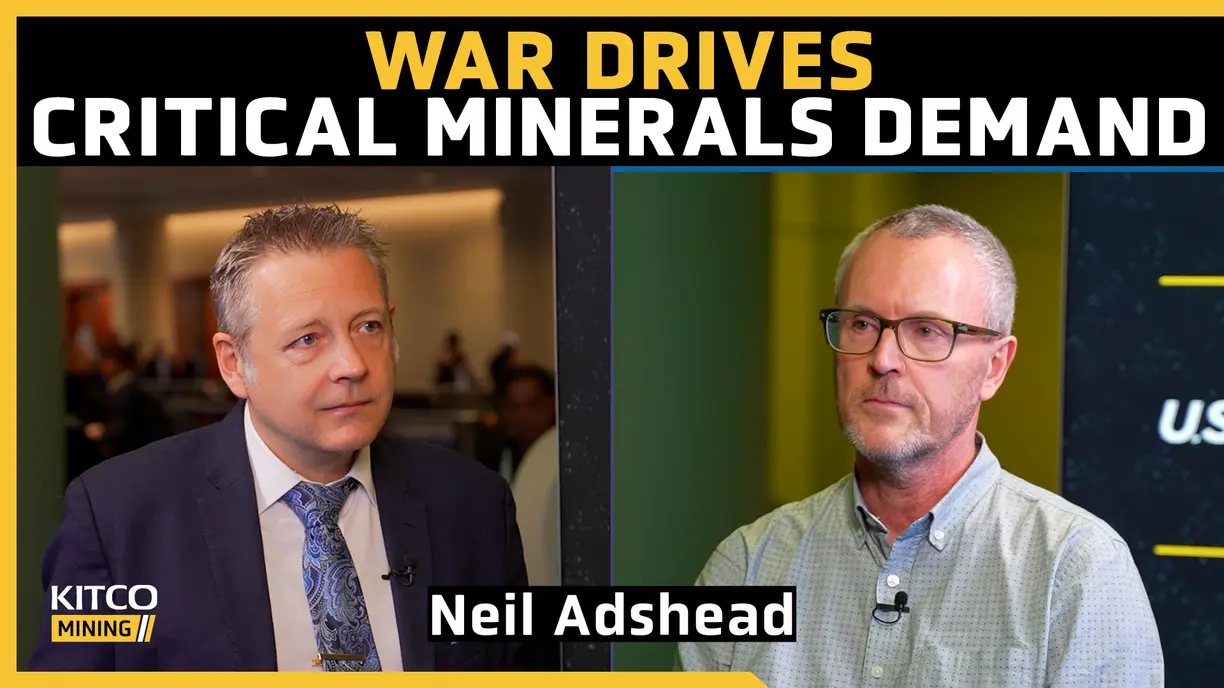
(Kitco News) Escalating geopolitical tension is intersecting with record profitability in the gold sector and a renewed surge in multi-billion-dollar mining transactions, according to Neil Adshead, Consultant Analyst at the Commodity Discovery Fund.
Speaking with Kitco Mining’s Digging Deep at PDAC 2026 in Toronto, Adshead said gold moved sharply higher in 24-hour trading following reports of U.S. strikes on Iran on Feb. 28. “The gold price has already reacted,” he said, noting bullion traded above $5,300 per ounce, roughly $100 higher than Friday’s spot close.
The move adds a geopolitical premium at a time when producers are entering 2026 from a position of unusual strength, noting, “We’ve never seen gold miners make the margins that they’ve been making like they did in Q4 2025.” Elevated realized prices combined with relatively subdued diesel costs expanded operating margins in the fourth quarter, strengthening balance sheets and increasing free cash flow across the sector.
Energy markets remain a key uncertainty, with around 20% of global petroleum liquids consumption moving through the Strait of Hormuz, raising the possibility of higher fuel costs if tensions persist. Adshead said the oil price “should definitely go up” in the near term, but added that “this time next week it may be business as usual.”
He noted that while the United States is largely self-sufficient in hydrocarbons, China remains more reliant on Persian Gulf crude, suggesting the economic impact of disruption could vary by region.
Beyond gold, Adshead said military escalation can intensify demand for minerals embedded in modern defense systems, including tungsten, heavy rare earths, copper, and silver. Sustained conflict requires replenishment of ordnance stocks. “You really don't want to launch into a war and then three months later, six months later, you basically run out of bullets,” he said, underscoring how supply security can become a strategic priority.
Capital markets activity has also accelerated. On Feb. 16, Wheaton Precious Metals announced a $4.3B silver stream agreement with BHP tied to production at Antamina in Peru. Adshead pointed to valuation context embedded in such agreements. “Right now that stream looks amazing because they bought it when silver was $15-$20 an ounce, and now silver's almost $90 an ounce,” he said.
Large-scale copper developments are also advancing. Lundin Mining published results of an integrated technical study in mid February, which included a preliminary economic assessment for the Vicuña project, a 50/50 joint arrangement with BHP that combines the Filo del Sol and Josemaria deposits. “The PEA had like a 70-year mine life in it,” Adshead said, describing the appeal of multi-decade assets despite large upfront infrastructure requirements.
In the United States, BHP and Faraday Copper announced last month that they had signed a non-binding letter of intent to explore a transaction involving BHP’s San Manuel property in Arizona. Adshead described the consolidation logic as strategic, commenting, “This does feel like a one plus one equals three,” as scale and jurisdictional stability become more central to long-term supply planning.
Taken together, the developments point to a mining sector navigating short-term geopolitical volatility alongside longer-term capital allocation decisions. Elevated gold margins have given producers financial flexibility, while strategic metals and supply security are playing a growing role in corporate strategy.