
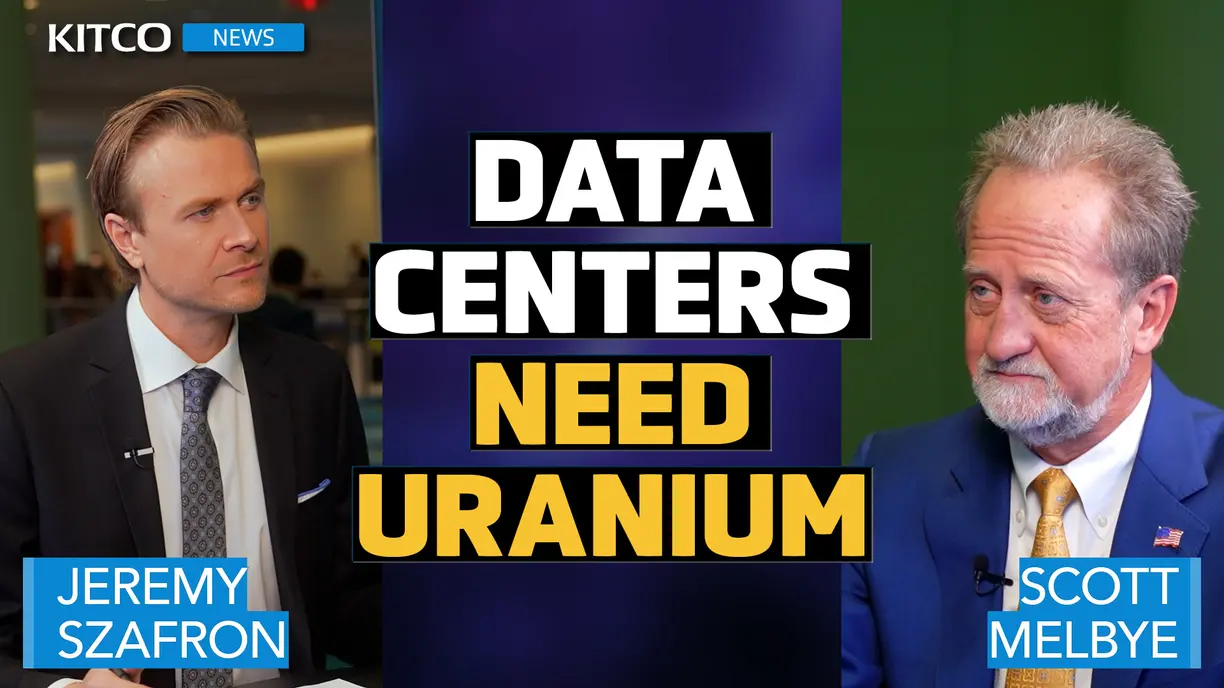
(Kitco News) - The global uranium market has transitioned from a period of speculative exploration into an "urgent reality" of production as a massive supply deficit collides with a new era of AI-driven energy demand and aggressive U.S. decoupling from Eastern fuel sources. Speaking with Jeremy Szafron at the PDAC 2026 convention, Scott Melbye, Executive Vice President of Uranium Energy Corp (UEC) and CEO of Uranium Royalty Corp, described the current environment as the beginning of an "epic" multi-year growth cycle.
Uranium prices, which surged to a two-year peak above $101 per pound in January before consolidating in the $86 range, are currently caught in what Melbye calls a "breather" before the next structural leg up. "The underlying fundamentals have never been better," Melbye stated. "Whether it's driven by the macro trends - at first it was just the green energy trends, now it's the world needs more energy transition - the geopolitics and the supply and demand fundamentals for uranium are essentially at a point where the reality is we have a 50 million pound deficit in the near term, going to 1.7 billion pounds by 2045."
The "Project Vault" and Policy Catalyst
The most significant shift in early 2026 is the rollout of Project Vault, a landmark $12 billion strategic critical minerals reserve launched by the Trump administration in February. Financed by a $10 billion loan from the U.S. Export-Import Bank and $2 billion in private capital, the initiative is designed to shield domestic manufacturers from supply shocks. Melbye, who also serves as President of the Uranium Producers of America, noted that this federal support represents a level of commitment to the nuclear sector not seen in decades.
"I’ve never seen in the United States this level of support, not just for critical minerals, but uranium, nuclear energy and energy more broadly," Melbye said. He highlighted the administration’s focus on energy independence, including a $2.7 billion investment into domestic enrichment services to decouple the U.S. power grid from Russian supply. Under the administration’s Fast-41 initiative, federal agencies are now mandated to compress the "torturous pathway" of federal licensing. Melbye noted that critical infrastructure projects like UEC’s Sweetwater mill in Wyoming are now targeted for permitting in 18 months rather than the traditional six-year cycle.
The AI Revolution and the "NVIDIA Basket"
A defining variable in the 2026 market is the entry of technology giants like Amazon, Meta, and Google, who are bypassing traditional utilities to sign direct power purchase agreements with nuclear providers. These "hyperscalers" are increasingly viewing nuclear energy as a strategic infrastructure asset essential for sustaining the power-hungry data centers required for artificial intelligence.
"Like it or not, the uranium equities are trading in the AI basket," Melbye observed. "If NVIDIA's having a good day, we're having a great day." He emphasized that these tech giants bring a refreshing level of innovativeness and a willingness to take risks. "These tech companies need this power to become multi-trillion market cap businesses. They're motivated, they come with a different mindset than maybe your traditional regulated utility," he added.

Geopolitical Bifurcation
The uranium market is currently undergoing a total bifurcation between East and West. Melbye warned that Kazakhstan, the world’s dominant producer, is increasingly being consumed by Russia, China, and India through new state-level controls. "The world's largest producer is Kazakhstan and certainly shares very important borders with Russia and China," Melbye warned. "I'm not sure we can count that much on that supply coming to the West. The focus for western utilities should be western supplies and places like Australia, Canada, the United States."
As the market enters this supply squeeze, UEC is transitioning from a developer into a primary operator. The company’s Christensen Ranch project in Wyoming is now in operation, and its Burke Hollow mine in South Texas is nearing startup. Reflecting on his 42-year career, Melbye expressed confidence that the industry is finally witnessing the "long cycle" it has long awaited.
"What keeps me up at night now is I’m so excited to get up and get to my desk in the morning because every other day there’s incredible positive news about nuclear," Melbye concluded. "In my 42 years, I'm just grateful that I'm at this stage in my career at this particular point in the uranium cycle. It's going to be an epic year for uranium investors."
Watch the full video interview with Scott Melbye at PDAC 2026 above.