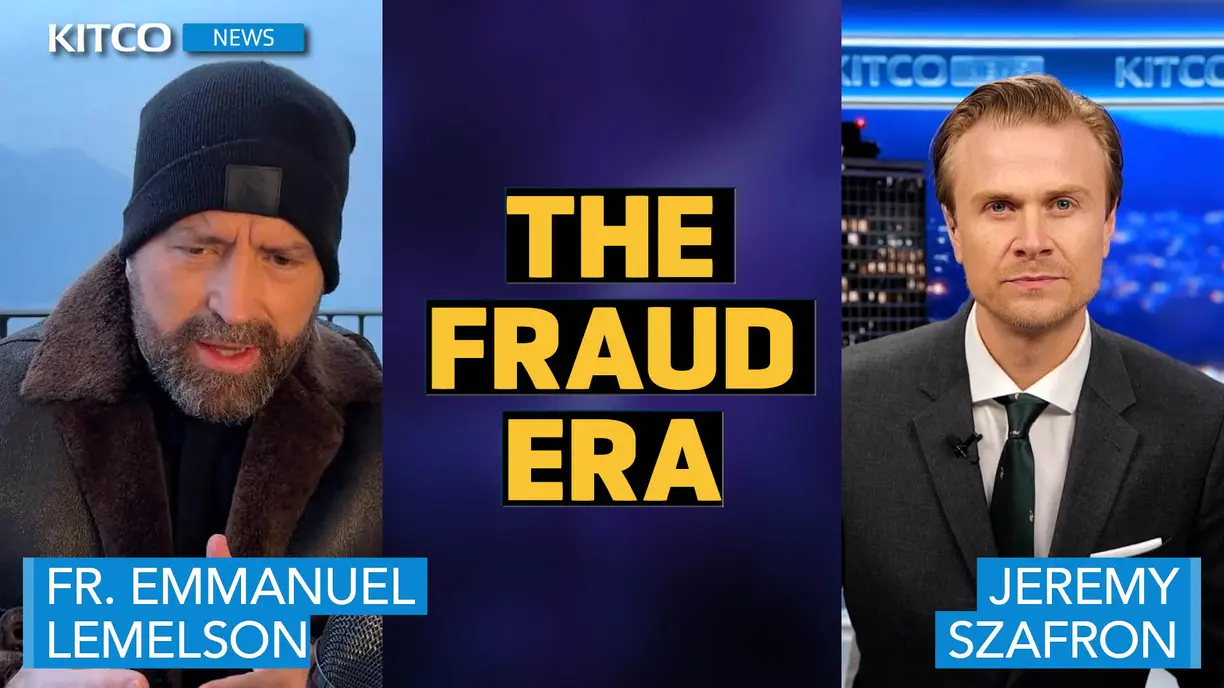
(Kitco News) - Global markets are attempting to stabilize following a historic $36 intraday swing in the price of oil. Stocks rallied Tuesday morning on hopes of a Middle East ceasefire, but the reality on the ground is a stark contrast to Wall Street's optimism.
The Pentagon announced its most intense day of attacks yet, and a UAE oil refinery halted operations following a drone strike. Iran explicitly rejected negotiations, and the U.S. ordered non-essential diplomats out of Saudi Arabia.
Despite roughly 20 million barrels of oil a day being knocked offline, crude prices dropped roughly 35% peak-to-trough in less than 24 hours. According to Father Emmanuel Lemelson, chief investment officer at Lemelson Capital Management, the current price action is detached from geopolitical and economic fundamentals.
"What we've seen is incredible volatility," Lemelson said. "I would tend to think that that's really a tremor before the major earthquake, that this simply is not sustainable, and there is no evidence that... Iran is simply willing to acquiesce and throw in the towel."
The "Cockroach Effect" in Credit and Real Estate
While geopolitical tensions escalate, domestic economic data shows signs of softening. The U.S. economy shed 92,000 jobs in February, and global debt has hit $350 trillion, according to the Institute of International Finance.
The strain is impacting institutional capital. BlackRock recently limited withdrawals on its $26 billion HLEND private credit fund. Simultaneously, mega hedge funds including Citadel and Millennium reported hundreds of millions of dollars in losses last week.
Lemelson views the gating of the BlackRock fund as a warning sign for the broader economy.
"It's that cockroach effect," Lemelson said. "It is reminiscent in some ways of all other credit bubbles. [Like in] 2008, you start to see the cracks and you start to wonder, what am I not seeing?"
This lack of liquidity is not isolated to private credit. Lemelson highlighted a slowdown in housing market liquidity, with inventory sitting at roughly 1.2 million units—about 40% lower than historical norms.
"Between that and private credit, you're talking about something like 10 trillion in market value," Lemelson said. "I think we're just at the very beginning of that and we'll see if it spreads to others, because at the end of the day, these things are very often interrelated."

The Hard Asset Trap and Silver's Crash
As traditional financial structures show signs of distress, retail investors have piled into alternative assets. Gold pushed past $5,200 an ounce on Tuesday, representing a roughly 70% increase over the last year. However, Lemelson warned that blindly chasing metals out of fear is a dangerous strategy, pointing to silver, which crashed 33% on Tuesday.
Lemelson cautioned investors against taking allocation advice from unregulated podcasters and influencers pushing precious metals.
"When everybody is pushing the same investment thesis or theme you should ask yourself, are they doing it out of the goodness of their heart?" Lemelson said.
He explained that the incentive structure for these promoters is enormous, noting that an unethical operator facilitating a $500,000 IRA rollover into precious metals could take an 8% cut, generating a $40,000 commission.
"Is the thinking independent? Are you being influenced by a network of influencers who are not being regulated, who are not disclosing their financial incentives?" Lemelson asked.
Finding Value in the "Golden Age of Fraud"
As algorithmic multi-strategy models fail to navigate the current volatility, Lemelson argued that the era of passive investing is over. Instead, he advocates for a rigorous, active approach rooted in reading financial statements to identify "proverbial price value dislocations."
He remains heavily critical of the artificial intelligence sector, warning of accounting chicanery and "roundtrip transactions" where companies engage in circular financing to inflate balance sheets.
"I've often said recently, it's also a golden age of fraud," Lemelson said, noting the low number of recent SEC enforcement actions.
To protect capital, Lemelson is allocating heavily into tangible, deeply discounted American companies. His top high-conviction ideas include General Mills, Adobe, and Harley-Davidson. He highlighted Harley-Davidson, noting investors can currently buy the company's tangible assets for about 70 cents on the dollar, securing a 16% yield through dividends and share buybacks.
"You don't have to make your alpha journey off the most exciting thing that you see on CNBC," Lemelson said. "It could be the most bland and boring and counterintuitive thing you would ever think of."
Watch the full interview with Father Emmanuel Lemelson in the video above to hear his complete breakdown of the ongoing credit crisis, the systemic risks within the AI sector, and his exact strategies for surviving this market volatility.
META description for google news:
As algorithmic hedge funds lose millions, Fr. Emmanuel Lemelson reveals why the passive investing era is dead and how to find alpha in a $350T debt crisis.