

(Kitco News) – Gold prices are selling off on Thursday morning after the Philadelphia Federal Reserve's manufacturing sector survey improved beyond expectations this month.
The regional central bank said its manufacturing business outlook for March came in at 18.1 after a reading of 16.3 in February. The data was far better than expected, as economists were looking for a reading of 10.0 this month.
“Responses to the March Manufacturing Business Outlook Survey suggest overall expansion in the region’s manufacturing activity,” the report said. “The indicators for current activity, new orders, and shipments were all positive. On balance, the firms continued to indicate overall increases in prices.”
“The survey’s broad indicators for future activity continued to suggest expectations for growth over the next six months,” they added.
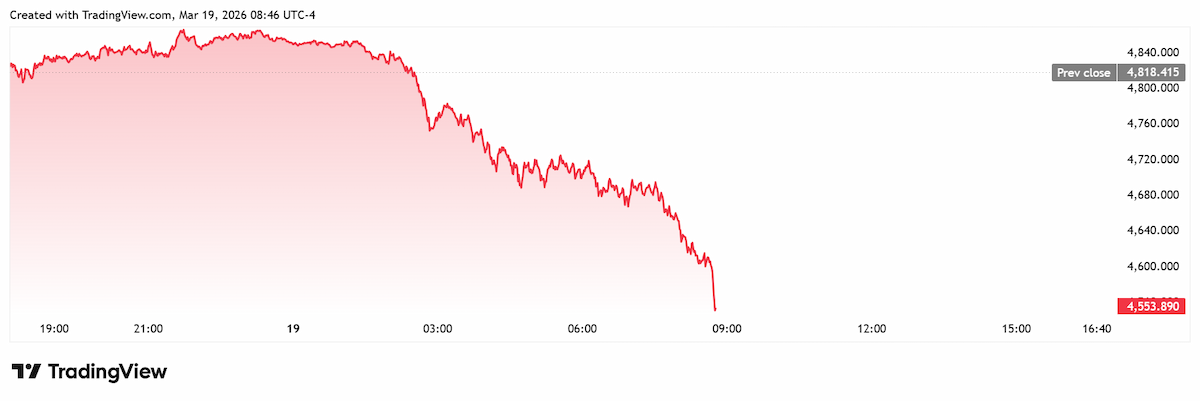
Gold prices slid back below the $4,600 support level in the moments after the 8:30 am EST release, and were trading at session lows 15 minutes later. Spot gold last traded at $4,554.98 per ounce for a loss of 5.57% on the session.
The current conditions indicators remained positive or improved this month. “The index for current new orders fell 3 points to 8.6, while the current shipments index rose 22 points to 22.2, its highest reading since January 2025,” the report noted. “Over 40 percent of the firms reported increases in shipments (up from 22 percent last month), 18 percent reported decreases (down from 22 percent), and 42 percent reported no change in shipments (down from 50 percent). The inventories index ticked up 2 points to 1.4.”
“On balance, the firms reported mostly steady employment, and the employment index rose 2 points to 0.8 in March,” they wrote. “More than 74 percent of the firms reported no change in employment levels this month; almost 13 percent reported increases, while 12 percent reported decreases. The average workweek index rose 14 points and turned positive at 2.8.”
The Philly Fed report also showed price pressures continued to rise in March.
“On balance, the firms continued to report overall increases in prices,” the report said. “The prices paid index rose 6 points to 44.7 in March, almost undoing its decline last month. Nearly 46 percent of the firms reported increases in input prices, while 1 percent reported decreases; 53 percent reported no change.”
“The current prices received index rose 5 points to 21.2. Over 21 percent of the firms reported increases in the prices of their own goods, nearly none reported decreases, and 75 percent reported no change.”
The survey’s broad indicators for future activity indicated firms continue to expect growth.
“The diffusion index for future general activity declined 3 points to 40.0 this month,” they noted. “More than 56 percent of the firms expect an increase in activity over the next six months, exceeding the 16 percent that expect a decrease; 23 percent expect no change. The future new orders index fell 5 points to 49.6, while the future shipments index rose 6 points to 53.6. The firms continue to expect increases in employment over the next six months, and the future employment index jumped 26 points to 40.4.”
“Both future price indexes remained above their long-run averages: The future prices paid index ticked down from 54.1 to 53.7, and the future prices received index fell 12 points to 38.4,” the report added. “The index for future capital expenditures rose 11 points to 25.8.”
