
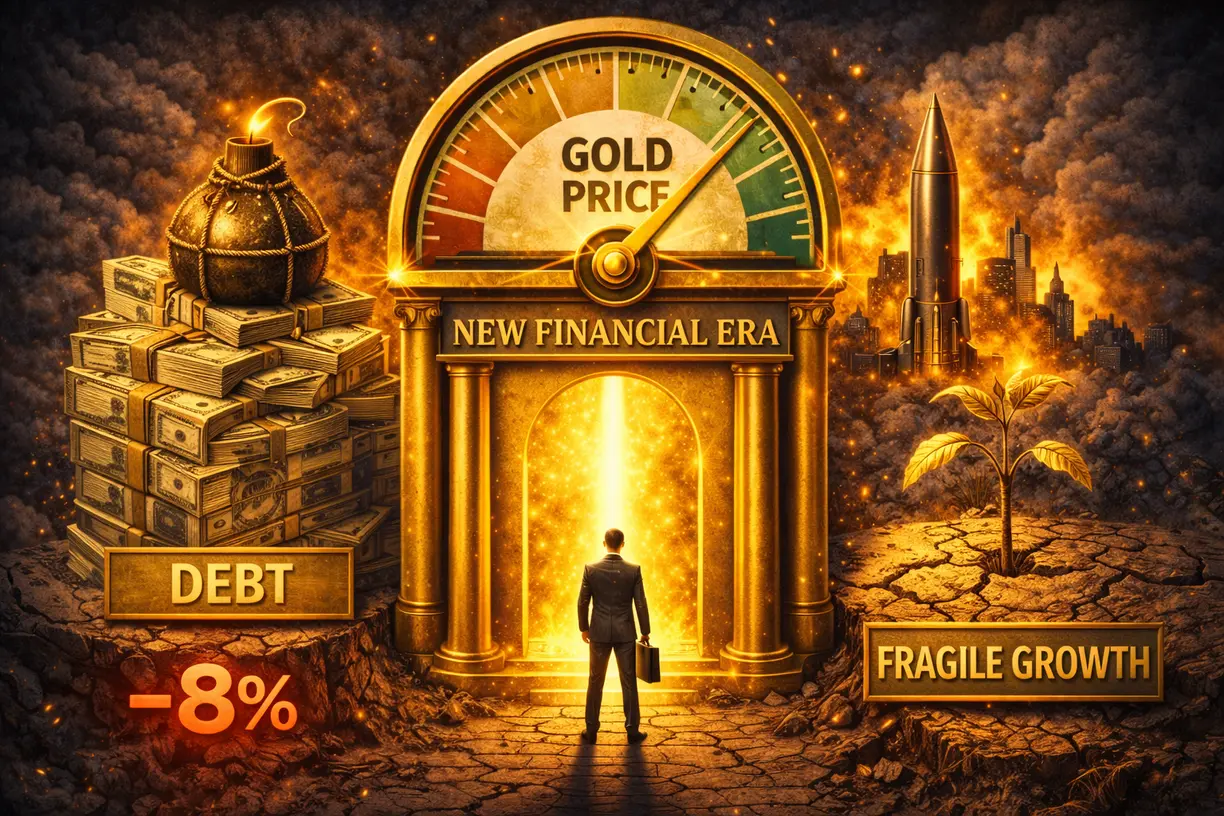
(Kitco News) - With gold prices suffering their worst weekly drop in six years—down 8%— we can expect investor sentiment to take a significant hit. Sharp pullbacks tend to shake out conviction, especially among speculative traders.
Despite the short-term volatility, the question gold investors have to ask themselves is: What has changed?
The same macroeconomic forces that pushed gold to record highs earlier this year remain firmly in place. Government debt continues to balloon at an unsustainable pace, global growth remains uneven and fragile, and geopolitical tensions show no signs of easing. If anything, the broader environment still supports gold’s long-term bull case.
However, this week I didn’t want to focus on gold’s price action as I am asking myself a more basic question: What does the future hold for gold?
This week, the World Gold Council announced a new initiative aimed at building shared infrastructure to connect the fragmented gold market and integrate physical bullion into a digital ecosystem. While the headlines may not have grabbed as much attention as gold’s price swings, the implications could be far more significant over the long term.
At the heart of this shift is the growing demand for tokenized gold. Similar to stablecoins backed by currencies, these digital assets are backed by physical bullion, offering investors exposure to gold in a more flexible and accessible format.
And the growth has been significant. Tokenized gold saw its market capitalization surge 177% in 2025, climbing from roughly $1.6 billion to $4.4 billion.
Admittedly, this is still a small slice of the overall gold market. But it’s the trajectory—not the size—that matters.
What makes digital gold particularly compelling is its ability to lower barriers to entry. Owning physical gold has traditionally required significant upfront capital. Not everyone can afford to purchase a full ounce at current prices. But tokenization allows investors to buy fractional amounts—$50 here, $100 there—while still maintaining exposure to a real, tangible asset.
In a world increasingly driven by digital finance, that accessibility could prove transformative.
The World Gold Council’s push to unify infrastructure is, in many ways, an acknowledgment that the future of gold will not look like its past. Physical bullion isn’t going away, but how it is owned, traded, and integrated into the financial system is clearly evolving.
So while recent price action may test investors’ patience, the underlying narrative remains intact—and arguably stronger than ever. Gold is not just holding its ground as a safe-haven asset; it is adapting to a new financial era.
And that may ultimately matter far more than any single week’s decline.
