
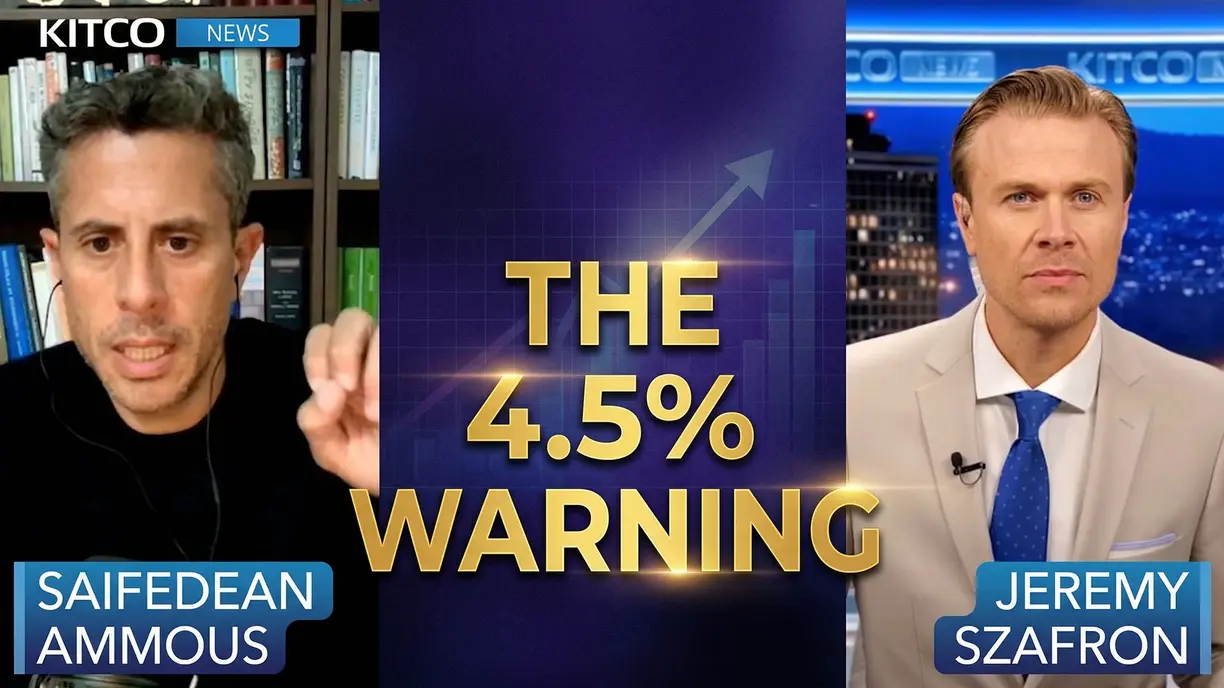
(Kitco News) - The U.S. national debt surpassed the $39 trillion mark on Wednesday, according to Treasury Department data, a milestone that economist Saifedean Ammous warns is part of a structural "debt wall" that will fundamentally change global wealth preservation.
In an interview with Kitco News Anchor Jeremy Szafron, the author of The Bitcoin Standard and The Gold Standard argued that the Federal Reserve is facing an unsolvable "$10 trillion math problem" as massive amounts of government debt must be rolled over at higher interest rates. Ammous told Kitco News that the current fiscal trajectory is no longer a theoretical risk but an immediate pressure on the dollar.
"The math of the fiat system is hitting a wall," Ammous said. "When you have $10 trillion in debt that needs to be refinanced at 4% or 5%, the interest payments alone begin to consume the federal budget. There is no 'soft landing' for a math problem of this scale."
Data from the Congressional Budget Office (CBO) released this month substantiates these concerns, projecting that net interest outlays will reach $1 trillion in fiscal year 2026. The Joint Economic Committee confirmed that as of March 25, the daily increase in national debt has averaged more than $7 billion over the past year.
The 4.5% Yield Threshold
Ammous identified the 10-year Treasury yield as the most critical signal for investors, specifically pointing to the 4.5% level as a threshold for systemic stress.
"The 4.5% yield is the ultimate warning signal for the war machine," Ammous said. "When yields stay at this level, it becomes physically impossible for the government to finance both its domestic obligations and global conflicts through debt alone. It forces the choice between a massive reduction in spending or an accelerated debasement of the currency."
As of Wednesday afternoon, the 10-year Treasury yield was trading near 4.34%, having retreated slightly from an eight-month high of 4.4% reached earlier in the week.

The ‘Paper Trap’ in Gold
Addressing the frustrations of gold investors regarding price action, Ammous argued that the physical gold market is currently neutralized by what he calls a "Paper Trap." According to Ammous, the financial system has created a clearance monopoly that prevents physical gold from functioning as a true medium of exchange.
"The government doesn't need to ban gold to stop it from being money," Ammous told Kitco. "They just ensure that the vast majority of gold 'ownership' stays in paper form within the banking system. You own the price of gold, but you don't own the ability to settle with it. This is why price discovery remains suppressed."
Stablecoins and the 'Backdoor Bailout'
In a contrarian take on the digital asset market, Ammous noted that stablecoins like Tether (USDT) are currently acting as a primary support pillar for the U.S. dollar.
According to a February 2026 transparency report, Tether has reached a record $141 billion in direct and indirect U.S. Treasury exposure. This makes the stablecoin issuer one of the largest non-sovereign holders of U.S. debt in the world, positioned just behind major nation-states.
"The irony of 2026 is that the very technology built to opt-out of the system is now bailing it out," Ammous said. "Tether and other stablecoins are creating a massive, global demand for dollars and Treasuries that didn't exist before. They are effectively providing the Fed with a backdoor bailout."
Ammous concluded by warning that traditional stock and bond portfolios have become "melting ice cubes" in the current era of debt expansion. He advocated for a shift into hard assets that sit outside the clearance monopoly of the traditional banking system.
This content is sponsored by Swan Bitcoin. Start your Bitcoin journey today at Swan.com/Kitco.