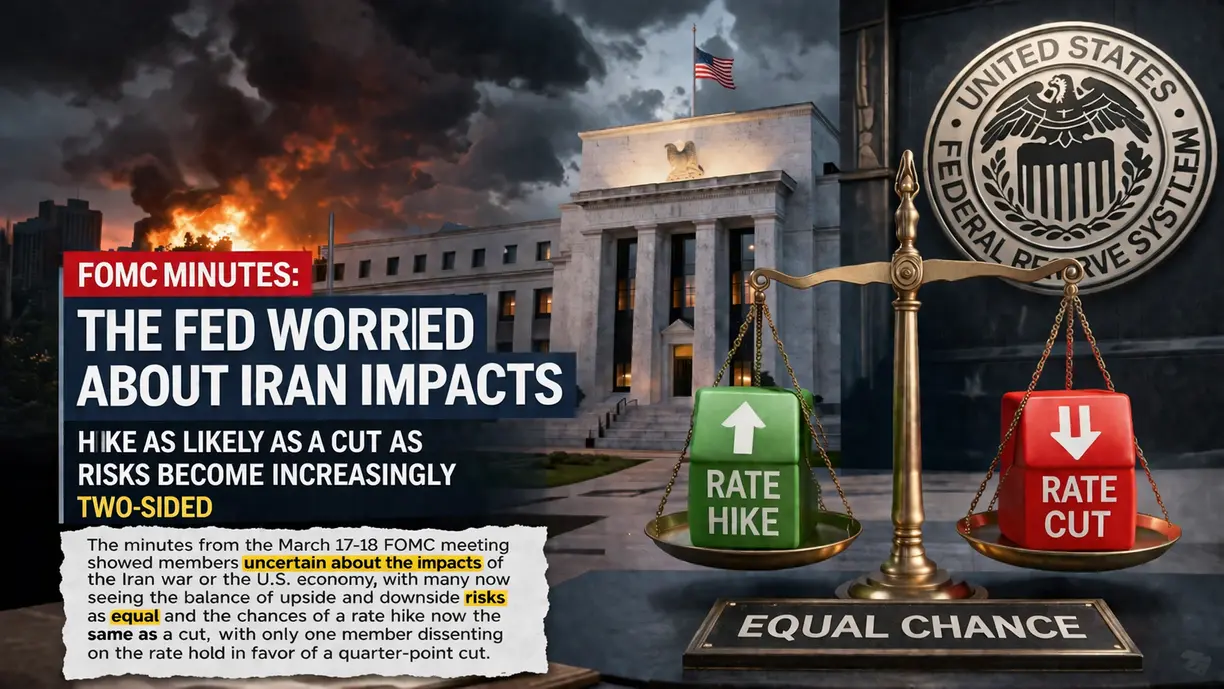
(Kitco News) – The minutes from the March 17-18 Federal Open Market Committee (FOMC) meeting showed members uncertain about the impacts of the Iran war on the U.S. economy, with many now seeing the balance of upside and downside risks as equal and the chances of a rate hike now the same as a cut, with only one member dissenting on the rate hold in favor of a quarter-point cut.
In the staff review of the financial situation, they noted that the market-implied expected path of the federal funds rate “moved higher, largely reflecting a shift in the anticipated timing of easing toward the end of this year,” while the two-year nominal Treasury yield increased on balance, “primarily driven by higher inflation compensation, consistent with rising near-term inflation concerns tied to surging energy prices following developments in the Middle East.”
“By contrast, the 10-year nominal Treasury yield was little changed on net,” they noted.
Meanwhile, equity indexes declined and volatility “increased notably, as concerns about Middle East developments appeared to weaken investor confidence.”
“In advanced foreign economies, the surge in energy prices led to notable increases in measures of short-term inflation compensation and sovereign bond yields,” the staff wrote. “The broad dollar index increased moderately, as both a deterioration in market risk sentiment and the status of the U.S. as a net energy exporter supported the dollar. Foreign equity prices decreased modestly, on net, but were volatile. Sovereign credit spreads widened in many emerging market economies, especially in those economies most reliant on energy imports.”
Turning to economic conditions, FOMC members were told that the information available at the time “indicated that real gross domestic product (GDP) continued to expand at a solid pace, particularly after accounting for the effects of the federal government shutdown in the fourth quarter of last year. The unemployment rate was little changed in recent months, though job gains continued to be low. Consumer price inflation remained elevated.”
The staff said that foreign headline inflation “generally remained near central banks' targets, despite still-elevated services price inflation in some economies,” though they noted that “some measures of near-term inflation expectations increased, as energy and other commodity prices surged with the Middle East conflict.”
The minutes then moved to future economic conditions, noting that “the staff projection of economic activity was not as strong as the one prepared for the January meeting, primarily reflecting incoming data and less expected support from financial conditions.”
“The staff had built in only a small effect on economic activity of the lower equity prices and higher crude oil prices associated with reactions to developments in the Middle East,” they said.
“All told, real GDP growth was expected to run about in line with potential growth through 2028. As a result, the unemployment rate was expected to remain near its current level through most of next year and then to edge down to the staff's estimate of the longer-run natural rate of unemployment.”
The Fed’s inflation forecast for 2026 “was slightly higher, on balance, than the one prepared for the January meeting, primarily reflecting incoming data and an expected boost to consumer energy prices given the recent run-up in crude oil prices,” though “inflation was projected to return to its previous disinflationary trend and to be close to 2 percent by the end of next year.”
The staff said uncertainty around the forecast was elevated due to “the potential economic effects of developments in the Middle East, government policy changes, and the adoption of AI,” while risks to the of employment and real GDP growth forecasts were “tilted to the downside,” and risks to the inflation projection were “a little more skewed to the upside than at the time of the January meeting.”
Turning to the outlook for monetary policy, the minutes noted that “participants emphasized the importance of being nimble in adjusting the stance of policy in response to incoming data, the evolving outlook, and the balance of risks,” while some participants “judged that there was a strong case for a two-sided description of the Committee's future interest rate decisions in the post-meeting statement, reflecting the possibility that upward adjustments to the target range for the federal funds rate could be appropriate if inflation were to remain at above-target levels.”
The majority of FOMC members “noted that upside risks to inflation and downside risks to employment “had increased with developments in the Middle East,” and that “a protracted conflict in the Middle East could lead to a further softening in labor market conditions, which could warrant additional rate cuts, as substantially higher oil prices could reduce households' purchasing power, tighten financial conditions, and reduce growth abroad.”
“Many participants pointed to the risk of inflation remaining elevated for longer than expected amid a persistent increase in oil prices, which could call for rate increases to help bring inflation down to the Committee's 2 percent objective and keep longer-term inflation expectations firmly anchored,” the minutes noted. “Most participants reiterated, however, that it was too early to know how developments in the Middle East would affect the U.S. economy and judged it prudent to continue to monitor the situation and assess the implications for the appropriate stance of monetary policy.”
Voting for the rate hold were Chair Powell along with Williams, Barr, Bowman, Cook, Hammack, Jefferson, Kashkari, Logan, Paulson and Waller. Voting against was Stephen Miran, who “preferred to lower the target range for the federal funds rate by 1/4 percentage point at this meeting.”
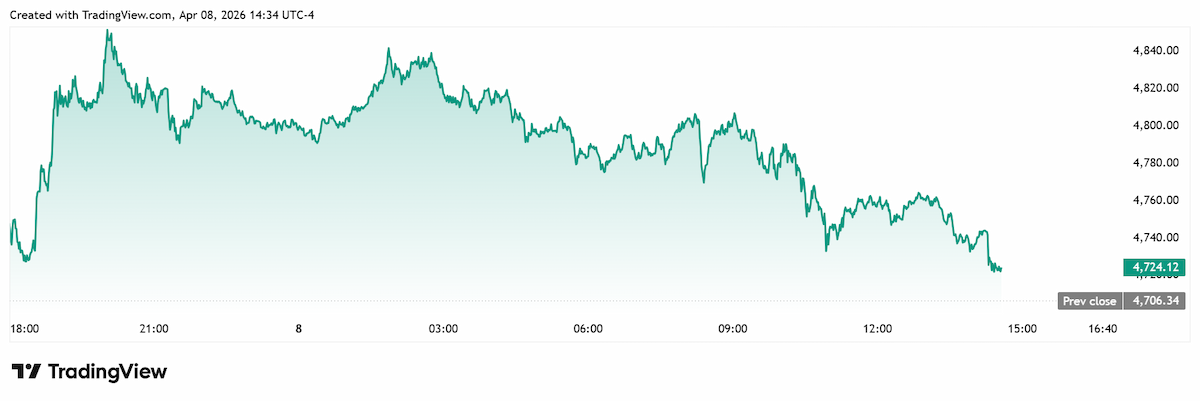
Gold prices slid closer to session lows following the 2 pm Eastern release. Spot gold last traded at $4,724.13 for a gain of 0.38% on the session.