(Kitco News) - Gold and silver continue to do what they do best: frustrate traders, as the precious metals have become significantly more nuanced within their broader consolidation pattern.
Although gold and silver remain stuck in neutral and face some significant short-term headwinds, analysts remain firmly bullish on their long-term prospects.
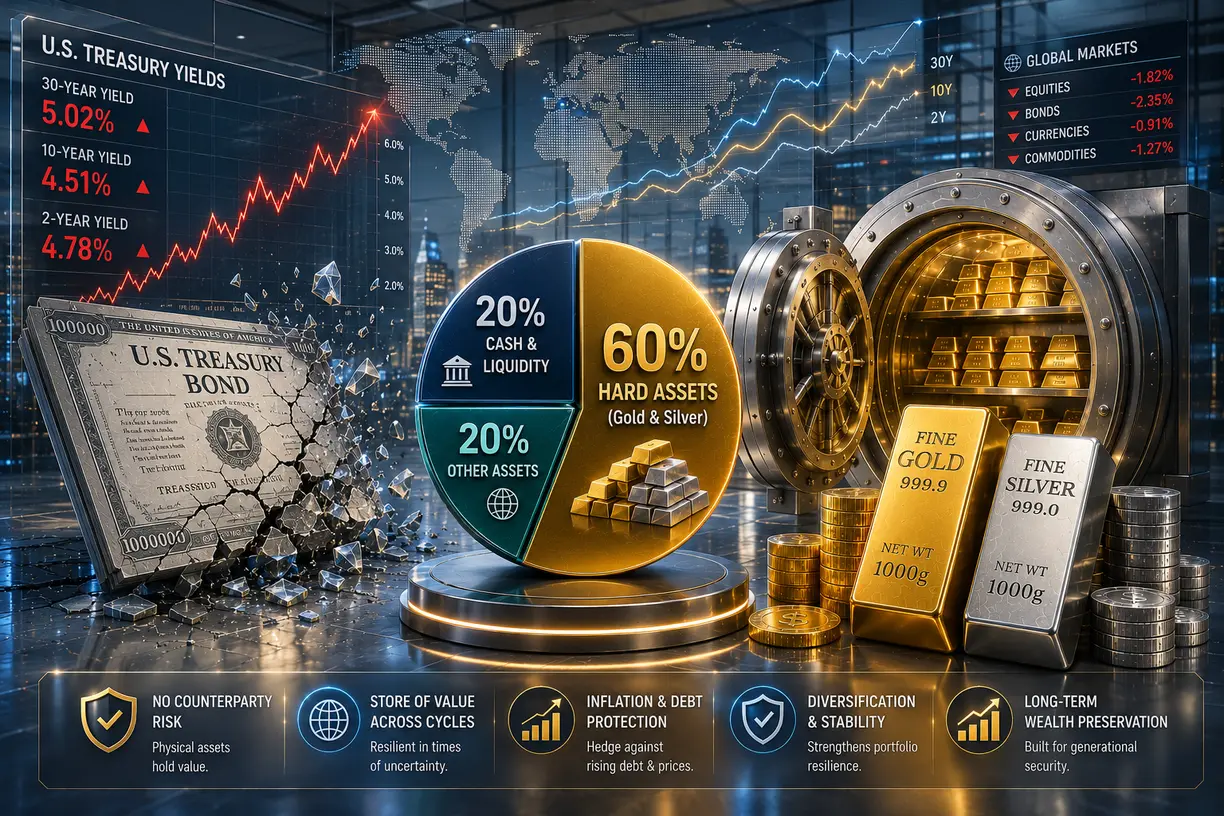
Last week, we noted that rising real yields had become the clearest threat to the precious metals market. That pressure has not gone away. In fact, it has intensified. With 30-year U.S. Treasury yields holding above 5% and 10-year yields above 4.5%, gold and silver continue to face a difficult near-term environment. Higher yields raise the opportunity cost of holding non-yielding assets, and markets are increasingly entertaining the possibility that the Federal Reserve may have to keep monetary policy tighter for longer, or even raise rates again.
But this is also where the story becomes more nuanced.
There is a fine line between higher bond yields that compete with gold and silver, and higher bond yields that signal something more dangerous. If investors are simply demanding more compensation because inflation remains sticky, then precious metals could remain under pressure. However, if the long end of the curve becomes disorderly and investors begin to question whether sovereign bonds still provide true safety, then gold and silver’s role will change dramatically. They stop being assets with no yield and become assets with no counterparty risk.
That distinction matters. Analysts are already warning that rising borrowing costs, persistent inflation, elevated energy prices and deteriorating fiscal dynamics could push markets closer to a breaking point. The bond market selloff has so far remained relatively orderly, but sentiment can shift quickly when yields move from being a valuation headwind to a systemic risk.
For gold, the risk-reward setup is becoming increasingly asymmetric. The metal may still be vulnerable to a correction if markets price in more rate hikes, stronger real yields and a firmer U.S. dollar. But the deeper these pressures become, the stronger the case grows for gold as a strategic wealth-preservation asset.
This argument is also nothing new as banks have been actively talking about the death of the traditional 60/40 portfolio balance and the rise of diversification of 60/20/20, with hard assets playing a key role.
Silver carries even more volatility, but also a compelling argument. It remains caught below key resistance, yet its dual role as both a monetary metal and an industrial commodity gives it unique leverage to a broader rotation out of overvalued financial assets and into hard assets. If tighter liquidity, higher energy costs and bond-market stress begin to undermine confidence in equities and credit, silver could benefit from the same preservation trade supporting gold, with added upside from supply constraints and industrial demand.
The message for investors is not that gold and silver are immune to higher yields. Rising real rates remain the biggest near-term obstacle for the sector. But the same forces weighing on precious metals today may ultimately become the catalyst for renewed demand tomorrow.
That is it for this week. For our American, European and British readers, have a great long weekend.

Neils Christensen
Neils Christensen has a diploma in journalism from Lethbridge College and has more than a decade of reporting experience working for news organizations throughout Canada. His experiences include covering territorial and federal politics in Nunavut, Canada. He has worked exclusively within the financial sector since 2007, when he started with the Canadian Economic Press. Neils can be contacted at: 1 866 925 4826 ext. 1526 nchristensen at kitco.com @KitcoNewsNOW

Disclaimer: The views expressed in this article are those of the author and may not reflect those of Kitco Metals Inc. The author has made every effort to ensure accuracy of information provided; however, neither Kitco Metals Inc. nor the author can guarantee such accuracy. This article is strictly for informational purposes only. It is not a solicitation to make any exchange in commodities, securities or other financial instruments. Kitco Metals Inc. and the author of this article do not accept culpability for losses and/ or damages arising from the use of this publication.