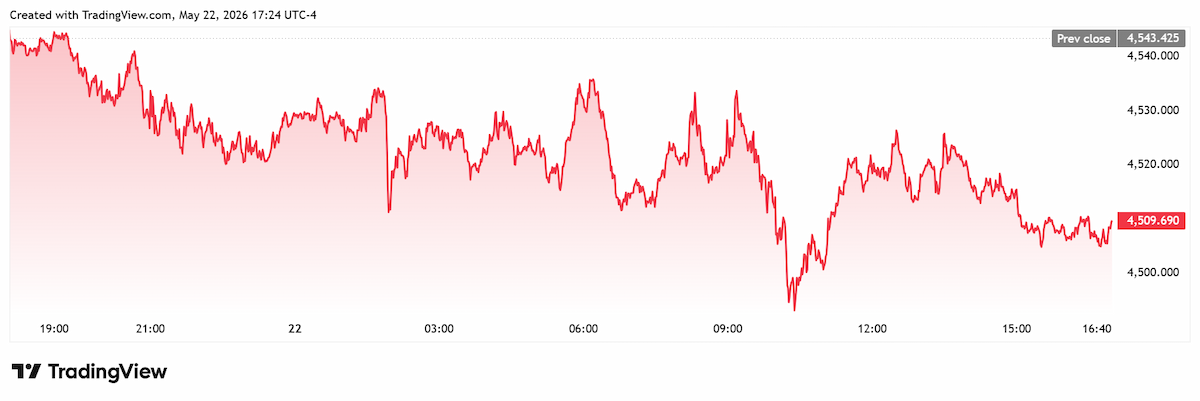

(Kitco News) – Gold prices saw another volatile week, with safe-haven demand from geopolitical uncertainty repeatedly colliding with a stronger U.S. dollar, rising Treasury yields, and renewed concerns that stubborn inflation could keep the Federal Reserve hawkish for longer.
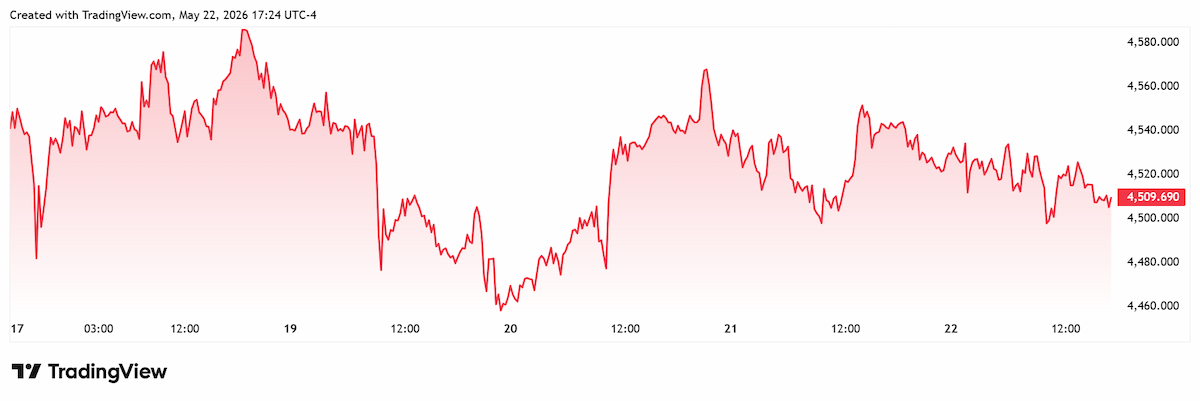
Spot gold kicked off the week trading at $4,539.09 per ounce on Sunday evening, and after a brief dip at the start of Asian trading, prices climbed steadily through Monday and into Tuesday as traders responded to ongoing uncertainty surrounding the Iran conflict and persistent concerns about global risk sentiment. The rally ultimately stalled just below the $4,600 level, with gold setting its weekly high at $4,588.64 per ounce before sellers regained control.
The reversal accelerated through Tuesday’s North American session as the U.S. dollar strengthened and markets repriced the inflation outlook amid higher energy prices and hawkish Fed expectations. Gold broke below $4,500, and the selling pressure continued into Wednesday, when spot prices fell to their weekly low of $4,453.00 per ounce ahead of the release of the April FOMC minutes.
The minutes confirmed that Fed officials remained concerned about inflation risks, particularly from energy prices and tariffs, limiting gold’s ability to sustain a rebound. Prices recovered back above $4,500 on Thursday and traders made one more attempt to stabilize Friday as hopes for de-escalation in the Middle East briefly cooled bond yields. But weaker U.S. consumer sentiment, rising inflation expectations, and hawkish comments from Fed Governor Christopher Waller kept pressure on the precious metal into the weekend, with spot gold trading at $4,508.25 at the close.
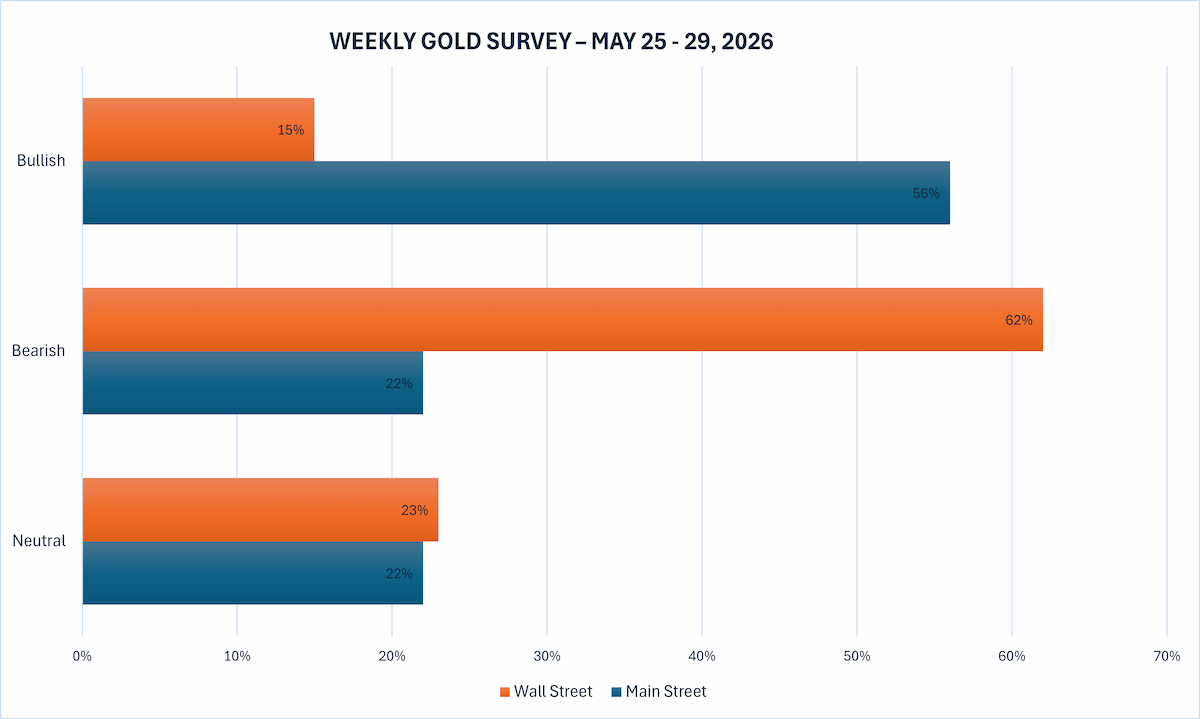
The latest Kitco News Weekly Gold Survey showed Wall Street still firmly bearish on gold’s near-term prospects, while Main Street maintained its stubborn bullish bias despite gold’s losses.
“Gold frayed the support at $4500 but has spent the week mostly consolidating above it,” noted Marc Chandler, managing director at Bannockburn Global Forex. “It has yet to prove itself on the upside. To do so would likely require a move above the $4600 area. Even with the rally in bonds, gold bugs could not reassert control. The downside risk may extend toward the 200-day moving average, now found around $4370.”
Chandler added that the longer the Middle East war continues, the greater the risk of further official gold sales from countries like Turkey and Gulf states.
“We shall likely see a continuation of the recent back and forth with an upward bias for the next week,” said Adrian Day, president of Adrian Day Asset Management. “So UP.”
“Down,” said Rich Checkan, president and COO of Asset Strategies International. “The fragile cease-fire between the U.S. and Iran is showing signs of breaking apart more and more each day. The sticking point remains nuclear weapons, and the situation is deteriorating as both sides dig in. And this has not been good for gold since the conflict began.”
“Further, both PPI and CPI came in last week markedly higher, with PPI hitting multi-year highs,” Checkan noted. “Interest rate cuts have been off the table for some time. Interest rate increases are now coming back up on the menu. Although we are nowhere near the point where real returns are anything to speak of, higher interest rates tend to push downward on gold prices.”
Kevin Grady, president of Phoenix Futures and Options, wanted no part of the gold market at these volumes, with Iran headline risk, and ahead of a long weekend and a short trading week.
“We just hit 80,000 contracts, and this is a rollover,” he said. “People are rolling positions, that's including spreads and everything: Of that 80,000, almost 30,000 of it is spreads.”
“I keep harping on this, but if you look at the chart, it's just not moving,” Grady said. “There's just not a lot of interest in [gold]. I think that people are just in a waiting pattern. There's not a lot of people in there really trading, and the people that are in there trading are the ones that are doing spreads. They're rolling over their positions from the June contract to the August contract.”
“When we came in today, there were still 145,000 Junes to roll,” he added. “They have until next week to do it, but I think some people are waiting to see, ‘What do I want to do here? Do I want to roll my positions? Do I want to liquidate my positions?’ We're sitting around those big support levels. I think the question now is, do we go back to that low? $4,128 is sitting down there from March 23rd. Are they going to test that?”
Grady said that with futures volumes so thin, traders are wary about entering a position in either direction, which they might not be able to exit cleanly.
“If the market does sell off down to $4,100 and gets swept, then they're not going to get caught,” he said. “People aren't positioning themselves either way.”
But despite gold’s recent weakness, with the spot market dipping as low as $4,492 on Friday, Grady believes that under current conditions, the yellow metal is just as likely to surge higher as it is lower.
“I think that you have as much downside risk as you do upside risk, because any sort of news is going to drive this market,” he said. “I think right now, everyone should wait. No one knows… especially on a holiday weekend,” he said. “You put a big position on here, and then all of a sudden you have to get out? Forget it. Anything can happen. I would not want to have a large position on, looking at this market right now. I would not want to have a large position on, in any direction.”
In the near term, Grady believes markets are still rangebound, and he doesn’t expect to see any consistent upside momentum until there’s a breakthrough in the Middle East.
“Every rally seems to be sold,” he said. “Right now, that's the market we're in, and we just have to wait. It's very frustrating for everybody to say, ‘Hey, we're waiting, nothing's changing, and we're waiting for Iran, waiting for a resolution.’ We're all in that same situation.”
This week, 13 analysts participated in the Kitco News Gold Survey, with Wall Street sentiment improving somewhat but remaining in bearish territory after gold once again failed to hold key support levels. Only two experts, or 15%, expected to see gold prices gain ground during the week ahead, while eight others, or 62% of the total, predicted a price decline. The remaining three analysts, representing 23%, expected consolidation during the week ahead.
Meanwhile, 32 votes were cast in Kitco’s online poll, with Main Street investors clinging to their bullish majority despite gold’s slide. 18 retail traders, or 56%, looked for gold prices to rise next week, while another seven, or 22%, predicted the yellow metal would lose ground. The remaining seven investors, representing 22% of the total, expected gold prices to trend sideways in the coming week.
Next week is a short one owing to the Memorial Day long weekend, but the economic data picks up when traders return on Tuesday with the release of the Conference Board’s Consumer Confidence survey. Market participants will be particularly focused on this indicator after Friday’s downside surprise from the final print of the University of Michigan Consumer Sentiment survey.
The remainder of the week’s economic data is concentrated on Thursday morning, when traders will be watching Preliminary Q1 GDP and PCE numbers, weekly jobless claims, and April’s Durable Goods Orders and New Home Sales.
John Weyer, director of the commercial hedge division at Walsh Trading, told Kitco News that gold remains beholden to Middle East developments, but the longer the conflict lasts, the harder it will be to avoid long-term damage to the economy.
Weyer agreed that the longer the Iran war drags on, the more the views of the general public begin to align with those of energy traders and economic experts: that the impacts are likely to be more severe and longer lasting than initially claimed by the Trump administration.
He said the downbeat University of Michigan consumer sentiment survey released on Friday is another indication that high gas prices are beginning to filter down through supply chains to impact consumers beyond the pump.
Weyer said the continuing strength in equity markets despite the Middle East conflict and other economic headwinds is also making it difficult for fund managers to justify putting money into gold or other alternatives, but if and when markets get an Iran resolution, strong equities will be in a position to help propel broader economic and financial gains.
He also made a point of underlining that while the dollar amounts of gold's selloffs appear dramatic with gold at $1,500 per ounce, but at $4,500 per ounce, the dips are actually quite small in percentage terms.
For next week, Weyer expects gold will continue to trade on both sides of the $4,500 per ounce threshold, likely between $4,470 on the downside and $4,560 or so to the upside, and he doesn't expect a major break in either direction.
Alex Kuptsikevich, senior market analyst at FxPro, expects gold prices to continue declining next week.
“Gold fell towards $4,460 in the first half of the week, but subsequent signs of geopolitical de-escalation in the Middle East helped the price rebound, leading to consolidation just above $4,500,” he wrote. “Technically, the price is now almost equidistant from the 200-day moving average below and the 50-day moving average above. This should be interpreted as a continuation of the long-term bullish trend, though the medium-term trend is bearish. This is also indicated by the sequence of lower local highs that the price has been recording since the price peak at the end of January.”
“Despite signs of progress in negotiations between the US and Iran, we still see a greater likelihood that the price will drift towards the $4,370–$4,400 range by the end of next week,” Kuptsikevich warned. “This would mark a return to the lows seen in late March and December, as well as a return to the highs of last October and the 200-day moving average. A significant battle between bulls and bears is to be expected here. In the event of a rapid collapse, the sell-off in gold could accelerate sharply, whilst a rebound may remain a local victory, and the market will need to consolidate above $4,800 before we can speak with greater confidence of a return to a bull market in gold.”
Michael Moor, founder of Moor Analytics, expects to see gold prices trend downward once again next week.
“LOWER, unless we take out lower timeframe formation mentioned below,” he wrote. “In a Higher time frame: I cautioned on 8/16/18 the break above $1,183.0 warned of renewed strength. We have seen $4,443.1. This is ON HOLD. We held exhaustion at 56192 with a 56268 high and rolled over $1,526.8. This is ON HOLD. On a medium timeframe basis: The trade below 52554 (+15 tics per/hour) projects this down $220 minimum, $740 (+) maximum—we attained $1,155.4. The trade back below 52036 (+13 per/hour) has brought in $1,103.6 of pressure. The trade back below 51606 (+13 per/hour) has brought in $1,060.6 of pressure. The trade below 48530 (+4 tics per/hour) has brought in $753.0 of pressure. These are OFF HOLD. We held exhaustion at 40956 with a 41000 low and have rallied $817.7. The trade above 41814 has brought in $736.3 of strength. The trade above 43642 has brought in $553.5 of strength. The trade above 47119 (-12 tics per/hour) projects this upward $155 min, $540 (+) max—we attained $205.8 so far. These are ON HOLD.”
“On a lower timeframe basis: We held exhaustion with a 49177 high and rolled over $462.7,” Moor said. “The break below 48185 projected this down $185 (+)—we attained $363.5. The trade below 47923 projected this down $205 (+)—we attained $337.3. The break below 47420 (-4.2 tics per/hour) brought in $287.0 of pressure. The maintained gap lower left a medium bearish reversal—we have come off $98.2 from the 45532 open. These are ON HOLD. I warned: we may be in the last stretch of the move down from 47834, with possible exhaustion at 44539—we are holding this with a 44550 low and have bounced $117.4 into a possible correction exhaustion against the move down from 47834; with possible exhaustion at 45804-951, 46057-244, 46580-783 and higher.”
At the time of writing, spot gold last traded at $4,509.69 per ounce for a loss of 0.79% on the week and 0.74% on the day.