
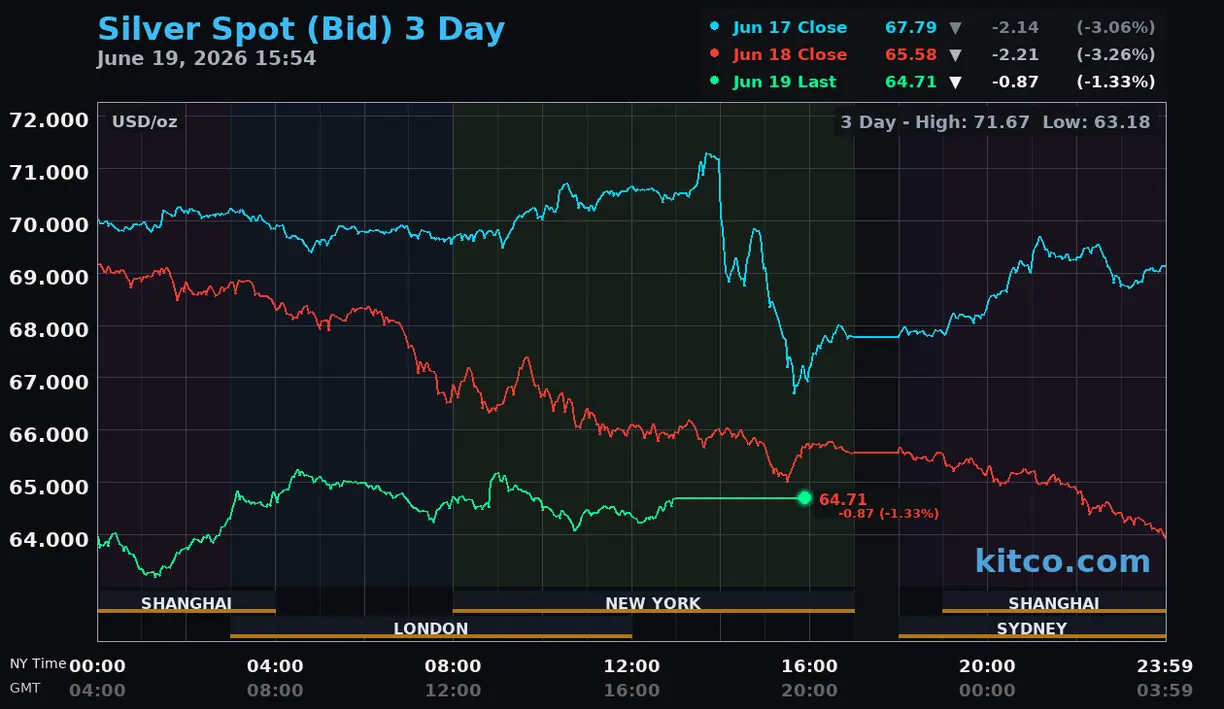
(Kitco NewsWire) - Spot gold and silver prices are weaker in thin holiday trading Friday, with U.S. cash equity and bond markets closed for Juneteenth and rate-sensitive flows continuing to lean against precious metals following this week's Federal Reserve meeting. At the time of writing, spot gold was trading near $4,154.70 an ounce, down 1.28%, while spot silver was trading at $64.71, down 1.33% on the session.
The Federal Reserve left the federal funds target range at 3.50% to 3.75% on Wednesday but has shifted firmly toward a hawkish bias. The market has moved from debating rate cuts to pricing in the risk of 2026 hikes, with one current estimate putting the probability of a July hike at 38.5%, a September hike at 51.7%, and two hikes by year-end still on the table. That repricing is keeping the opportunity-cost argument against gold in focus, even as crude oil has retreated from war-premium levels.
Positioning in gold now looks more like de-risking than liquidation. “Less about panic selling,” Laurence Booth, global head of markets at CMC Markets, said in comments provided to Kitco, adding that the decline has been orderly despite a move of more than $200 in a matter of days. Booth said the more important signal is physical demand: softer premiums in China and other major markets have removed a source of support, leaving gold without an obvious metal-specific catalyst unless the macroeconomic outlook shifts back toward lower rates or renewed stress.
The Strait of Hormuz remains the primary geopolitical tail risk, but the latest market impact is less inflationary than it was earlier in the conflict. Commercial traffic has begun to resume following the U.S.-Iran memorandum, helping pull Brent crude back toward the $79.50 area and U.S. crude toward $75.85. However, shipping has not fully normalized. Mine-related disruptions, navigation risks, and a backlog of stranded vessels mean the route is open enough to reduce the immediate oil shock, but not clear enough to erase the geopolitical premium. For gold, that combination is awkward: lower oil prices reduce inflation-hedge demand, while unresolved U.S.-Iran tensions keep safe-haven buying from disappearing entirely.
Global markets were mixed Friday, with Japan’s Nikkei 225 rising 0.3% to a record high, Germany’s DAX adding 0.2%, and U.S. futures easing during the holiday session. The U.S. dollar remains firmer following the Fed-driven repricing, while the benchmark 10-year Treasury yield is trading near the 4.4% area. Traders are watching June flash U.S. manufacturing and services PMIs at 9:45 a.m. ET on Tuesday, followed by May PCE inflation, weekly jobless claims, final first-quarter GDP, durable goods orders, and personal income and spending data at 8:30 a.m. ET on Thursday.
The key outside markets see Nymex WTI crude oil prices trading around $75.85 a barrel, while Brent crude is near $79.50. The U.S. dollar index is firmer, and the yield on the benchmark 10-year U.S. Treasury note is trading near the 4.4% area.
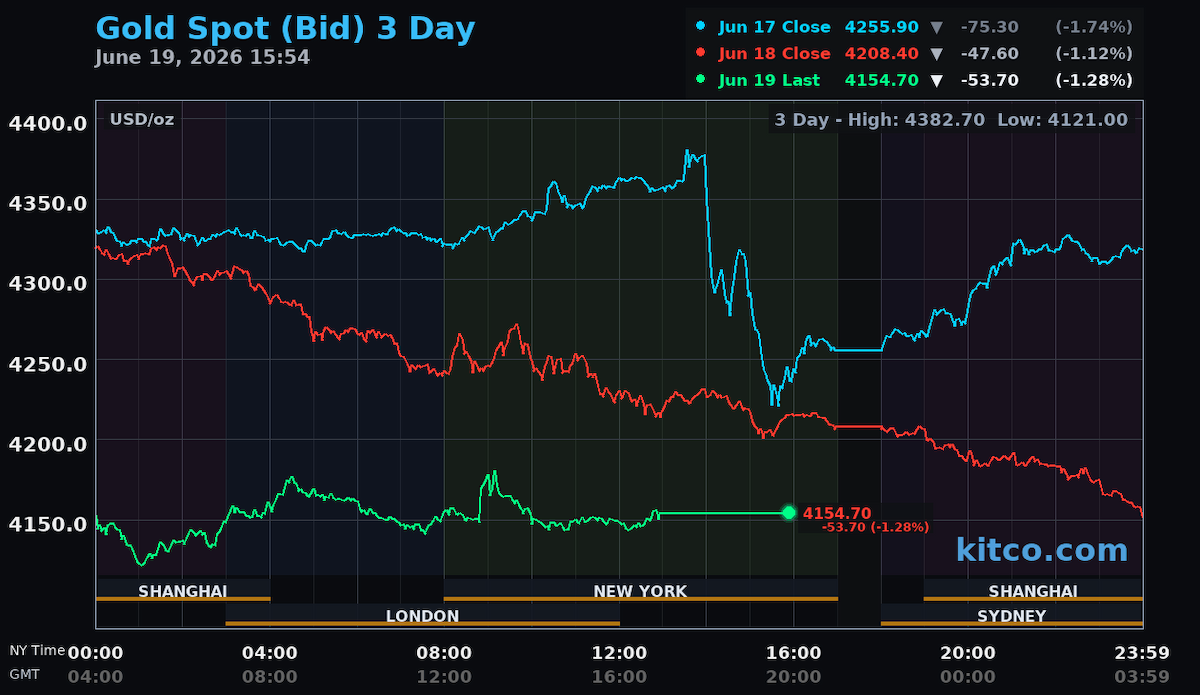
Technically, spot gold bulls' next upside price objective is to push prices back above the $4,180 to $4,200 resistance zone, with a sustained move targeting the $4,370 to $4,390 zone. Bears' next near-term downside price objective is a break below the $4,121.00 session low, with deeper downside targets at $4,040 and then $4,020. First resistance is seen at $4,180 and then at $4,200. First support is seen at $4,121.00 and then at $4,040.
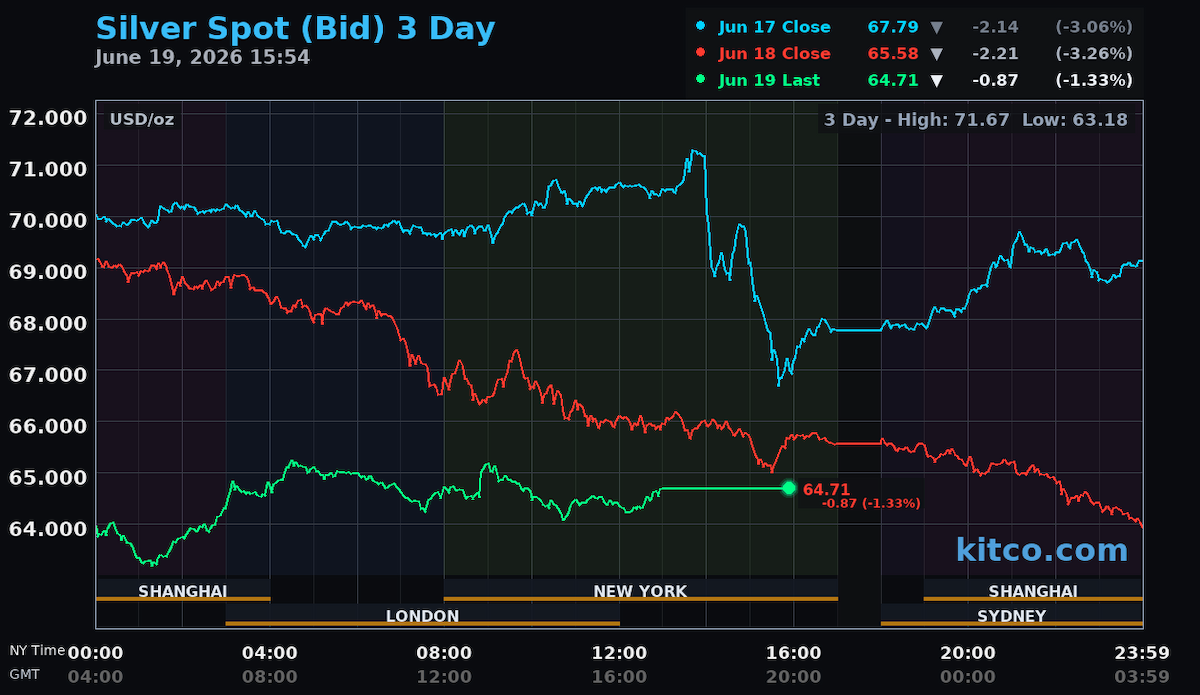
Spot silver bulls' next upside price objective is to drive prices back above the $65.00 to $66.00 area, with a move above that zone targeting $66.57 and then $68.32. The bears' next downside price objective is a break below $63.18, with deeper downside targets at $62.00 and then $61.00. First resistance is seen at $65.00 and then at $66.00. Next support is seen at $63.18 and then at $62.00.
