

(Kitco NewsWire) - Spot gold and silver prices are higher ahead of the North American market open Thursday, as traders rebuilt part of Wednesday’s selloff while Treasury yields, the U.S. dollar and crude oil prices held firm on renewed U.S.-Iran escalation. At the time of writing, spot gold was trading near $4,113.84 an ounce, up 0.88%, while spot silver was trading near $59.39, up 1.80% on the session.
Gold’s early range was $4,053.60 to $4,121.00, leaving the metal back above the $4,100 area but still below the $4,162 to $4,214 resistance zone that capped the latest rebound. Silver’s early range was $57.47 to $59.60, with the metal stabilizing after Wednesday’s drop but still below the $60.00 to $62.80 resistance area.
Positioning after last Thursday’s June employment report and Wednesday’s Fed minutes remains mixed for gold. Payrolls rose 57,000 in June, the unemployment rate held at 4.2% and April and May payrolls were revised down by a combined 74,000, initially supporting gold by reducing confidence in another near-term Fed hike. The minutes then shifted attention back to inflation risk, with Fed officials split on the path of rates and 9 of 18 policymakers seeing at least one hike by December. The 10-year Treasury yield was near 4.579%, down from Wednesday’s seven-week high of 4.597%, while DXY was near 100.96. That leaves gold supported by softer labor momentum, but still capped by sticky yields and a dollar that has not given back much of its post-minutes bid.
Initial jobless claims fell by 1,000 to 215,000 in the week ending July 4, below expectations around 220,000 to 225,000, while continuing claims held near 1.81 million. The data point to limited layoff pressure, but against last week’s 57,000 payrolls print, they reinforce a labor market that is cooling through slower hiring rather than rising job losses.
The Strait of Hormuz situation is best characterized as open transit under active military and shipping risk, not a confirmed chokepoint closure. The U.S. launched new airstrikes against Iran after attacks on ships in the Strait of Hormuz, while Iran responded by targeting U.S.-allied Kuwait and Qatar. Brent crude traded near $78.66 after briefly topping $80 on Wednesday, while WTI was near $74.06. For gold, the immediate impact is two-sided: Hormuz risk is keeping a geopolitical bid in the background, but oil-driven inflation concerns are lifting yields and limiting the upside. For broader markets, the trade remains oil bid, bonds under pressure, equities mixed and the dollar steady.
Traders are watching follow-through from Wednesday’s Fed minutes, the July 14 CPI release at 8:30 a.m. ET and any further escalation around Hormuz shipping lanes. A renewed rise in crude above $80 Brent would keep inflation pressure in focus; softer labor or inflation data would give metals a cleaner path to extend the rebound.
The key outside markets see Nymex WTI crude oil prices firmer and trading around $74.06 a barrel, while Brent crude was near $78.66. The U.S. dollar index is steady near 100.96. The yield on the benchmark 10-year U.S. Treasury note is trading near the 4.58% area.
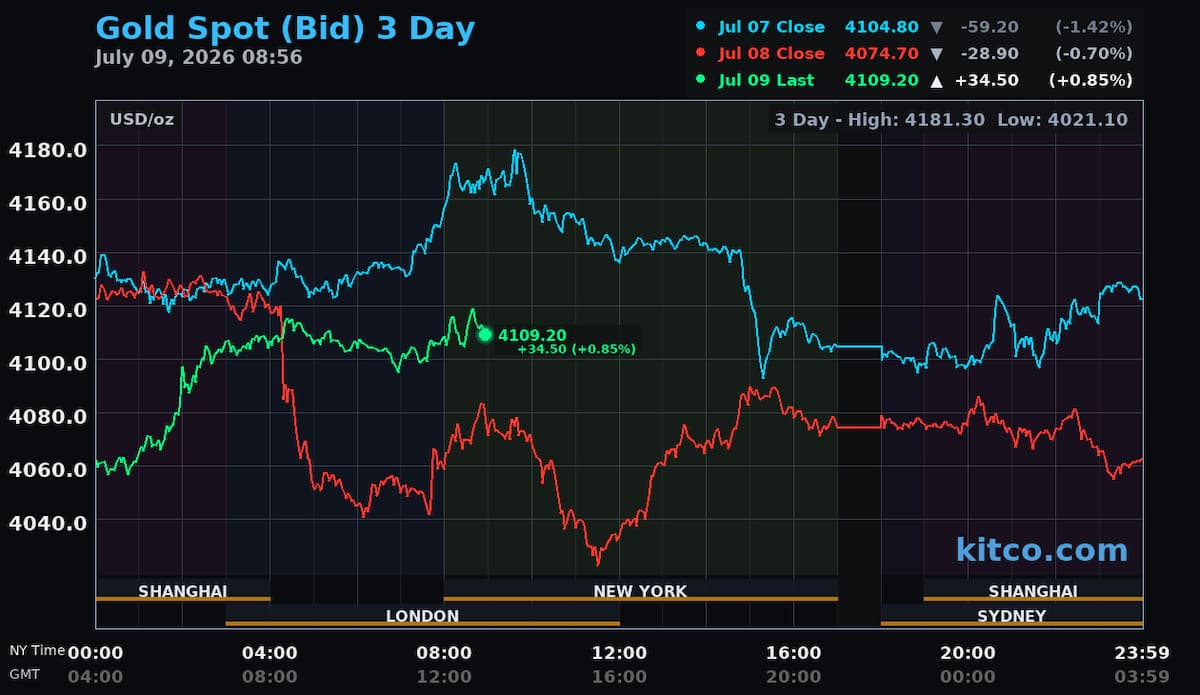
Technically, spot gold bulls' next upside price objective is to push prices back above the $4,091.00 to $4,103.00 resistance zone, with a sustained move targeting $4,140.00 and then $4,203.00. Bears' next near-term downside price objective is a break below $4,000.00, with deeper downside targets at $3,959.00 and then $3,942.00. First resistance is seen at $4,091.00 and then at $4,103.00. First support is seen at $4,053.60 and then at $4,000.00.
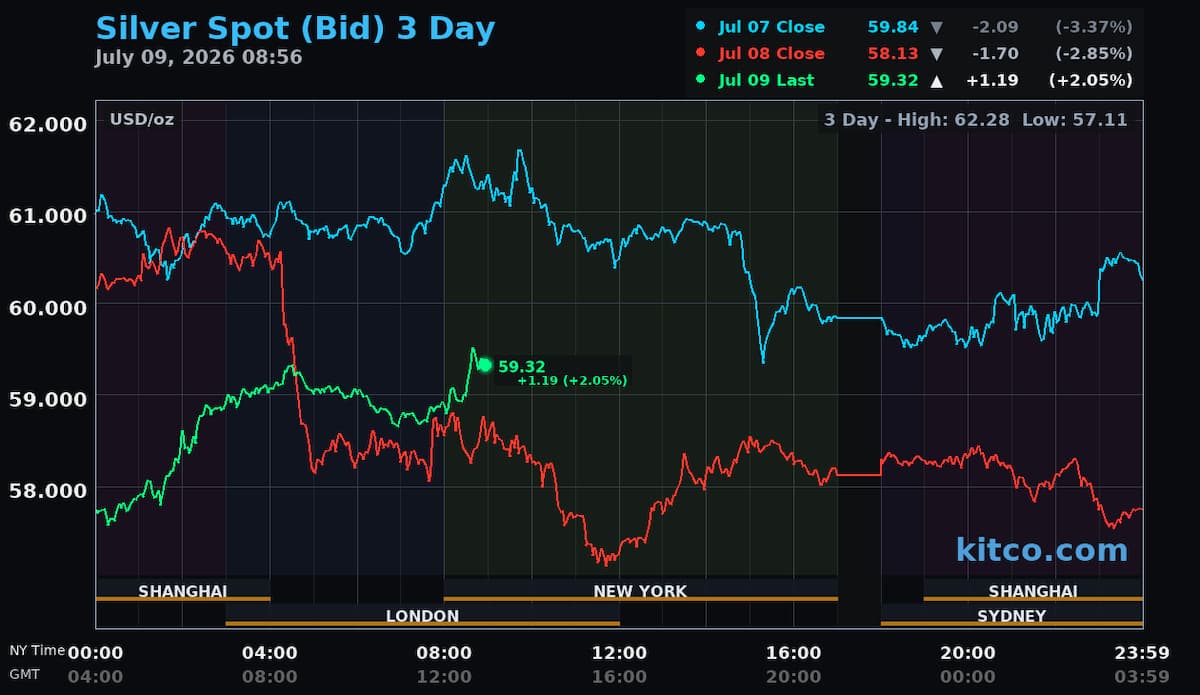
Spot silver bulls' next upside price objective is to drive prices back above the $59.36 to $62.81 area, with a move above that zone targeting $64.00 and then $65.00. The next downside price objective for the bears is a break below $57.00, with deeper downside targets at $55.60 and then $50.00. First resistance is seen at $59.36 and then at $62.81. Next support is seen at $57.47 and then at $55.60.