

(Kitco NewsWire) - Spot gold and silver prices are lower in late-afternoon U.S. trading Friday, as rising Treasury yields and firm Fed-rate expectations offset a softer U.S. dollar and renewed geopolitical risk tied to the Strait of Hormuz. At the time of writing, spot gold was trading near $4,118.66 an ounce, down 0.13%, while spot silver was trading near $59.809, down 0.90% on the session.
Gold’s session range was $4,021.00 to $4,138.00, leaving the metal above the $4,000 area but below the $4,180 to $4,200 resistance zone that capped the week’s rebound. Silver’s session range was $58.53 to $60.89, with the metal failing to sustain a move above $60.00 and finishing the week below the $61.00 to $62.00 resistance band.
Positioning after last Thursday’s June employment report and Wednesday’s Fed minutes remains mixed for precious metals. Payrolls rose 57,000 in June, about half of expectations, while the unemployment rate held at 4.2% and April and May payrolls were revised down by a combined 74,000. That weaker labor print initially supported gold by reducing confidence in another near-term Fed hike, but the Fed minutes kept inflation risk in focus and left traders reluctant to price a clean dovish pivot. The 10-year Treasury yield was near 4.55% late Friday, while the 2-year yield held above 4.20% and DXY was near 100.87. That leaves gold supported by softer hiring momentum but capped by elevated real-rate pressure.
The Strait of Hormuz situation is best characterized as open transit under elevated military and shipping risk, not a confirmed chokepoint closure. Unclaimed strikes hit parts of Iran after the U.S. said it had finished a round of attacks, while Tehran continued to insist that the strait should be under its control and that vessels should pay fees to transit. Maritime advisories continue to urge ships to use the southern route through Omani waters after earlier attacks on merchant vessels. Oil prices remain below wartime highs but above pre-escalation levels, keeping an inflation-risk premium in the background. For gold, the impact is two-sided: Hormuz risk supports defensive demand, but higher oil, sticky inflation expectations and firm yields continue to limit upside.
Traders are watching next week’s CPI release, Fed Chair Kevin Warsh’s congressional testimony and any further disruption to Hormuz shipping lanes. A softer CPI print would reduce the pressure from real yields and give gold a cleaner path back toward the $4,180 to $4,200 resistance zone, while a renewed oil spike would bring the inflation-rate channel back into focus.
The key outside markets see Nymex WTI crude oil prices modestly lower and trading around $72.00 a barrel, while Brent crude was near $77.00. The U.S. dollar index is steady near 100.87. The yield on the benchmark 10-year U.S. Treasury note is trading near the 4.55% area.
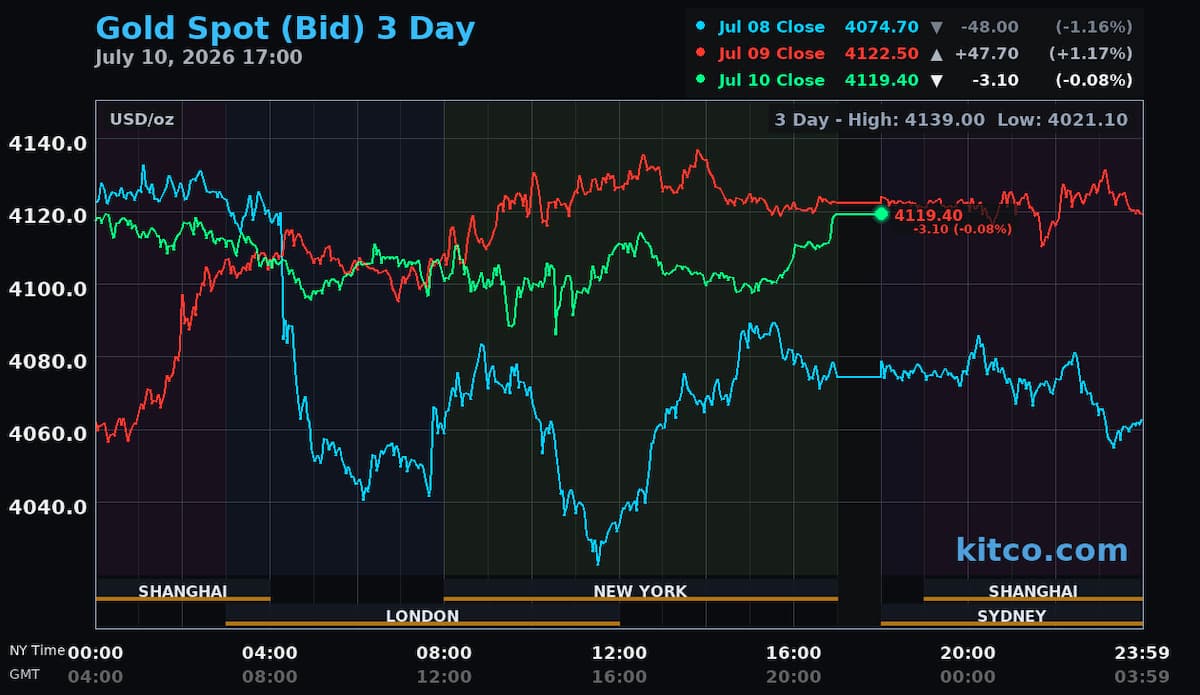
Technically, spot gold bears have the overall near-term technical advantage as prices remain below key trend resistance at the 20-day moving average and the uptrend line. Bulls' next upside price objective is to push prices back above $4,138.00, with a sustained move targeting $4,203.00 and then the 50-day moving average near $4,352.00. Bears' next near-term downside price objective is a break below $4,021.00, with deeper downside targets at $3,942.00 and then $3,886.00. First resistance is seen at $4,138.00 and then at $4,203.00. First support is seen at $4,021.00 and then at $3,942.00.
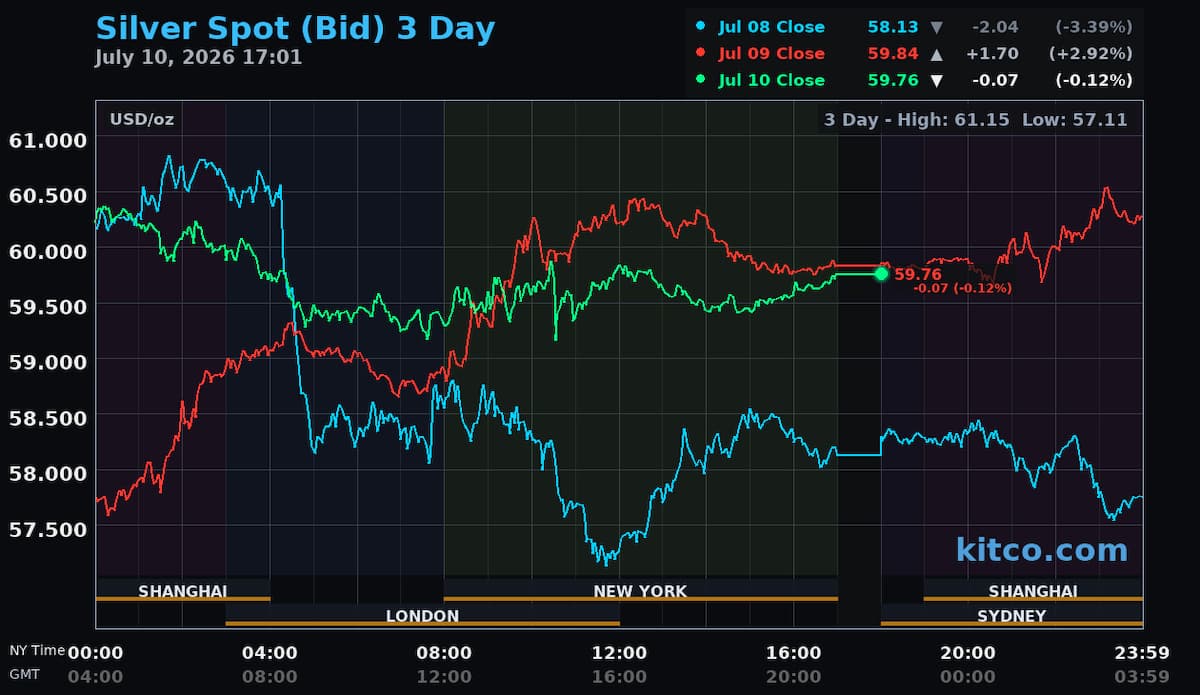
Spot silver bears have the overall near-term technical advantage as prices failed to hold above $60.00 and remained below the red moving average at $62.81. Silver bulls' next upside price objective is to drive prices back above $61.71, with a move above that level targeting $62.81 and then the $65.00 to $66.00 resistance zone. The next downside price objective for the bears is a break below $58.27, with deeper downside targets at $55.60 and then $52.00. First resistance is seen at $61.71 and then at $62.81. Next support is seen at $58.27 and then at $55.60.