

It was a volatile end to the week for the cryptocurrency market as the price of some tokens dumped, while others pumped, and Bitcoin (BTC) flirted with support at $40,000.
Financial headlines continue to focus on the recent launch of spot BTC ETFs in the U.S., with reactions split between calling it a success or a failure. In reality, the result falls somewhere in the middle, as trading volumes have been high, but Bitcoin’s price has drifted lower.
Stocks closed out the week on a positive note, with the S&P hitting a new all-time high despite a decline in interest rate cut expectations. The CME FedWatch Tool now shows that the market gives only a 50% chance of a reduction in March, down from 80% just last week.
According to BlackRock senior macro investment strategist Laura Cooper, the Fed is unlikely to cut rates in the next few months, based in part on the latest retail sales data, which she said is evidence that the U.S. economy remains resilient.
“Considering that inflation is still above the 2 percent target, I think the Fed will start reducing interest rates in June at the earliest,” Cooper said during an interview with Bloomberg. “I also expect the Fed to start reducing interest rates before the European Central Bank. I predict that the Fed will reduce interest rates by 75-100 basis points by the end of 2024.”
At the closing bell, the S&P, Dow, and Nasdaq recorded healthy gains, finishing up 1.23%, 1.05%, and 1.70%, respectively.
Data provided by TradingView shows that miner sales and large transfers of BTC to Coinbase from the Grayscale Bitcoin Trust, followed by liquidation, put pressure on Bitcoin throughout the day, with the top crypto hitting a low of $40,240 in the afternoon as bears looked to push its price below the psychologically important $40,000 level.
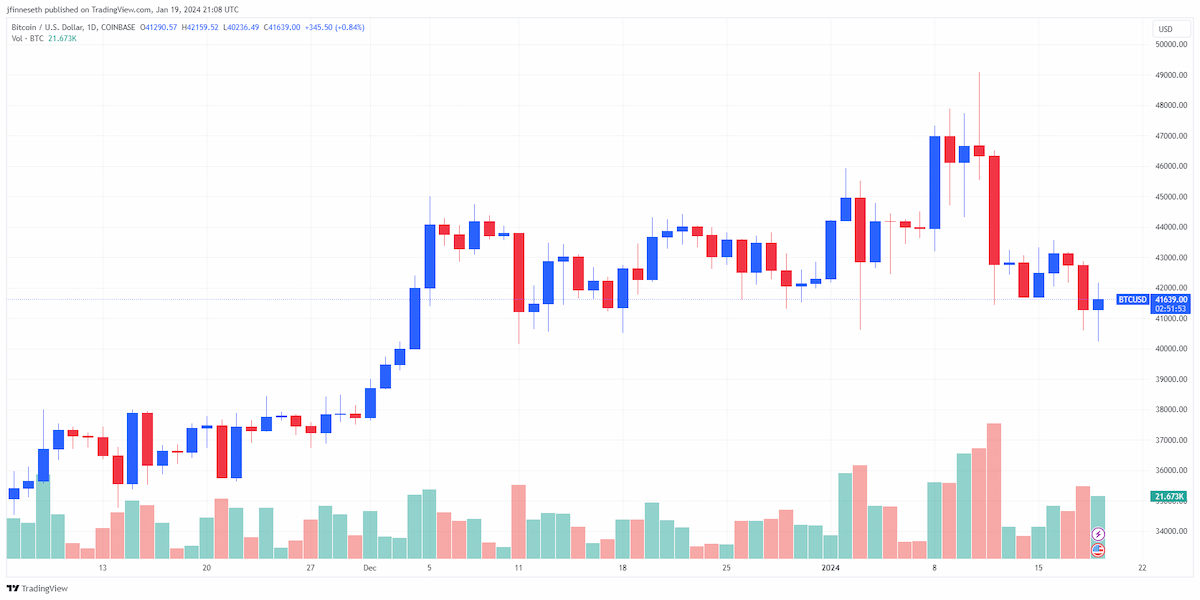
BTC/USD Chart by TradingView
But bulls mounted a strong defense and reversed the price action, rallying Bitcoin to a price of $41,880 at the time of writing.
Kitco senior technical analyst Jim Wyckoff noted that “Bulls still have the overall near-term technical advantage but have faded as prices have dipped just below what was strong chart support at the December and early-January lows.”
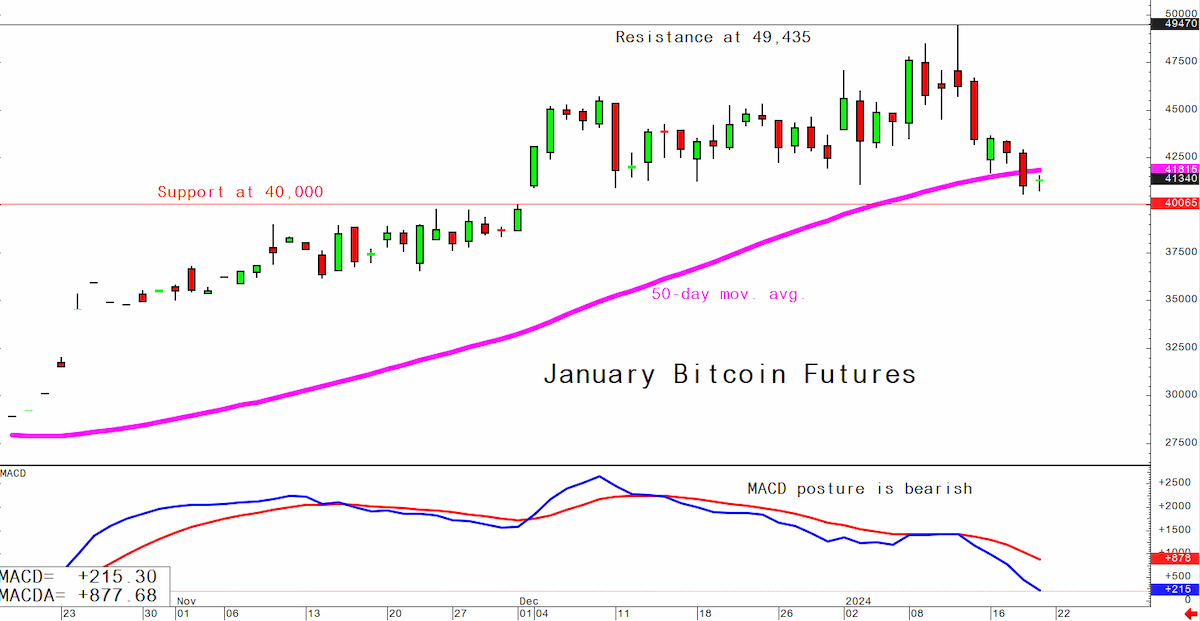
Bitcoin futures 1-day chart. Source: Kitco
“A price uptrend on the daily bar chart has stalled out,” Wyckoff warned. “The bears now have momentum on their side.”
History shows that Bitcoin has displayed weakness in the lead-up to a halving, and according to crypto analyst Benjamin Cowen, BTC could potentially decline by double-digit percentage points if it follows a pattern witnessed during the previous three halvings.
“In February of the halving year, Bitcoin has always tagged the bull market support band,” Cowen said in a YouTube video. “From the current levels, that would represent a substantial drop, about a 15% drop.”
The bull market support band is an indicator made up of the 20-week simple moving average and the 21-week exponential moving average, and is used to identify possible support levels for the price of Bitcoin during the bull market.
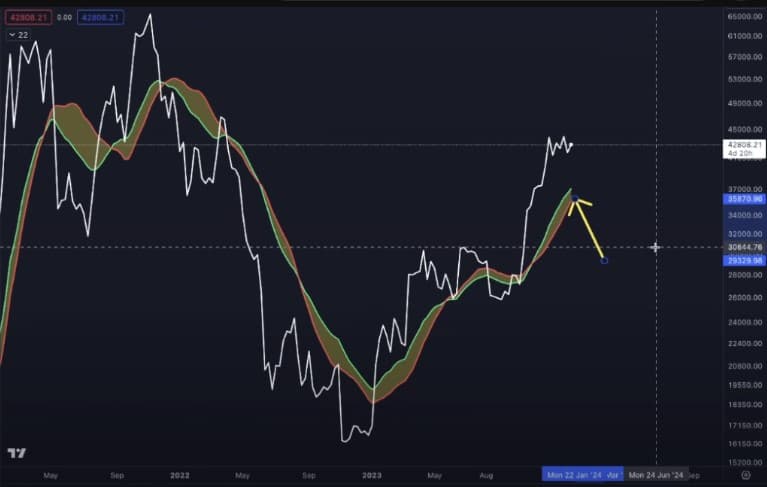
Cowen pointed to the U.S. economy as the determining factor in whether Bitcoin will fall to the support band, which is located near $37,000.
“In the case of 2012 [Bitcoin halving], and in the case of 2016, we held it [bull market support band] as support. But in the case of 2020, we did not hold it as support,” Cowen said. “We had the pandemic drop, we ended up having a recession where the unemployment rate went up a lot… If the economy holds up, then we might bounce off at that level. If the economy does not hold up and the Federal Reserve has pushed us into a recession, then it might not hold up.”
With Bitcoin and gold struggling to gain momentum to start the year while stocks climb to new record highs, Oaktree Capital Management co-founder Howard Marks thinks they both “lack intrinsic value,” and said investors should be in a high-yield bond fund instead.
“Gold is a little more tried and true, but it also lacks any kind of analytical raison d'etre,” Marks said in an interview on this week’s Merryn Talks Money podcast.
According to Marks, the investment environment has undergone a “sea change,” and the world won’t be returning to a regime of 0% interest rates anytime soon.
“Fixed income securities offer substantial yields today, and the return or yield on a fixed income security is virtually, by definition, safer,” Marks said when recommending what investors should consider instead of gold or BTC.
Mixed end of the week for altcoins
Altcoins closed the week mixed, with the top 200 tokens evenly split between winners and losers.
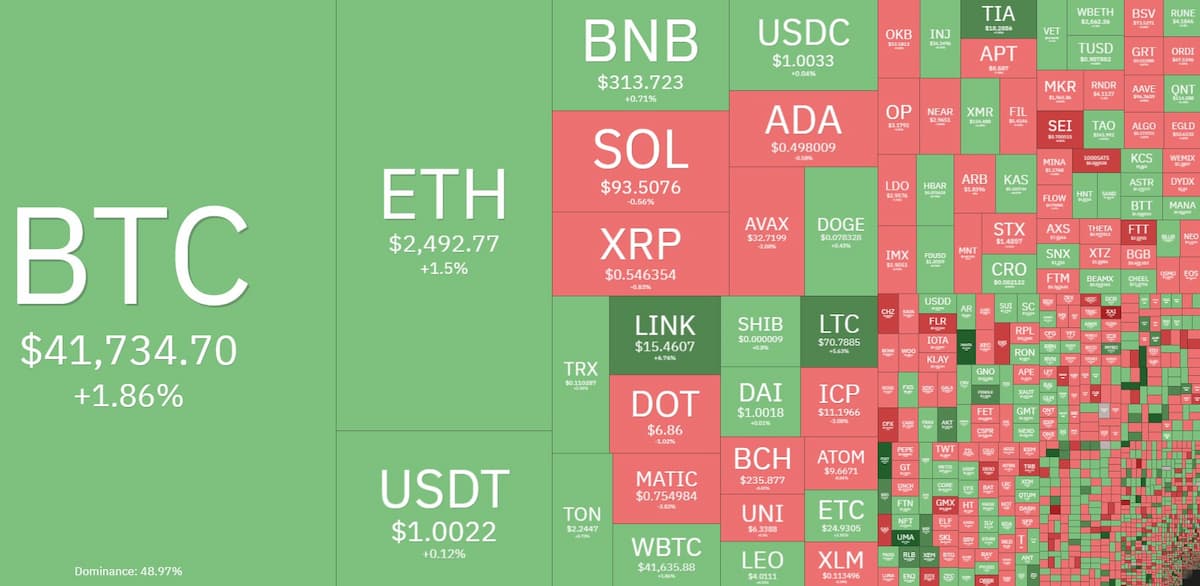
Daily cryptocurrency market performance. Source: Coin360
UMA (UMA) was the breakout performer of the day, increasing by 160% to trade at $5.16, while Manta Network (MANTA) climbed 17.5%, and Pendle (PENDLE) gained 14.7%. Conflux (CFX) recorded the biggest loss, declining by 13.3%, followed by Xai (XAI), which fell 13.2%, and Memecoin (MEME), which lost 8.3%.
The overall cryptocurrency market cap now stands at $1.64 trillion, and Bitcoin’s dominance rate is 49.9%.
