

(Kitco News) – Bitcoin's (BTC) price has shown signs of compression over the past couple of days, albeit with a hint of volatility, as King Crypto has traded in a range between $69,500 and $71,300 with the halving just a week away.
Data provided by TradingView shows that after trading near support at $70,800 in the early hours on Friday, BTC underwent a rapid 2.45% slide that saw it dip to $69,200, with Bears now attempting to take out the support level.
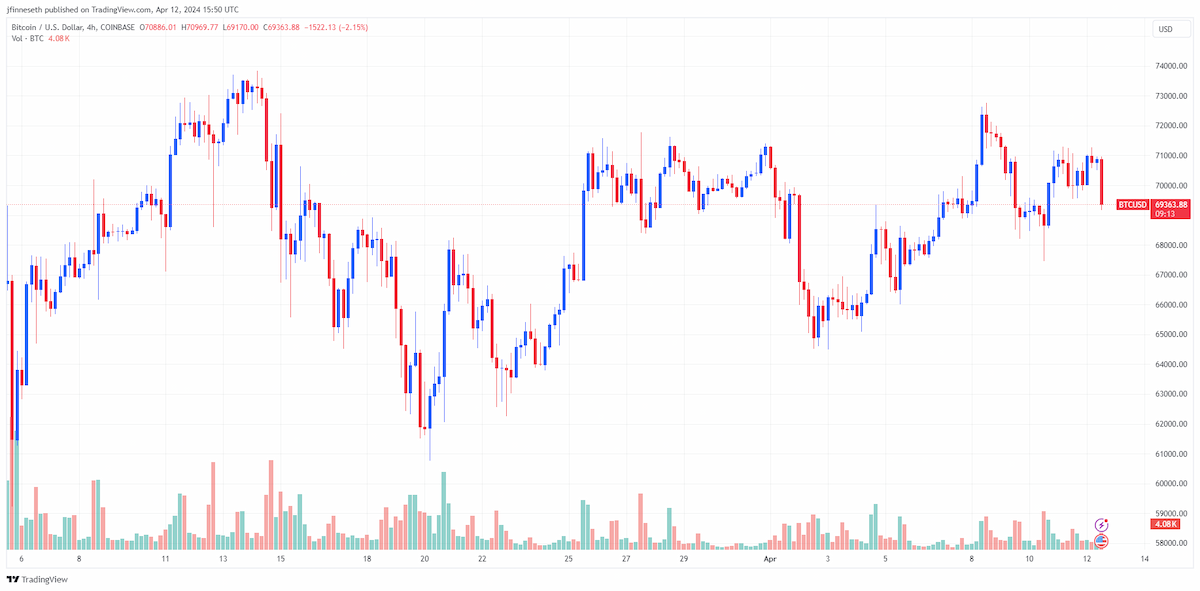
BTC/USD Chart by TradingView
“This week, the U.S. Consumer Price Index (CPI) was reported at 3.5%, exceeding expectations and triggering a sharp response across risk assets, alongside diminished expectations for three rate cuts within the year,” said analysts at Ryze Labs. “Bitcoin's price dipped to $67,500 but made a swift and strong recovery, crossing the $70,000 mark.”
“This recovery signals a robust risk-on sentiment as we approach the Bitcoin halving,” they added. “Despite anticipating some short-term market softness due to the upcoming tax season, we hold a positive long-term view, expecting relief as quantitative tightening slows and policies potentially adjust to facilitate U.S. government debt rollovers.”
Another metric pointing to rising bullish energy is an increase in stablecoins, which has often preceded a leg up in the market.
“In the last three months, the total supply of stablecoins has grown from 138 billion at the beginning of 2024 to 162 billion in April, largely due to increased issuance from Tether and Circle,” the analysts said. “This uptrend suggests positive structural support for the crypto ecosystem as liquidity inflows continue to rise.”
“Additionally, Ethena's launch of the delta-neutral stablecoin, USDe, last month has quickly expanded its supply to over 2 billion, highlighting the growing demand for stable and scalable crypto financial instruments,” they concluded.
Friday’s weakness comes despite accumulation activity from whales, who have been scooping up Bitcoins at every pullback, according to data shared by crypto analytic firm CryptoQuant.
“Demand growth from large #BTC holders is currently at its highest ever, with a month-over-month increase of 11%,” CryptoQuant tweeted.
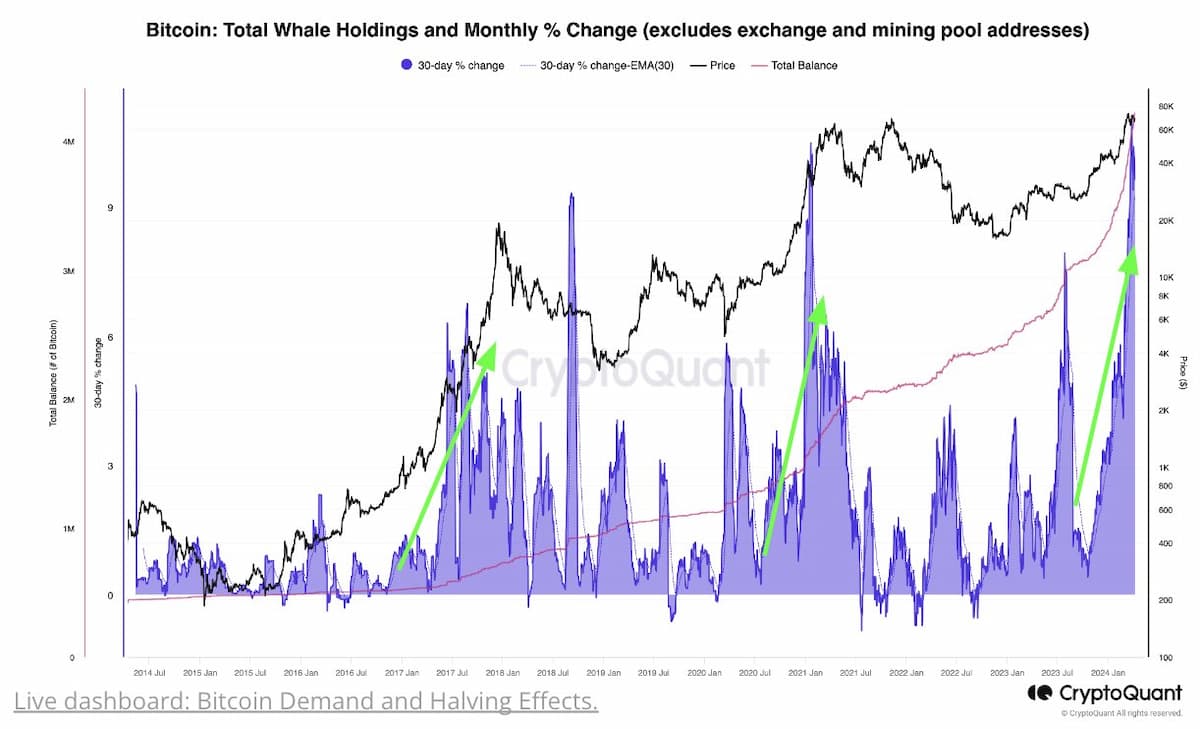
“#Bitcoin acquisition by permanent holders is substantially exceeding the new $BTC issuance, indicating a strong demand-side push,” they added.
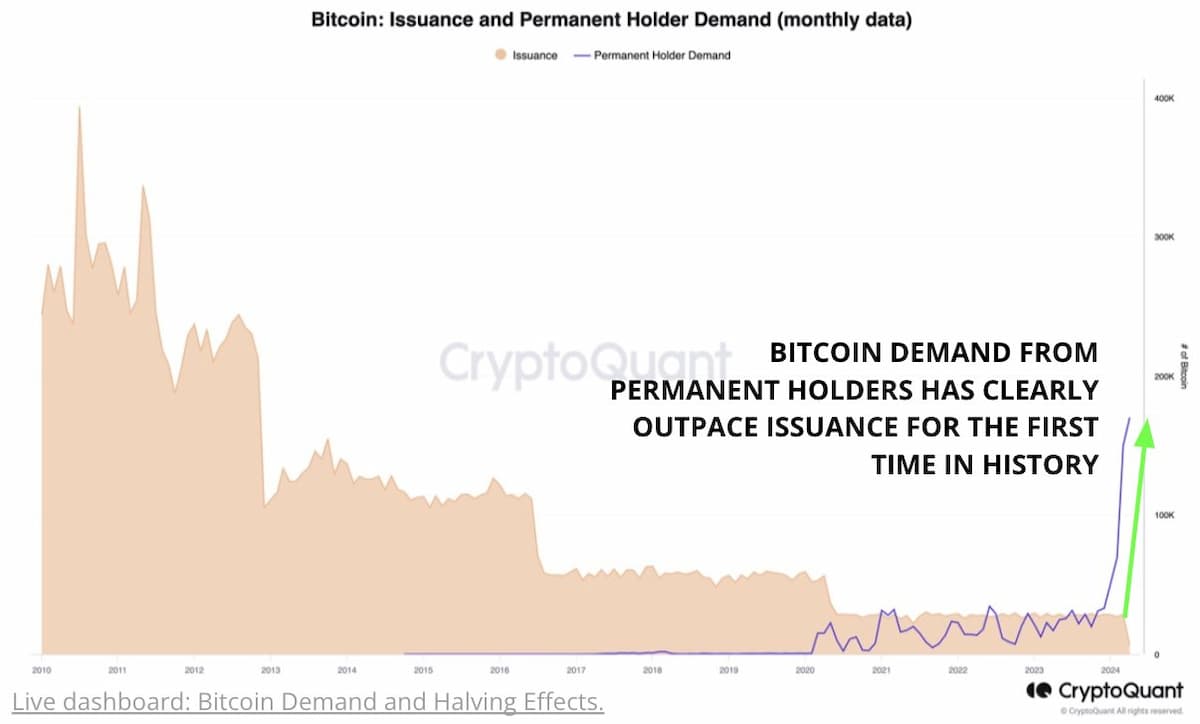
“The next Bitcoin halving shifts market dynamics significantly,” CryptoQuant said. “Increasing demand and permanent holder activity are becoming more influential than traditional supply cuts. The halving's effect on #Bitcoin prices is decreasing as $BTC's new issuance becomes less significant compared to selling from long-term holders.”
What comes after the halving?
With the halving expected to occur between April 19 and 20, the focus of the crypto ecosystem is on the effect the quadrennial reduction in new emissions will have on Bitcoin’s price, hashrate, and mining industry.
“Despite an immediate fall in total block reward in both Bitcoin and USD terms after a halving, previous rallies in the price of BTC have meant that the total block reward miners earn in USD terms recovers to pre-halving levels just months after each halving,” said Eamonn Gashier, founder and CEO of Block Scholes, in a note shared with Kitco Crypto. “We expect to see a drop in hash rate close to the average of 25% in the two weeks following this halving.”
“There will be 672 blocks after the halving – block 840,000 – before difficulty is adjusted, which is the shortest ever period of time miners have had to wait post halving,” he noted. “It will likely take at least a further 2,016 blocks before difficulty is adjusted to a level that fully compensates for lost revenue and begins to attract lost hashrate back to the network.”
“In the short term, we expect a more significant drop in hashrate following the halving that will take longer to recover from since this will be the largest dollar-denominated impact to miner revenue ever, plus miners will potentially have to wait a while for a significant difficulty adjustment,” Gashier said.
“In the long term, we expect hashrate to continue to grow exponentially, albeit at a slower pace, as miner rewards remain high and difficulty eventually adjusts to compensate for the lower block reward,” he concluded.
At the time of writing, Bitcoin trades at $69,350, a decrease of 0.7% on the 24-hour chart.
