

(Kitco News) – The highly anticipated Bitcoin (BTC) halving is now just two days away, and dedicated crypto fans are eager to get the quadrennial reduction in Bitcoin emissions behind them as halving periods are known to be volatile, and this cycle is no exception.
While halvings are tricky times in their own right, this year has been especially choppy amid a backdrop of rising geopolitical tensions, escalating conflicts, stubbornly high inflation, and a resurgence in the U.S. dollar as global investors seek a safe haven.
According to a report from CoinWire that looked at Google Trends data over the past year, the highest level of interest in the halving is found in Europe, led by the Netherlands, Slovenia, Switzerland, and Austria. Singapore is also in the top-five countries with the highest level of interest, while the US ranked 22nd in search interest on Bitcoin Halving, led by South and North Dakota.
The launch of spot BTC ETFs in the U.S., and the institutional adoption that came with it, has driven the high level of interest in the Bitcoin halving, CoinWire said.
“During the second halving, July 2016, the interest level stood at a modest score of 4, which then rose significantly to 51 in May 2020,” the report said. “However, the most recent data from April 2024 reveals a substantial spike, with the interest level reaching an impressive score of 100. This indicates a doubling of interest rates from 2020 to 2024, reflecting the growing curiosity and awareness surrounding Bitcoin halving.”
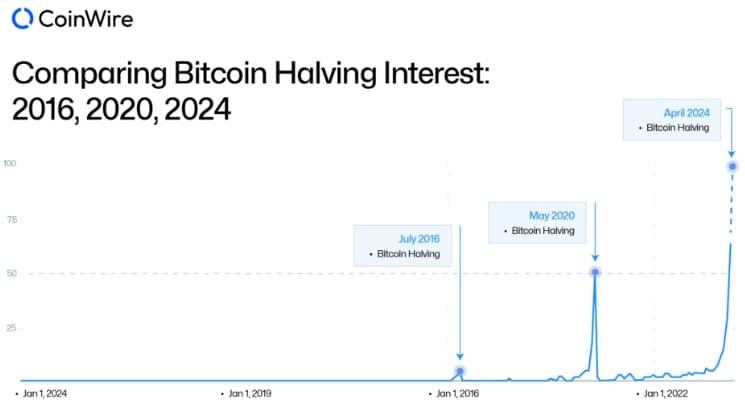
“The dominance of European countries, along with Singapore, indicates a potential shift in cryptocurrency hubs and investor focus,” CoinWire concluded. “Interestingly, while the United States remains a major crypto player, public interest in Bitcoin halving appears less concentrated compared to other regions. In coming years, as Bitcoin continues to mature, the role of halving in its price trajectory and overall adoption will be a crucial area to monitor for investors and enthusiasts alike.”
Price predictions
History shows that Bitcoin experienced a significant rally in the months that followed a halving, but with numerous headwinds coming from the macro landscape, analysts have warned that this cycle could play out differently.
"Historically, the previous three halvings have been accompanied by BTC price appreciation after the halving, although the time it took to reach the all-time highs differs significantly,” said analysts on Goldman Sachs’ Fixed Income, Currencies and Commodities (FICC) and Equities team. “Caution should be taken against extrapolating the past cycles and the impact of halving, given the respective prevailing macro conditions.”
Goldman cited the differences in the macroeconomic environment at the time of each halving as the reason caution is warranted, as the current high inflation and high-interest rate climate have reduced investor appetite for risk exposure.
The launch of multiple spot BTC ETFs also helped propel Bitcoin to a new all-time high 45 days before the halving, a feat never before achieved by King Crypto. This has led some analysts to conclude that a major portion of the usual post-halving surge has been brought forward, leaving the door open for a sell-the-fact pullback after the halving.
"Whether BTC halving will next week turn out to be a ‘buy the rumour, sell the news event’ is arguably less impactful on BTC’s medium-term outlook, as BTC price performance will likely continue to be driven by the said supply-demand dynamic and continued demand for BTC ETFs, which combined with the self-reflexive nature of crypto markets is the primary determinant for spot price action,” Goldman’s analysts concluded.
According to analysts at Bitwise, while the short-term response after the halving remains open to debate, the long-term effect on BTC price is clear.
“The data is limited but the picture reveals an intriguing pattern: The market prices in the short-term impact of the halving but underestimates the long-term impact,” Bitwise said. “The change in Bitcoin’s price in the month following the halving: 2012: 9%; 2016: -10%; 2020: 6%,” they noted. “The change in Bitcoin’s price in the year following the halving: 2012: 8,839%; 2016: 285%; 2020: 548%.”
“I think the market has underestimated the long-term demand for Bitcoin, for a number of reasons,” said Matt Hougan, Chief Investment Officer for Bitwise. “For instance, I don’t think the market fully appreciates the size of the opportunity in the ETF market once wirehouses and the rest of the roughly $60 trillion U.S. wealth management industry are able to allocate to Bitcoin ETFs, which could start to happen as early as Q3. I also don’t believe the market has fully factored in the extent to which rising concerns about inflation will drive significant allocations.”
The main question on the minds of investors relates to how long it will take for Bitcoin’s post-halving rally to manifest.
“Market participants tend to believe that the Bitcoin halving event ultimately results in exceptionally strong positive price action, due to supply shock,” said Rikke Staer, CEO of Coinify. “Yet there are insufficient data points to show any proof that the halving produces positive market results, with only three prior halving events, to make statistically significant claims about its impact on price.”
“Price reaction is typically not immediate, historically speaking, major post-halving growth occurs 6-18 months and larger price movements become statistically less likely with increasing market size,” she said. “The dramatic percentage gains observed in prior halvings might be difficult to replicate simply due to the sheer size of the Bitcoin market.”
Staer said there is a chance this halving could be a “buy the rumor, sell the news” event thanks to the arrival of “more sophisticated market participants and institutional investors in this market cycle.”
“If the halving cuts miner rewards in half, for less efficient miners, continuing operations might become unprofitable,” she added. “They might be forced to sell existing Bitcoin holdings to cover electricity costs, equipment maintenance, and other operational expenses.”
This could lead to further weakness, Staer warned. “A sudden influx of Bitcoin from miners selling to stay afloat could overwhelm existing buy orders and drive down the price. This can create a negative feedback loop, where lower prices force more miners to sell, further depressing the price.”
“During the early post-halving period, miners are expected to sell BTC. This has occurred during previous halvings,” said Kadan Stadelmann, Chief Technology Officer at Komodo, in a note shared with Kitco Crypto. “According to 10x Research, this sell-off might last four to six months after the halving, equaling as much as $5 billion worth.”
With the block reward set to decline to 3.125 BTC per block, many analysts are now debating whether the halving matters more than other factors – such as ETF demand – due to the low emission rate. Stadelmann said that while “subsequent halvings will have less impact on Bitcoin’s value, in 2024, the halving has a major impact.”
“If we look at the halving, it’s all about a change in supply and demand,” he said. “Although reducing the amount of new Bitcoin being mined is critical, demand from new investors presents one factor that is potentially even more important. What boosts demand? The short answer is a combination of Bitcoin ETFs making the market more accessible and rising interest from institutions entering the space.”
Based on its historical performance and the factors listed above, Stadelmann said “BTC may trade sideways for 3 months after the halving, due to sell-offs from miners.”
“However, across the longer term (i.e. 6 to 12 months), BTC price should increase if the historical post-halving trend repeats itself this cycle,” he added. “I expect this bull cycle to go strong through 2025, and would not be surprised to see it continue up from there with the institutional demand being seen so early.”
