

(Kitco News) – Volatility with little overall change continued to be the name of the game for cryptos in early trading on Thursday as Bitcoin’s (BTC) price chopped in a range between $66,224 and $68,463 following yesterday’s cooler-than-expected CPI and hawkish interest rate forecast from the Fed.
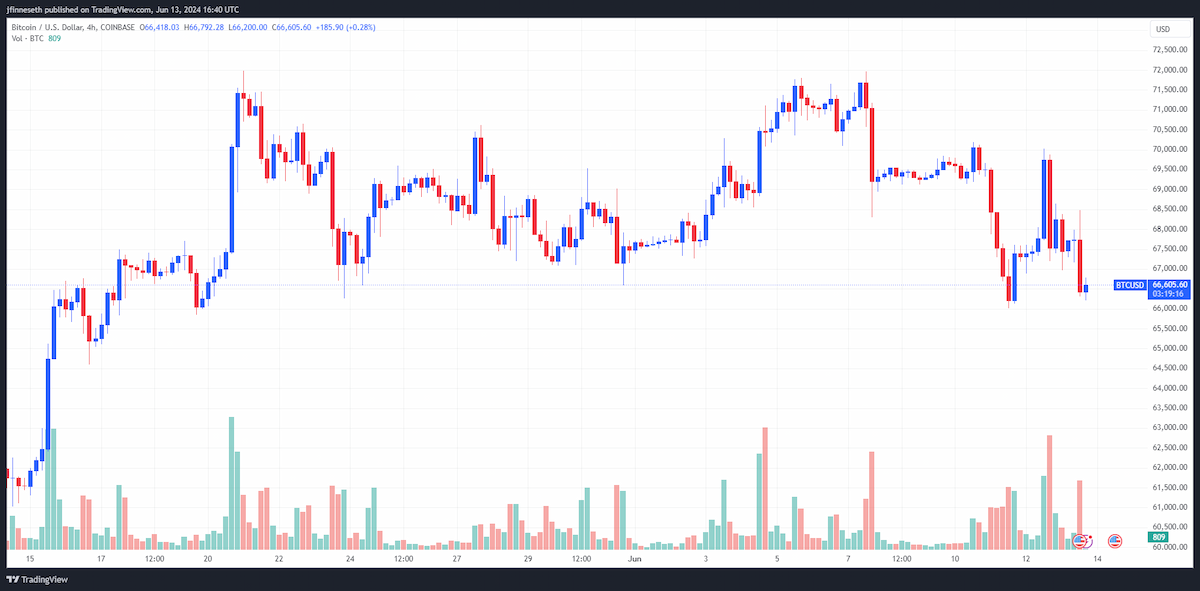
BTC/USD Chart by TradingView
Stocks opened higher after the producer price index for May dropped 0.2% month-over-month after rising 0.5% in April. This was the latest sign that inflation is easing, but its effect on the markets was short-lived as equity prices drifted lower near midday, with the S&P flat and the Dow down 0.65% at the time of writing, while the Nasdaq struggled to hold a gain of 0.13%.
“Bitcoin has demonstrated remarkable stability recently, holding steady above $67,000,” said analysts at Secure Digital Markets. “With the stock market reaching record highs, it is anticipated that Bitcoin may soon follow suit. However, we should be prepared for some short-term resistance around $70,000, with the more substantial barrier being at $72,000.”
Analyst and trader Nicholas Merten interpreted Bitcoin’s recent price action differently, alerting his YouTube followers that several warning signs are pointing to a Bitcoin downturn.
“I think there are some significant warning signs that people are ignoring right now,” he said. “There’s a lot of complacency in the market and a lot of people are not prepared for a major flush down that could very well play out here over the next week or two.”
The warning from Marten relates to the resistance levels that analysts at Secure Digital Markets highlighted.
“Every single time we’ve come up here towards around $71,500 to around $72,500, this has been a range where we constantly get shot down,” he said.
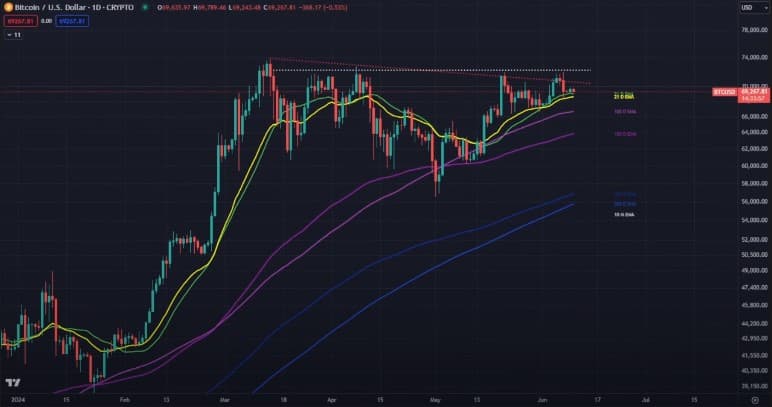
Marten said the repeated rejection at this level – which sits just below Bitcoin’s all-time high – indicates the presence of heavy selling pressure.
“It is showcased that over the last 3 months, we have been basically ranging at the same price range… this is the previous all-time high range back in the past… around $69,000, which is where we peaked out last time in 2021,” he said. “And we have treaded at that all-time high from the prior cycle for over three months here since back in March of this year. That is the longest, by a long shot, the longest period of time we have consolidated at a prior all-time high from the previous bull market.”
He said this is “a very big warning sign here that there are tons of whales – it’s not one player, most likely it’s probably a lot of participants in the market – who are offloading positions here, taking advantage of that ability to sell at a much higher price range.”
While the short-term looks bearish based on Marten’s analysis, market analyst Rekt Capital helped provide some context, posting a chart that shows Bitcoin is only halfway through the typical post-halving weakness period, and suggesting that the next breakout higher could come in September.
#BTC
If history repeats, a Bitcoin breakout from the Re-Accumulation Range would occur in September 2024$BTC #Crypto #Bitcoin pic.twitter.com/wRUJABBRy8— Rekt Capital (@rektcapital) June 8, 2024
At the time of writing, Bitcoin trades at $66,664, a decrease of 4.13% on the 24-hour chart.
Interest rates and debt printing
At the conclusion of its policy meeting on Wednesday, Fed Chair Powell said they anticipate only one rate cut in 2024, down from the three that the central bank forecasted in March. “Dot plot” projections from the 19 Federal Open Market Committee members showed that four officials opted for no cuts this year, while seven projected one reduction and eight forecasted two rate cuts in 2024.
Thursday morning saw Treasury Secretary Janet Yellen attempt to calm rising fears about rising debt from non-stop printing.
"If the debt is stabilized relative to the size of the economy, we're in a reasonable place," she told CNBC's Andrew Ross Sorkin. “The way I look at it is that we should be looking at the real interest cost of the debt. That's really what the burden is.”
Net interest costs on the U.S. debt have totaled $601 billion thus far in the fiscal year 2024, more than what the government has spent on health care or defense and more than four times what has been set aside for education.
According to the latest report from the Congressional Budget Office (CBO), rising national debt will slow economic growth and reduce projected incomes. The CBO found that when compared to a scenario with stable debt-to-GDP, it is estimated that “Rapidly rising debt could reduce income growth by 33 percent over the next three decades and 42 percent annually by FY 2049.”
They also determined that “Rapidly rising debt would reduce projected income by about $14,500 per person in FY 2054, in today’s dollars.”
Other reports from the CBO have warned that the public share of the national debt – currently about $27.6 trillion – will hit a new record as a share of the total economy over the next decade. The public share of the national debt as a share of GDP currently stands at 97% but is expected to surpass 100% if the current spending rates continue.
CBO also projects that rising debt will slow output growth and boost interest rates. “Over the long term, CBO projects real GDP will grow about 1.2 percent per year with rapidly rising debt, compared to 1.8 percent per year with stable debt – leading to an 8 percent reduction in output by FY 2054,” the Committee for a Responsible Federal Budget said.
“Meanwhile, the average interest rate on federal debt is projected to rise to 4.8 percent with rising debt, compared to 3.6 percent with stable debt,” they added. “The gap for interest rates on new debt is likely to be significantly higher than that, flowing through to higher mortgage, car loan, and business loan interest rates.”
“To secure strong income and economic growth and keep interest rates low, policymakers should work to stabilize the debt and put it on a downward path, rather than enacting further deficit-financed tax cuts and spending increases,” they concluded.
