
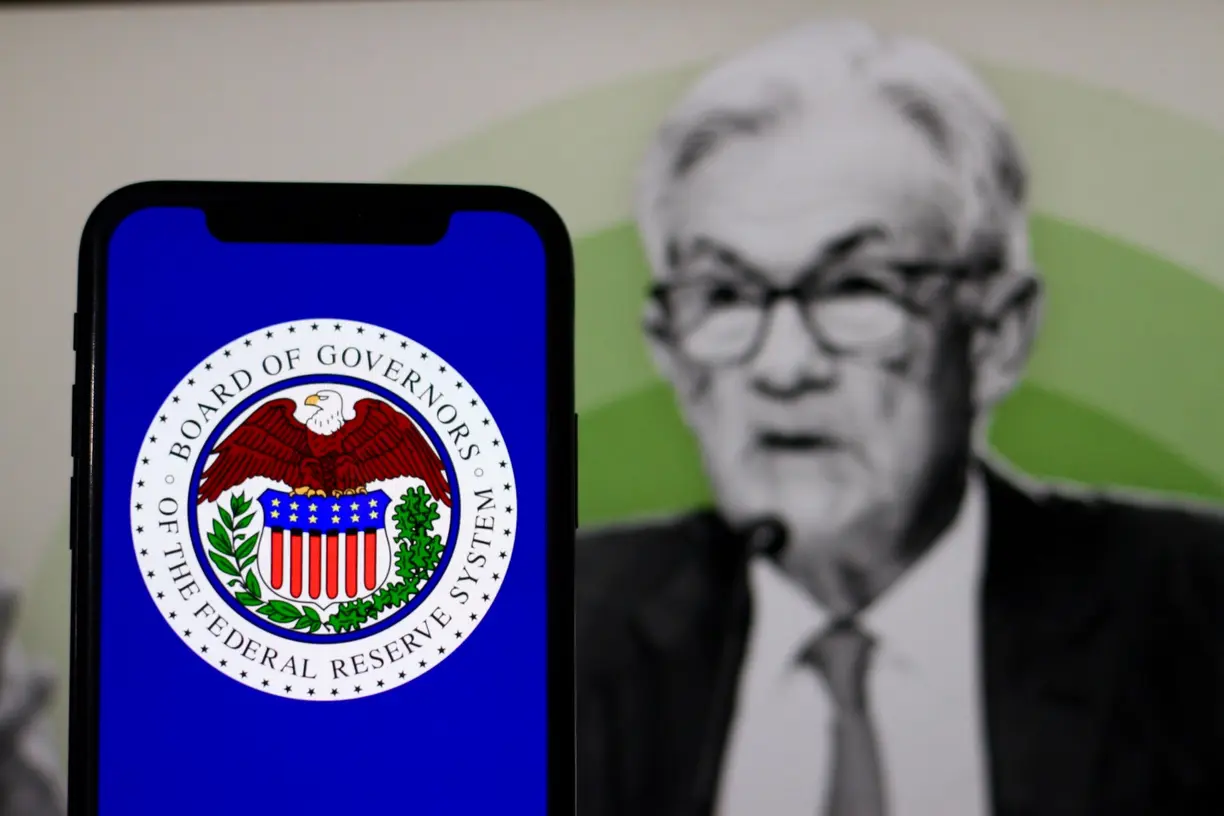
(Kitco News) – Federal Reserve Chair Jerome Powell testified before the U.S. Senate Committee on Banking, Housing, and Urban Affairs in Washington, D.C. on Tuesday morning, and apart from some testy exchanges with members from both parties, his words served to reinforce the messaging from the June FOMC meeting, including the perceived easing bias toward the fed funds rate.
“The Federal Reserve remains squarely focused on our dual mandate to promote maximum employment and stable prices for the benefit of the American people,” Powell said in his opening remarks. “Over the past two years, the economy has made considerable progress toward the Federal Reserve's 2 percent inflation goal, and labor market conditions have cooled while remaining strong. Reflecting these developments, the risks to achieving our employment and inflation goals are coming into better balance.”
Powell was there to present the Federal Reserve's semiannual Monetary Policy Report, which summarized the central bank’s views on the economy and the role of monetary policy going forward.
In his review of the current economic situation, the Fed Chair said that recent indicators suggest that “the U.S. economy continues to expand at a solid pace” with GDP growth appearing to have moderated in H1 2024 following the unexpected strength in the second half of 2023.
On the labor market, Powell told the committee that “a broad set of indicators suggests that conditions have returned to about where they stood on the eve of the pandemic: strong, but not overheated.” He noted that the jobs-to-workers gap “is well down from its peak and now stands just a bit above its 2019 level,” while nominal wage growth has eased over the past year. “The strong labor market has helped narrow long-standing disparities in employment and earnings across demographic groups,” he added.
Regarding inflation, the Fed Chair said that following “a lack of progress toward our 2 percent inflation objective in the early part of this year, the most recent monthly readings have shown modest further progress” while “Longer-term inflation expectations appear to remain well anchored, as reflected in a broad range of surveys of households, businesses, and forecasters, as well as measures from financial markets.”
Powell then addressed the Federal Reserve’s stance on monetary policy, telling the committee that the FOMC’s actions “are guided by our dual mandate to promote maximum employment and stable prices for the American people,” and said that their restrictive monetary policy stance “is helping to bring demand and supply conditions into better balance and to put downward pressure on inflation.”
He also reiterated that FOMC members do not expect to cut the federal funds target rate until “we have gained greater confidence that inflation is moving sustainably toward 2 percent.”
“Incoming data for the first quarter of this year did not support such greater confidence,” Powell said. “The most recent inflation readings, however, have shown some modest further progress, and more good data would strengthen our confidence that inflation is moving sustainably toward 2 percent.”
The Fed Chair also emphasized that the FOMC would continue to make decisions on a meeting-by-meeting basis “after carefully assessing incoming data and their implications for the evolving outlook, the balance of risks, and the appropriate path of monetary policy.”
One of the first questions Powell faced was from the Committee’s Chairman, Sen. Sherrod Brown (D-OH), who asked how the Fed can ensure that they don’t overshoot their target by keeping rates too high for too long and cause an “unnecessary recession.”
“The most recent labor market data do send a pretty clear signal that labor market conditions have cooled considerably compared to where they were two years ago,” Powell replied. “This is no longer an overheated economy, this is an economy that is more or less back, by most measures, to where it was before the pandemic. That was a strong labor market, but it was not an overheated labor market.”
Powell said that FOMC members are aware that they now face two-sided risks. “If we loosen policy too late or too little, we could hurt economic activity,” he said. “If we loosen policy too much or too soon, then we could undermine the progress on inflation, so we're very much balancing those two risks.”
While he refused to offer a timeline for changes to the target rate, he did concede that “the direction seems to be going towards lowering interest rates at some point.”
“I think if you look at the last summary of economic projections, it doesn't seem likely that the next policy move would be a rate increase,” he added. “We don't take things like that off the table, but that does not seem the likely direction. The likely direction does seem to be, as we make more progress in inflation, and as the labor market remains strong, we begin to loosen policy at the right moment.”
Powell was also questioned about the Basel III banking framework, promising to ensure that the amended proposal would be opened to a sufficiently long period of public comment.
“My view, and the strongly held view of some of my colleagues on the board, is that it will be appropriate for us to put out the changes again for a period of comment, just because it's the right thing to do,” he said. “It's what we would do typically in a situation where there are material changes to a proposed rule.”
When pressed by Sen. Mike Rounds (R-SD) on when the updated proposal would be ready for review, Powell offered a likely timeframe of early 2025. “It's hard to be precise,” he said. “It takes some time to write this stuff up, then you put it out for comment, then you get the comments, then you read the comments, then you write the final rule. Beginning part of next year is a good guesstimate.”
Stephen Brown, Deputy Chief North America Economist at Capital Economics, said Powell’s remarks offered few clues about the potential timing of interest rate cuts.
“That said, the neutral tone of the opening statement seems at odds with the softer tone of the recent activity data, so our sense is that a September interest rate cut remains very much in play,” he said.
“Powell notes that ‘recent indicators suggest that the U.S. economy continues to expand at a solid pace’, the same line used in the minutes of the June FOMC meeting,” Brown noted. “The repetition of that line is somewhat surprising given the softer activity data released since then, with the Atlanta Fed GDPNow for second-quarter GDP growth at just 1.5%, only marginally better than first-quarter growth of 1.4%. Powell does not seem overly concerned by the rise in the unemployment rate to 4.1% in June either, which he described as ‘still at a low level’, but he does note that ‘in light of the progress made both in lowering inflation and in cooling the labor market over the past two years, elevated inflation is not the only risk we face. Reducing policy restraint too late or too little could unduly weaken economic activity and employment.’”
“In short, there are some tentative signs that the Fed is becoming more attuned to the downside risks of tight policy to the economy and labour market,” Brown said. “We continue to expect two 25 bp cuts this year, in September and December.”
