
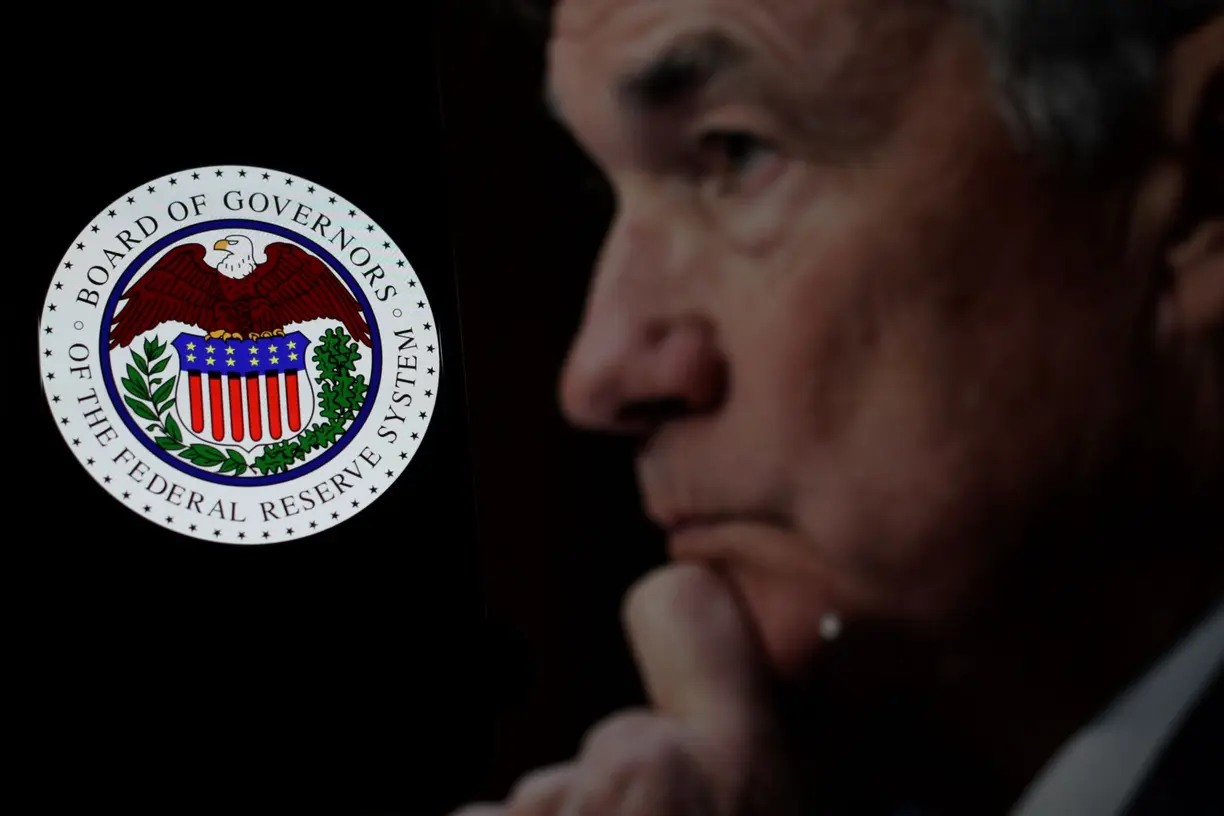
(Kitco News) – After the FOMC voted unanimously to keep the benchmark rate unchanged at today’s meeting, Federal Reserve chair Jerome Powell’s press conference saw him walk the tightrope between market expectations of a September interest rate cut and the central bank’s need to keep all options open, and between the central bank’s apolitical mandate and the pressures of an election year.
The first question Powell fielded from reporters was the one on everybody’s mind since markets first set the odds of a September rate cut at 100%: Would there be a cut at the next meeting, and if so, why not just cut today?
“On September, let me say this: We have made no decisions about future meetings,” Powell said. “That includes the September meeting. The broad sense of the committee is that the economy is moving closer to the point at which it will be appropriate to reduce our policy rate. In that, we will be data dependent, but not data-point dependent. It will not be a question of responding specifically to one or two data releases.”
The Fed chair reiterated that the decision would be made based on whether “the totality of the data, the evolving outlook, and balance of risks are consistent with rising confidence and maintaining a solid labor market.”
“If that test is met, the reduction of the policy rate could be on the table as soon as September,” he said.
As for why the FOMC chose not to cut today, Powell said it was too early in the estimation of the FOMC members. “The broad sense of the committee is we're getting closer to the point at which it will be appropriate to reduce our policy rate,” he said. “They were not quite at that point yet.”
While the Fed chair refused to commit to a specific date or trigger for the start of the central bank’s easing cycle, he shared some potential scenarios.
“If we were to see inflation moving down quickly, or more or less in line with expectations, growth remains reasonably strong, and the labor market remains consistent with its current condition, then I would think that a rate cut could be on the table at the September meeting,” Powell said. “If inflation were to prove stickier and we were to see higher rates of inflation, and disappointing readings, we would weigh that along with the other things.”
“I think it is going to be not just any one thing,” he added. “It is going to be the inflation data, the employment data, it is going to be the balance of risks as we see it. It is going to be the totality of all of that to help us make the decision.”
Powell said that today’s hold in the benchmark rate was not an indication that the Fed lacks confidence that inflation is returning to 2 percent.
“It’s just a question of seeing more good data,” he said. “The last couple of readings have added to confidence. We've seen progress across all three categories of core PCE inflations, goods, non-housing services, and housing services. We had a quarter of poor inflation data at the beginning of the year. Then we saw some more good inflation data.”
“We did gain confidence,” Powell emphasized. “More good data would cause us to gain more confidence.”
One reporter pointed out that the March Summary of Economic Projections (SEP) suggested multiple cuts, and since the inflation data had improved and the labor market had cooled since the June meeting, asked whether the March rate path would be the best guide for policy rather than the one cut indicated in the June SEP.
“The path ahead is going to depend on the way the economy evolves,” Powell said. “I can't really give you any better forward guidance on it than that. We didn't do an SEP at the meeting. We'll do another one at the September meeting. I can imagine the scenario in which there would be everything from zero cuts to several cuts, depending on the way the economy evolves. And I wouldn't want to lay out a baseline path for you there today.”
Powell was asked whether he believes inflation is now back on the positive track of H2 2023 after a few bumpy months at the start of 2024.
“Actually, what we're seeing right now is better than last year,” he replied. “A whole lot of the progress from last years was goods prices, which were going down at an unsustainable rate. This is a broader disinflation. This has goods prices coming down, and we're also now seeing progress in the other two big categories, non-housing services and housing services.”
“It doesn't look like an overheating economy,” he added. “It looks like an economy that's normalized.”
Later on, the Fed chair was challenged on whether the FOMC planned to remain apolitical about a September rate cut.
“I absolutely do,” he said. “First of all, we haven't made any decisions about the future meetings. I don't know what the data will reveal or how it will affect the path. I know how we'll make the assessment.”
“Congress has ordered us to conduct our business in a non-political way at all times, not just some of the time,” he continued. “We never use our tools to support or oppose a political party, a politician, or any political outcome.”
“This is my fourth presidential election at the Fed,” Powell said. “I can tell you this is how we think about it. This is what we do. Anything that we do before, during, or after the election will be based on the data, the outlook, and the balance of risks and not on anything else.”
Powell was then asked whether the Fed’s economic forecasts and models account for the very different economic plans of presidential candidates Kamala Harris and Donald Trump.
“No, we do not do that,” he replied. “We don't know who is going to win, we don't know what they are going to do, we don't act as though we know. We can't do that.”
“We can run simulations of different potential policies,” Powell said. “We would never try to make policy decisions based on the outcome of an election that hasn't happened yet. That would just be a line we would never cross. We are a non-political agency. We don't want to be involved in politics in any way.”
The Fed chair was pressed on discussions surrounding today’s hold and the possibility of a September cut.
“People expressed their views about this,” he said. “People have different ways of thinking about the economy. There's a range of perspectives.”
“There was a unanimous decision,” Powell said. “At the end, everyone supported the outcome, not just the voters, but everyone.”
“We think the time is approaching,” he added. “If we get the data that we hope we get, a reduction of the policy rate could be on the table at the September meeting.”
Powell was asked whether he believes the chances of a hard landing have increased.
“I don't know whether they've increased,” he said. “They are low. You don't see a reason to say the economy is overheating or sharply weakening, that's not in the data right now. What's in the data right now is an economy that's growing at a solid pace, a labor market that has cooled off, but nonetheless, unemployment is low. It is neither an overheating economy nor is it a sharply weakening economy. It is what you would want to see.”
The final question related to the potential issuance of a central bank digital currency (CBDC), and Powell was quick to quash any speculation on that front.
“It is not something that comes up at all in the FOMC,” he said. “We have people who are researching [digital finance] and try to keep up to speed. We play an important role in the payments sector, both as a convener and an operator too.”
“In terms of a CBDC, there's not much new going on at all,” he said. “We don't have the authority to issue a retail CBDC that's available to the public, and we're not seeking that authority. What we're doing is keeping up with developments. We're just evaluating the story and what's happening out there. It is work that we need to be doing which could be very beneficial down the road.”
“On the CBDC, we don't have any plan,” he added. “We would need to go to Congress. We have no plan to do that. No one here has decided we think it is a good idea yet.”
