

(Kitco News) – Recession fears have spiked in recent weeks amid deteriorating economic conditions and persistently high inflation, and for Canadians, the pinch in the pocketbook is only exacerbated by high taxes, with one report showing that in 2023, the average Canadian household spent 43% of its income on taxes alone.
“The Canadian tax system is complex and there is no single number that can give us a complete idea of who pays how much,” the Fraser Institute said in its recent report titled Taxes versus the Necessities of Life: The Canadian Consumer Tax Index 2024 edition. “That said, the Fraser Institute annually calculates the most comprehensive and easily understood indicator of the overall tax bill of the average Canadian family: Tax Freedom Day.”
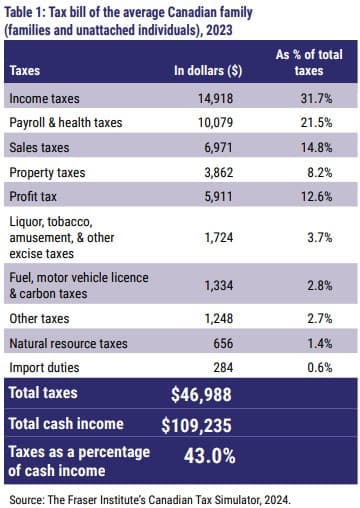
“In 2023, the average Canadian family, including both families and unattached individuals, earned cash income of $109,235 and paid total taxes equaling $46,988,” report authors Jake Fuss and Callum MacLeod wrote. “In other words, the total tax bill of the average Canadian family in 2023 amounted to 43.0% of cash income.”
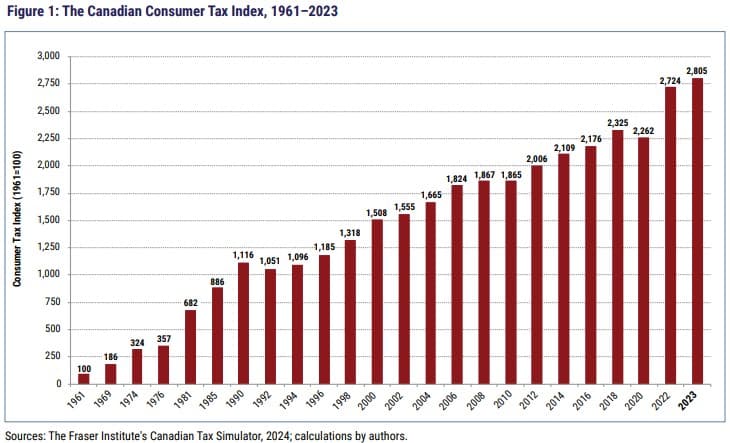
The report highlighted the Canadian Consumer Tax Index, which tracks the total tax bill paid by a Canadian family with an average income.
“The ‘consumer’ in question is the taxpaying family, which can be thought of as consuming government services,” the authors said. “Much like the Consumer Price Index calculated by Statistics Canada, which measures the average price that consumers pay for the goods and services that they buy of their own choice, the Canadian Consumer Tax Index measures the price of goods and services that government buys on behalf of Canadians.”
“The Canadian Consumer Tax Index thus answers the following question: How has the tax burden of the average family changed since 1961, bearing in mind that the average family has itself changed in that period?” they said. “In 1961, the average Canadian family earned an income of $5,000 and paid $1,675 in taxes (33.5%). In 2023, the average Canadian family earned an income of $109,235 and paid a total of $46,988 in taxes (43.0%).”
To obtain the Canadian Consumer Tax Index, the tax bill of an average Canadian family is divided by the average tax bill of an average family in 1961 and then multiplied by 100 for each of the years included in the index.
“The Canadian Consumer Tax Index has a value of 100 in 1961; in subsequent years, values reflect the percentage increase over the 1961 value,” the report said. “The value of the Canadian Consumer Tax Index for 2023 is 2,805 (Figure 1), which indicates that the tax bill of the average Canadian family has increased by 2,705% since 1961.”
“Part of that increase reflects the effects of inflation,” Fuss and MacLeod said. “In order to eliminate the portion of the increase that is due to the erosion of purchasing power, we also calculate the tax index in real dollars, that is, in dollars with 2023 purchasing power. While this adjustment has the effect of reducing the steepness of the index’s path over time, the inflation-adjusted Consumer Tax Index nevertheless increased by 180.3% over the period.”
As for what has contributed to the increase, the authors said “The interaction of a number of factors has produced the dramatic increase in the average family’s tax bill from 1961 to 2023.”
“Among those factors is, first, a sizeable increase in incomes over the period: 2,085% since 1961,” they said. “Even with no changes in tax rates, the family’s tax bill would have increased substantially; growth in family income alone would have produced an increase in the tax bill from $1,675 in 1961 to $36,599 in 2023.”
“Second, the average family faced a tax rate increase from 33.5% in 1961 to 43.0% in 2023,” they added.
Making matters worse is the fact that the government has been using debt to pay for rising costs.
“The federal and provincial governments have reverted to deficits to finance their expenditures in recent years, especially during and coming out of the COVID-19 pandemic,” the authors said. “Of course, these deficits must one day be paid for by taxes. Deficits should therefore be considered as deferred taxation.”
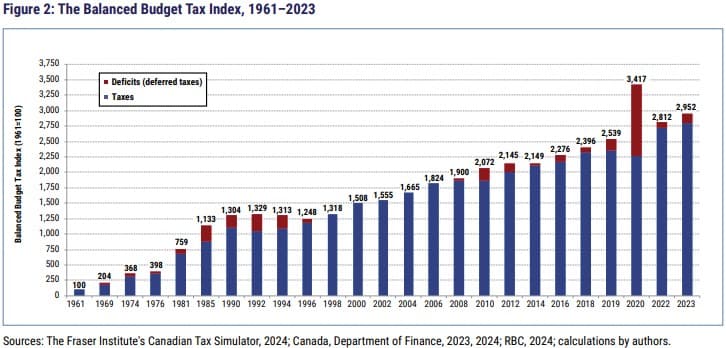
“Figure 2 shows what the Canadian Consumer Tax Index looks like when the annual deficits of governments are added to the tax bill,” they said. “The total tax bill of the average family would be much higher than it actually is if, instead of financing its expenditures with deficits, all Canadian governments had simply increased tax rates to balance their budgets.”
“Indeed, the Canadian Consumer Tax Index would have increased to 2,952 if deferred taxation was added to the average family’s total tax bill,” they noted. “Once deferred taxes are included, the tax bill of the average Canadian family has increased by 2,852% since 1961.”
The Fraser Institute found that the cost of taxes for the average Canadian family now surpasses the cost of basic expenditures, including food, shelter, and clothing.
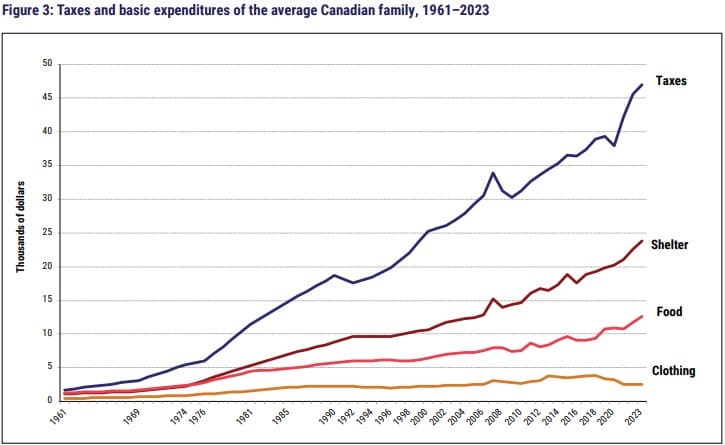
“It is clear that taxes have become the most significant item in family budgets, and that taxes have grown more rapidly than any other single item,” the report said. “In 1961, the average family spent 56.5% of its cash income to pay for shelter, food, and clothing. In the same year, 33.5% of the family’s income went to governments as tax.”
“By 1981, the spending demands had roughly evened up: 40.8% of an average family’s income went to governments in the form of taxes, while 40.5% was spent to provide it with shelter, food, and clothing,” the authors noted. “After crossing paths again in 1992, the situation in 2023 is quite different from 1961: the average family spent 35.6% of its income on the necessities of life while 43.0% of its income went to taxes.”
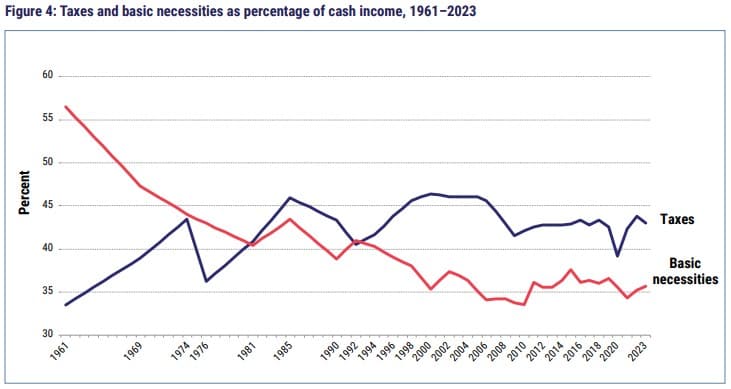
“Figures 3 and 4 show a sharp drop-off in the tax bill in 2020 due to the COVID-19 pandemic,” they said. “Declining tax revenues and an increase in family incomes produced an anomaly in 2020 that caused the tax bill to drop temporarily. The years following have seen the tax bill increase and exceed pre-COVID levels as government revenues rebounded and the economy has since recovered.”
The study found that while the average cash income rose by 2,085% from 1961 to 2023, “overall consumer prices rose by 901%, expenditures on shelter by 2,006%, food by 901%, and clothing by 478%. Meanwhile, the tax bill of the average family grew by 2,705%.”
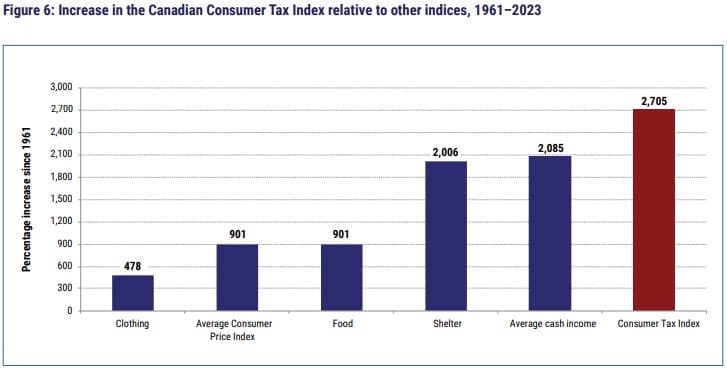
“The Canadian Consumer Tax Index tracks the total tax bill paid by a Canadian family with average income from 1961 to 2023. The results show that the tax burden faced by the average Canadian family has risen compared with 62 years earlier,” the report concluded. “The total tax bill, which includes all types of taxes, has increased by 2,705% since 1961, and the tax bill has grown more rapidly than any other single expenditure item.”
