

(Kitco News) – Asset prices struggled to gain their footing on Wednesday as traders adopted a cautious approach to investing amid the escalating Israel-Iran tensions, which have magnified worries about a wider Middle East conflict.
“Iran launched approximately 200 ballistic missiles at Israel on Tuesday, intensifying geopolitical tensions as Israeli Prime Minister Benjamin Netanyahu pledged a strong counterstrike,” noted analysts at Secure Digital Markets. “This escalation followed a series of Israeli attacks on Lebanon in recent weeks.”
“Bitcoin (BTC) reacted sharply to the development, posting its largest decline in over a month, with intraday losses reaching as high as 6% and 24-hour declines settling around 4%,” they added. “This marks the worst start to October for an asset that typically experiences bullish momentum during this period.”
It’s been a different story for spot gold, which has seen “an uptick as investors sought safe-haven assets,” the analysts said. And while the yellow metal has seen a slight pullback on Wednesday amid profit-taking, down 0.19% and trading at a price of $2,658.90/oz at the time of writing, the flight to safety could soon return as Israel has threatened to retaliate.
“Polymarket traders are currently assigning a 49% probability that Israel will retaliate against Iran before the week concludes,” Secure Digital Markets analysts said. “Israel has vowed a decisive response to Iran’s missile assault on Tel Aviv, leaving the region on high alert. With Iran accounting for 4% of global oil production, any further escalation could impact oil markets, which are already trading higher.”
The trepidation about a further escalation was reflected in the stock market, which “briefly rallied after the ADP payroll report revealed 143,000 new jobs in September, surpassing expectations of 124,000, a sign of resilience in the labor market amid broader economic concerns.” But the rally was short-lived, and the major indices spent the day oscillating between positive and negative territory.
“The Volatility Index (VIX), Wall Street's key fear gauge, is hovering around 19, reflecting the rising anxiety among market participants,” the analysts noted. “Traders are closely watching how these geopolitical dynamics will shape the risk landscape in the coming days.”
At the close of markets, the Dow and Nasdaq finished in the green, up 0.09% and 0.08%, respectively, while the S&P was flat.
Data provided by TradingView shows that Bitcoin bulls attempted to initiate a turnaround in the price action, pushing King Crypto to a daily high of $62,400 in the afternoon. However, bears harnessed rising fears to pound it back below $61,000, initiating a retest of support at $60,000.
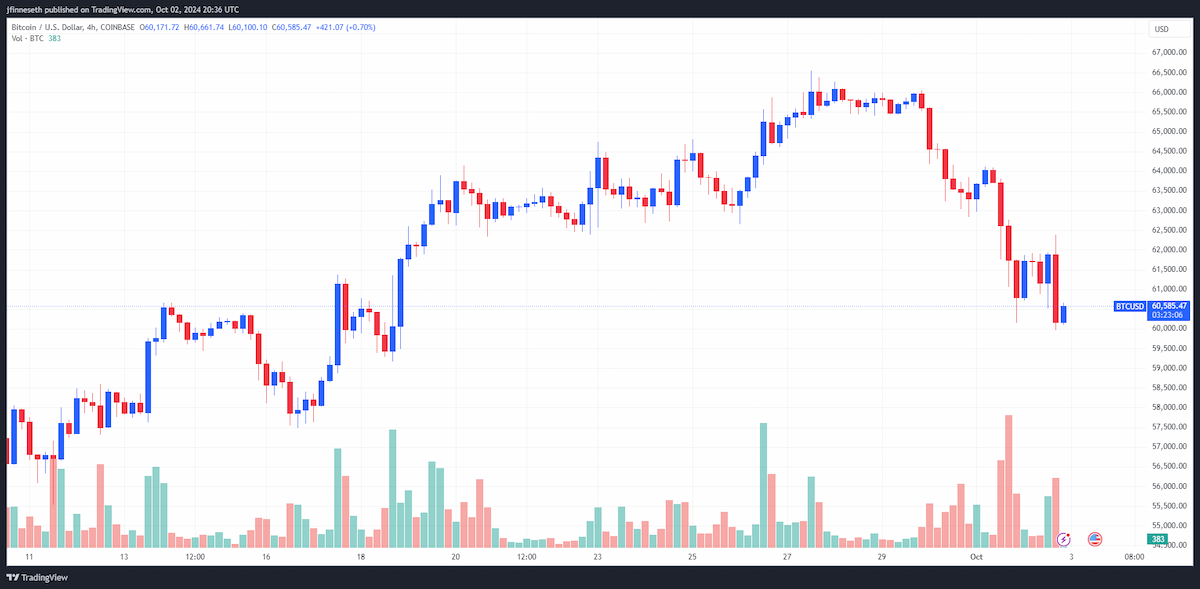
BTC/USD Chart by TradingView
Short-term Bitcoin holders have worked in the bear's favor, with Secure Digital Markets analysts noting that these non-hodlers “liquidated $3 billion in assets at a loss, with total liquidations exceeding $450 million in the past 24 hours.”
U.S.-listed Bitcoin ETFs have also suffered, experiencing “outflows totaling $242.6 million, the largest since early September, on trading volumes hitting $2.53 billion, the highest since late August,” the analysts said. “Ethereum (ETH) ETFs, however, saw more modest outflows of $48.6 million, marking the smallest decline over the past week.”
At the time of writing, Bitcoin trades at $60,622, an increase of 0.51% on the 24-hour chart.
‘Uptober’ in question
Heading into the month of October, crypto proponents were flying high as Bitcoin recorded its best September on record, leading many to declare that ‘Uptober’ would see King Crypto rally to new highs. But the Middle East conflict has risked derailing the bull train as investors move to de-risk at the prospect of a wider war.
“What this ‘Uptober’ calls into question is whether Bitcoin is truly a safe-haven asset,” said Aaron Evans, Head of Foundational Operations at Moonbeam Foundation, in a note to Kitco Crypto. “In the past, Bitcoin tended to show degrees of correlation with gold and other traditional safe-haven assets. With geopolitical tensions rising, the common line of thinking is that investors are going to flock to Bitcoin for safety.”
“However, this time, we saw Bitcoin mirror traditional markets and take a downturn,” he noted. “Despite the recent volatility, there’s a chance for Bitcoin to finish this last quarter on a bullish note. There is still institutional interest in BTC ETFs and a political shift in the US to become more crypto-friendly. It’s likely that the current decline will be a blip and a bearish October will occur once again.”
Ed Hindi, CIO at Tyr Capital, said they also remain bullish that the year will end on a positive note for the crypto market.
“We expect BTC to sustain its recent outperformance into year-end,” he said in a note shared with Kitco Crypto. “Global monetary and fiscal policy loosening has increased the institutional appetite for BTC. BTC reaching USD100k+ in the coming few months is looking as promising as ever.”
Regarding the ramping conflicts, Hindi noted that “Investors and consumers are slowly waking up to the reality that the world is going into a period of extreme instability.”
“Fully allocating your portfolio to the traditional financial system is now a risky one-sided bet,” he said. “The ongoing wars and tensions in Europe, the Middle East and Asia are hurting consumer confidence and their blind faith in their respective governments. Unlike fiat currencies, we believe BTC protects your wealth from a broadening of the geopolitical crisis.”
The rising fears of a broader conflict have led to a curious development among the general public, he noted, as “‘Doom spending’ has been prolific in 2024.”
“The ongoing uncertainty and increased threat of a doomsday scenario means consumers have less incentive to save and are instead overstretching their finances,” Hindi explained. “We are currently seeing this in both developing and developed economies including the US. BTC is one of the beneficiaries of ‘doom spending.’”
And with cryptos seeing a rising stature in the U.S. elections and abroad, Hindi expects that meaningful regulations will soon follow, which will further boost the outlook for Bitcoin.
“Some nation-states are turning their attention to BTC and other digital currencies as geopolitical shocks threaten their ability to trade freely and access legacy fiat rails,” he said. “Digital assets regulations are already being put in place across many jurisdictions, and throughout 2025 we expect to see the race to regulate and adopt heat up.”
In his latest update, TradingView analyst TradingShot highlighted that Bitcoin is now at the tail end of the “March - October effect” and suggested that it will soon start to trend higher.
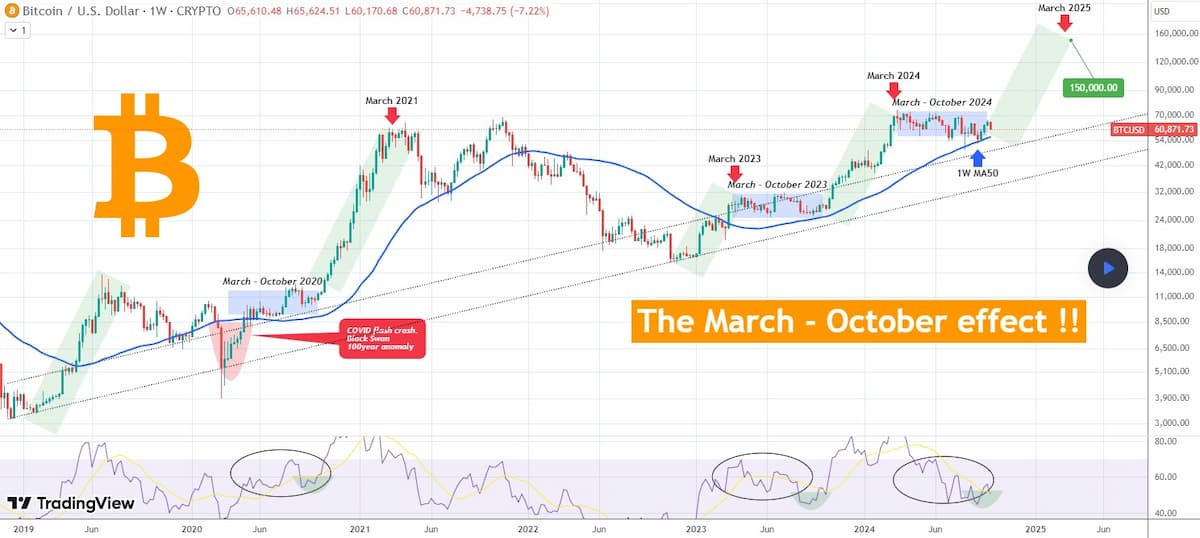
“As you can see, this is nothing more than a consolidation that the market tends to make within this 6-month range that ends on October, which kick starts an aggressive rally,” he said. “That was the case in 2020 (would be more flawless if the COVID crash hadn't distorted the chart) and more recently in 2023. Note that historically October shows gains of around +21.00%.”
“What we can additionally keep from this chart is that the 1W MA50 (blue trend-line) held on three 1W candle tests since the August 05 Low, and that provides the base for a potential October 2024 - March 2025 rally,” he noted. “March 2025 has high chances of forming the peak of the rally as it historically tends to tops such Bullish Legs and then starts consolidation phases. That was the case on March 2024, March 2023, March 2021 and (as mentioned) if it weren't for the COVID flash crash, would have been most likely the case for March 2020.”
“All in all, even though the first two days haven't been ideal, we expect October to prepare the foundation for an incredible rally, especially on its last 2 weeks, a rally that might very well reach as high as $150000 before it enters a correction again,” TradingShot concluded.
Altcoins follow Bitcoin’s lead lower
Roughly a dozen tokens in the top 200 recorded meaningful gains on Wednesday, while the remainder booked losses.
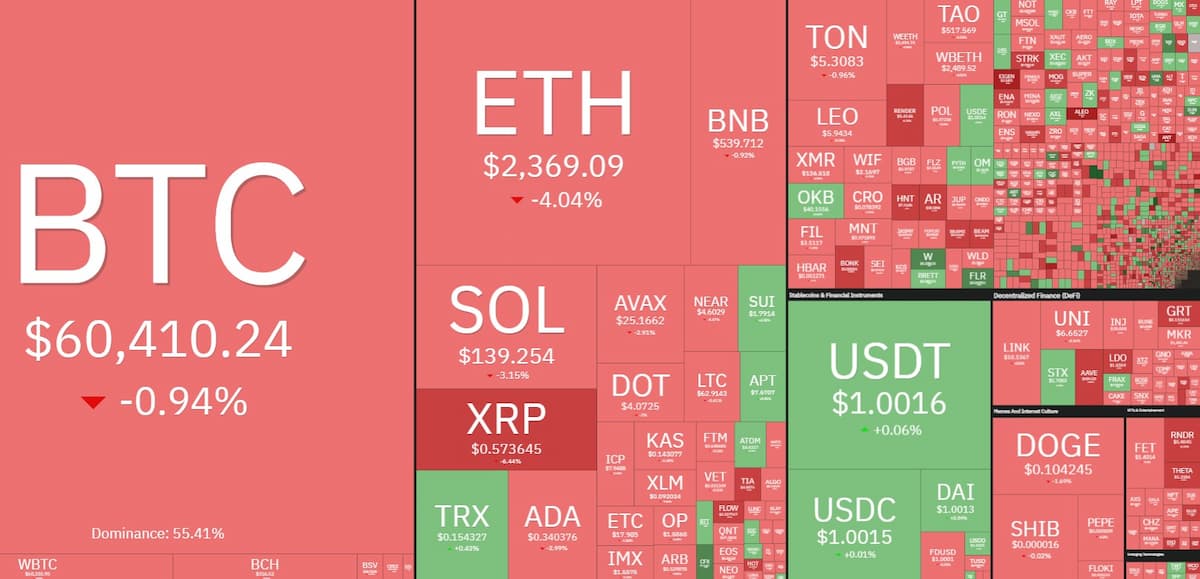
Daily cryptocurrency market performance. Source: Coin360
Flare (FLR) was the top gainer, increasing by 12%, followed by gains of 10.6% and 8.1% for Wormhole (W) and Conflux (CFX), respectively. EigenLayer (EIGEN) saw the biggest drop, falling 17.5%, while Mog Coin (MOG) and AltLayer each lost 11.4%.
The overall cryptocurrency market cap now stands at $2.1 trillion, and Bitcoin’s dominance rate is 56.5%.
