
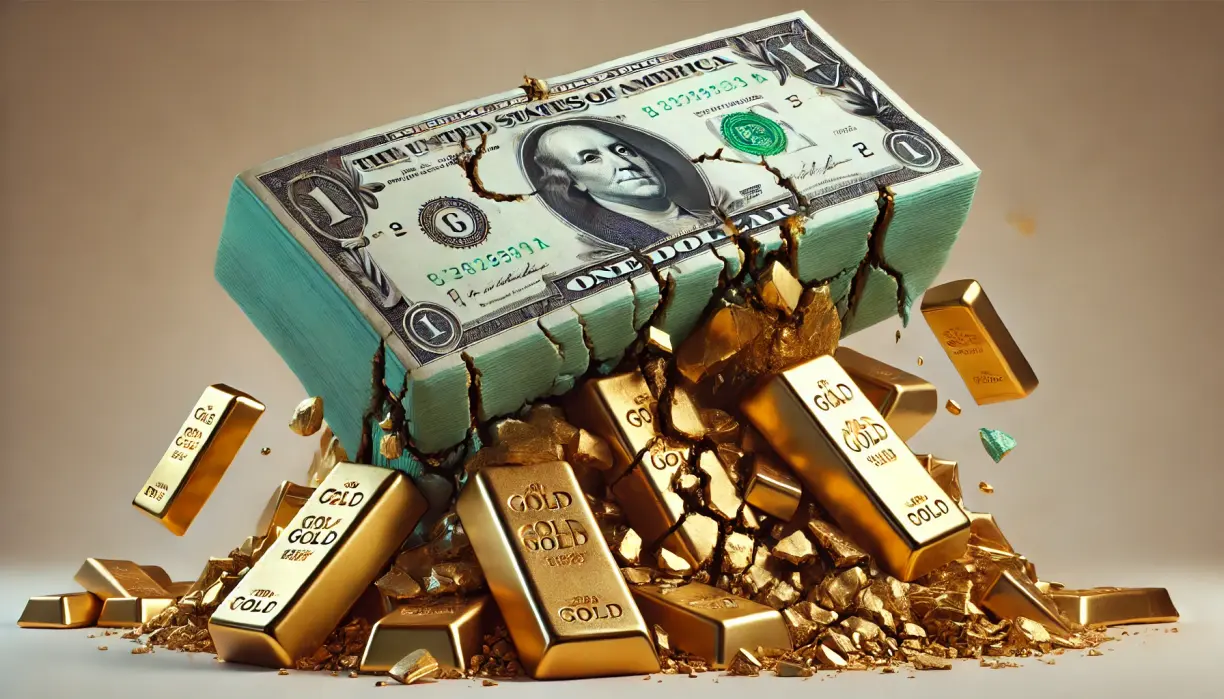
(Kitco News) – The Project 2025 conservative policy blueprint has been making waves in recent months as journalists, lawmakers, and academics pore over its recommendations. And while much of the attention has centered on its ideas around social policy and executive authority, one economic proposal will quicken the pulse of precious metals investors regardless of their political affiliation: Reestablishing the gold standard.
The 900-plus page document from the Heritage Foundation is aimed at shaping the policy agenda for the United States government with a focus on conservative principles. Launched in 2023, the Project is geared toward preparing for a potential Republican administration in 2025, emphasizing the need for a comprehensive plan to restore what its proponents view as core American values and governance principles.
Key elements of Project 2025 include: dissolve the departments of Education and Homeland Security, ban the ‘morning-after pill’, compel Health and Human Services to “maintain a “biblically based, social science-reinforced definition of marriage and family” and place the entire federal bureaucracy under direct Presidential control.
Republican Presidential candidate Donald Trump has completely disavowed Project 2025. In July, after Heritage Foundation director Kevin Roberts faced backlash for saying that the country was “in the process of the second American Revolution, which will remain bloodless if the left allows it to be,” Trump was emphatic that the document did not represent his policies.
“I know nothing about Project 2025,” he said in a post shared on Facebook and Truth Social. “I disagree with some of the things they’re saying and some of the things they’re saying are absolutely ridiculous and abysmal.”
Still, given that six of his former Cabinet secretaries helped write or edit the document, and at least 140 people who worked in the Trump administration contributed to Project 2025 in some way, it can at the very least be taken as a representation of the zeitgeist – with all its extremes and contradictions – of the American conservative policy establishment.
And these extremes and contradictions extend to monetary as much as social policy. Project 2025 proposes a very different vision for the U.S. dollar. Indeed, Chapter 24 of Project 25 calls for the outright elimination of the Federal Reserve – and the complete privatization of the currency regime – with the gold standard presented as a partial victory to that end. It was written by Paul Winfree, who served as Trump’s Deputy Assistant to the President for domestic policy, Deputy Director of the Domestic Policy Council, and Director of Budget Policy.
In order to unpack the many potential implications and impacts of a return to metal-backed money and other ideas to overhaul (or overthrow) the Fed, Kitco News reached out to two of the foremost experts on modern economic theory, monetary policy, and the gold standard: Michael Bordo and John Cochrane.
Dr. John Cochrane is a specialist in financial economics and macroeconomics, and one of the most original and influential economists on the planet. He is the Rose-Marie and Jack Anderson Senior Fellow at the Hoover Institution and a professor of finance and economics at the Stanford Graduate School of Business since 2016. Cochrane has also served as a research associate at the NBER since 1998, and directed its Asset Pricing Program from 1998 to 2007. From 2009 to 2010, he was President of the American Finance Association.

The central thesis of Dr. Cochrane's research is that macroeconomics and finance should be linked, and any comprehensive theory must explain how households and firms decide on consumption, investment, and financing based on prices and financial returns, all while prices and financial returns are determined by decisions made by households and firms. Cochrane's current research incorporates a fiscal theory of the price level, which posits that inflation is affected by more factors than simply the supply of money.
Dr. Michael Bordo is arguably the world’s leading authority on monetary policy and the gold standard. He is the Board of Governors Professor of Economics and Distinguished Professor of Economics at Rutgers University, a research associate at the National Bureau of Economic Research, and a Distinguished Visiting Fellow at the Hoover Institution at Stanford University. He is the third most influential economic historian worldwide according to the RePEc/IDEAS rankings, and was a student and PhD. supervisee of Milton Friedman.

Dr. Bordo is among the most widely cited academic experts on the gold standard, and in addition to his many journal articles on the topic, his books include A Retrospective on the Classical Gold Standard,1821–1931 and Money in Historical Perspective with Anna J. Schwartz, The Gold Standard and Related Regimes: Collected Essays, and The Origins, History, and Future of the Federal Reserve: A Return to Jekyll Island with William Roberds.
Free banking and the end of regulation
The two most favored approaches to monetary policy in Project 2025 are 'free banking' and a return to the gold standard. Both are held up as an effective means of delivering more economic and price stability while also eliminating government and industry incentives to debase the currency and inflate the money supply.
“In free banking, neither interest rates nor the supply of money is controlled by the government,” Winfree writes. “The Federal Reserve is effectively abolished, and the Department of the Treasury largely limits itself to handling the government’s money.”
“Under free banking, banks typically issue liabilities (for example, checking accounts) denominated in dollars and backed by a valuable commodity,” he writes. “Competition would determine the right mix of assets in banks’ portfolios as backing for their liabilities.”
Winfree writes that this unfettered competition would prevent banks from overprinting money or lending irresponsibly. “This is because any bank that issues more paper than it has assets available would be subject to competitor banks’ presenting its notes for redemption,” he says. “In the extreme, an overissuing bank could be liable to a bank run. Reckless banks’ competitors have good incentives to police risk closely lest their own holdings of competitor dollars become worthless.”
“In this way, free banking leads to stable and sound currencies and strong financial systems because customers will avoid the riskier issuers, driving them out of the market,” Winfree writes. “[F]ree banking could dramatically strengthen and increase both the dominant role of America’s financial industry and the use of the U.S. dollar as the global currency of choice.”
Other benefits of free banking cited by Winfree include “dramatic reduction of economic cycles, an end to indirect financing of federal spending, removal of the ‘lender of last resort’ permanent bailout function of central banks, and promotion of currency competition.”
Winfree writes that the only true downside of a free banking system is the “massive political hurdles” it would face.
“Transitioning to free banking would require political authorities, including Congress and the President, to coordinate on multiple reforms simultaneously,” he says. “Getting any of them wrong could imbalance an otherwise functional system. Ironically, it is the very strength of a true free banking system that makes transitioning to one so difficult.”
‘Free’ banking led to costly crises
Both Cochrane and Bordo see this free banking proposal as misguided, based on a misunderstanding of how this system actually worked in the past and a failure to grasp how impractical it would be in the present.
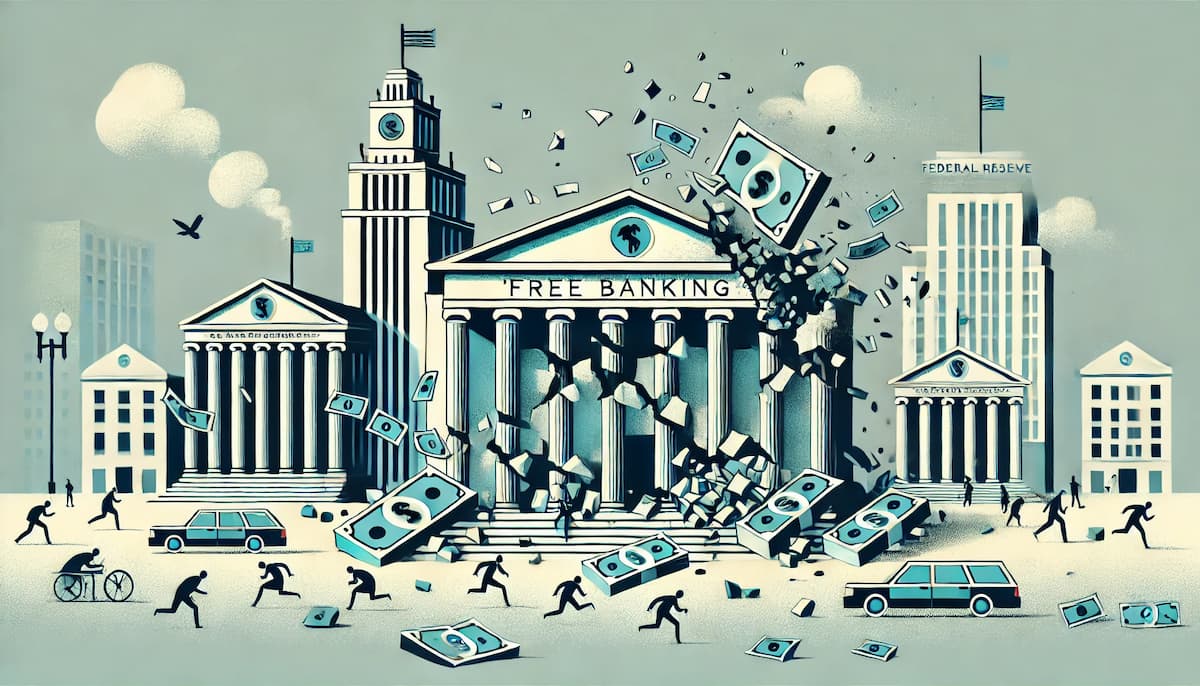
“Free banking says banks should not be regulated: the free market should work, banks know how much reserves to hold, they're going to act in their own interest,” Bordo said. “The historical evidence is so strongly against free banking that it's a joke that they're even talking about it.”
“Free banking is another chimera that passes around Austrian [school of economics] circles,” Cochrane said. “We just tried free banking… FTX.”
“Crypto is exactly creating notes (now electronically) backed by whatever assets are enough to convince people to buy them,” he said. “Usually not enough. Free banking is not immune from runs.”
“The free market people, the Austrians, argue that we need to have free banking, no regulation of the banking system, that in the pre-Civil War period, we had free banking in the United States, and it worked very well,” said Bordo. “[They say] we should not have government involved in banking or the financial system, and we should not have government involved in the monetary system.”
“Economic theory predicts and economic history confirms that free banking is both stable and productive, but it is radically different from the system we have now,” Winfree claims.
Bordo said this story is completely wrong. “The free banking episodes in the 19th century were ones of considerable instability,” he said. “They only ended when government took over. I find myself hearing the same arguments again and again, and the same historical examples raised.”
“The question isn't whether we should have government and regulation. It’s doing a good job, following sound principles that agree with market incentives and work with the financial sector. The question isn't ‘yes’ or ‘no’, it's having proper regulation.”
Cochrane said that he understands why the idea of free banking looks appealing. “It is offensive to free market principles that some government agency sets the most important price in the economy,” he said. “We don’t trust them to set gas prices, how are they going to get the interest rate right? There is a role for government, as there is a role for a bureau of weights and measures to define the foot, and a role for government to decide if we should drive on the left or right side of the street. We need to standardize on one thing to quote prices in, and define the value of that one thing. Yes, private monies can work, but on the list of things to privatize this is pretty low, and the government has some natural advantages in defining money and its value.”
“We would not want an economic czar lengthening and shortening the yard, or changing which side of the road we drive on, to try to stimulate or soften the economy, so some sort of transparent rule to define the value of the dollar is attractive,” Cochrane added. “Saying ‘the dollar is worth 1/32 of an ounce of gold, period’ was a lovely objective definition of the value of the dollar.”
“However, neither free banking nor gold will work for the US economy today.”
The gold standard and the end of fiat currency
Winfree treats a return to gold-backed money as a kind of half-measure, a silver-medal solution compared to the free banking ideal.
“[R]estoring a gold standard retains some appeal among monetary reformers who do not wish to go so far as abolishing the Federal Reserve,” he writes. “Both the 2012 and 2016 GOP platforms urged the establishment of a commission to consider the feasibility of a return to the gold standard, and in October 2022, Representative Alexander Mooney (R–WV) introduced a bill to restore the gold standard.”
“In economic effect, commodity-backing the dollar differs from free banking in that the government (via the Fed) maintains both regulatory and bailout functions,” Winfree writes. “However, manipulation of money and credit is limited because new dollars are not costless to the federal government: They must be backed by some hard asset like gold. Compared to free banking, then, the benefits of commodity-backed money are reduced, but transition disruptions are also smaller.”
Gold standard through rose-colored glasses
Cochrane and Bordo view a return to the gold standard as rooted in a romantic and idealized notion of how it actually worked… and didn’t work.
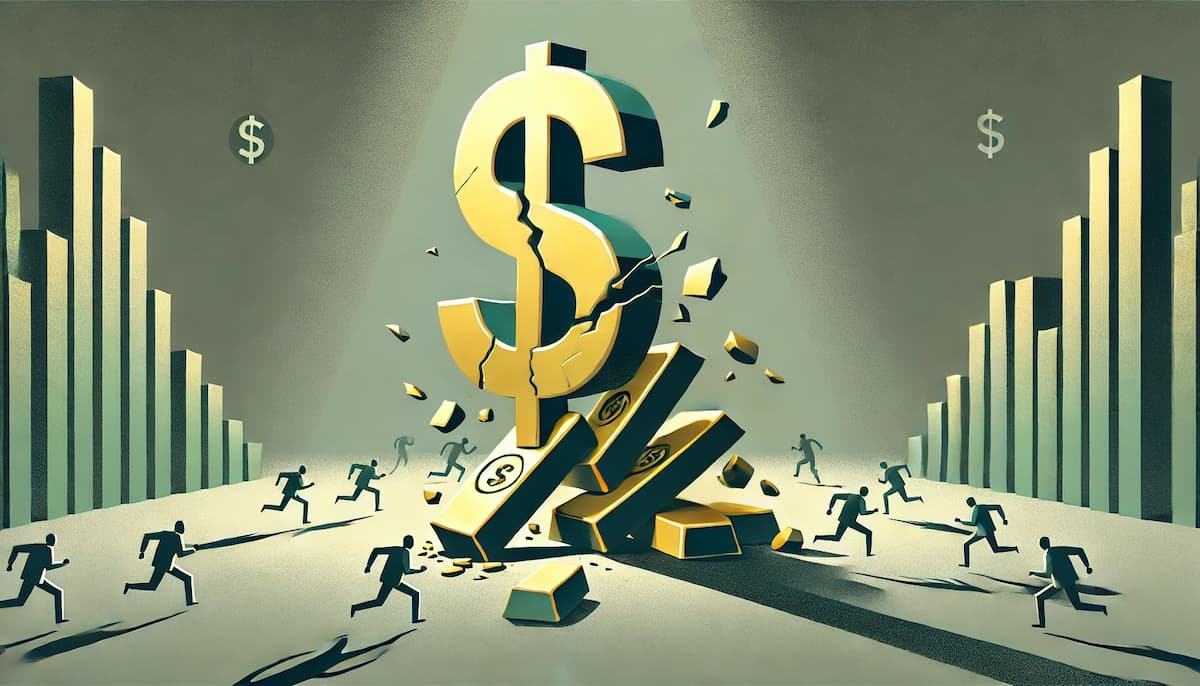
First, on an average annual basis, both inflation and deflation were actually far more extreme under the gold-backed currency regime than they are today.
“The gold standard did not give us absolute price stability,” Bordo said. “That's a myth. What it gave us was long-run – over a century – price stability. If you put a graph of the U. S. price index or the UK, or Canada, and you go all the way back to when the data begins, you will see that at the beginning of the 19th century, one index was equal to one. By 1913, it was back to one, but it went through three or four swings. That's not price stability. That's long-run price stability, and that's really what the benefit of the gold standard was, but people forget that. They don't know the details.”
The second fundamental problem is that for gold to stabilize the value of the dollar, the precious metal’s own value must remain stable.
Winfree calls the transition to a gold-backed dollar “very straightforward,” but note the numbers in his characterization of that transition, written only one year ago:
“Treasury could set the price of a dollar at today’s market price of $2,000 per ounce of gold,” he writes [emphasis mine. “This means that each Federal Reserve note could be redeemed at the Federal Reserve and exchanged for 1/2000 ounce of gold—about $80, for example, for a gold coin the weight of a dime. Private bank liabilities would be redeemable upon their issuers. Banks could send those traded-in dollars to the Treasury for gold to replenish their vaults.”
At the time of writing, spot gold was trading at $2,636.83 per ounce, for a 12-month gain of over 40%... or a little more than four-tenths the weight of a dime, presumably. If the U.S. had transitioned to a gold-pegged dollar when Project 2025 was written, what would the price situation in the country look like today?
“Notice how much gold goes up and down relative to the dollar,” Cochrane said. “Would you like gold relative to the dollar to stay constant, but the price of everything else to whipsaw up and down? The price level was stable over long time periods under gold, but there was much more temporary inflation and deflation.”
“I have always viewed the essence of a gold standard as fixing the nominal price of gold, and that, in turn, allowed a market mechanism called the commodity theory of money to work, which, over long periods of time, gave you price stability,” Bordo said. “Now, take this phrase ‘long periods of time.’ If you look at the history of the gold standard, you will see that there were wild swings in the value of money. The real price of gold would rise when there was deflation, and it would fall when there was inflation. We had an episode of inflation at the beginning of the 19th century with the wars. Then we had deflation for a very long period of time until the gold discoveries came in the 1840s. Then we had 30 years of inflation – that means prices rising 2 to 3 percent per year – until prices started falling in the 1870s.”
It is unlikely that either political party would want to run on a platform of 40% annual price swings, and Americans would be unlikely to accept reassurances from any President that while these extreme price disruptions could well continue in the same direction for a decade or more, they would no doubt even out within a century or so.
Bordo and Cochrane said history shows the United States of the 19th and early 20th centuries didn't accept this state of affairs either.
The third common misconception about the gold standard is that it removed the government from the position of controlling the value of the currency. But governments were involved in much the same ways as they are today, only far less efficiently.
“The gold standard was not pure, and also involved central banks… wait for it… raising and lowering interest rates to defend the gold standard,” Cochrane said. “As Winfree points out, governments never had 100% gold backing for currency, so a gold standard is largely a commitment not to run too big deficits.”
“Under the gold standard, the government was involved,” said Bordo. “It set the nominal price of gold. Once the 19th century came along, once the economy started to evolve, you needed to peg the price of gold to make it work.”
“The most important thing to have in the monetary economies is a nominal anchor,” he said. “The nominal anchor sets the value of money relative to all other goods and services, and you have to have a stable nominal anchor. The number one goal of monetary policy is price stability and maintaining a stable nominal anchor.”
The second goal is macroeconomic stability. “Macro stability can involve the price level rising and falling, but over the long run, it has to be stable,” Bordo said. “The third function of a central bank is financial stability. That means preventing banking panics, preventing financial crises.”
“The gold standard was, a long time ago, the nominal anchor, and it worked pretty well,” he added. “But it worked pretty well because of the fact that we didn't worry about the business cycle much. If there was a shock, and there was a big recession, people just left, or the prices fell, or wages declined.”
“What the 20th century taught us was that the political economy consequences of just allowing free market adjustments and following the gold standard was political instability,” Bordo said. “That's why we've moved away from the gold standard. Going back to a system which worked in the 19th century, but broke down after World War One, is just silly. It's like saying we're going to put back steam engine railroads across the country, we're going to get rid of cars, we're going to get rid of planes, and go back to the 19th century technologies. That's a dumb idea.”
“The principles of the gold standard, the importance of nominal anchor, and the importance of prices, that still holds,” Bordo said. “But trying to go back to something that broke down just seems really silly to me.”
Gold-backed currencies exacerbate crises
The gold standard had another big weakness, Cochrane said, which became all too apparent in 1933. “It nails the value of dollars relative to gold, but what if gold and the dollar both rise in value relative to goods and services – deflation,” he said. “Then the government has to raise taxes and cut spending to pay bondholders back in more valuable gold and dollars, which makes deflation worse. That’s why the US abandoned gold in 1933.”
“And, as Winfree quickly points out, nothing stops a government from devaluing,” he added. “So the gold standard becomes like an exchange rate peg; governments overdo it, put in restrictions, use up taxpayer dollars defending the peg; speculators attack, and we get recurrent crises with big devaluations.”
“I am sympathetic, and a dollar that automatically held its value relative to, say, the basket of commodities in the CPI would be a great thing,” Cochrane said. “But alas, most of that is not tradeable, so you can’t, say, bring in three haircuts and two months’ apartment services and I give you a dollar.”
“I have some proposals for how to fix the dollar relative to the CPI, but none ready to be legislated quite yet,” he said. “And I know enough about commodity money to say nobody else’s are ready either.”
Cochrane said that an interest rate target that rises and falls “pretty hawkishly” to enforce a price level target is probably the best we can do at present. “I’m actually surprised [Winfree] didn’t go there,” he said. “How about the CPI shall stay at [its current level] forever, and if it goes up it must come back down? If you like the gold standard, you should at least want the Fed to aim for the price level stability the gold standard was supposed to achieve.”
Project 2025 lite: Six Fed reforms
After laying out grand schemes for a complete overhaul of the monetary system, Winfree offers a scaled-back series of six more modest proposals which he characterizes as “minimum effective reforms.” And while several are still quite radical by mainstream economic standards, on these, Bordo and Cochrane see a great deal of common ground.
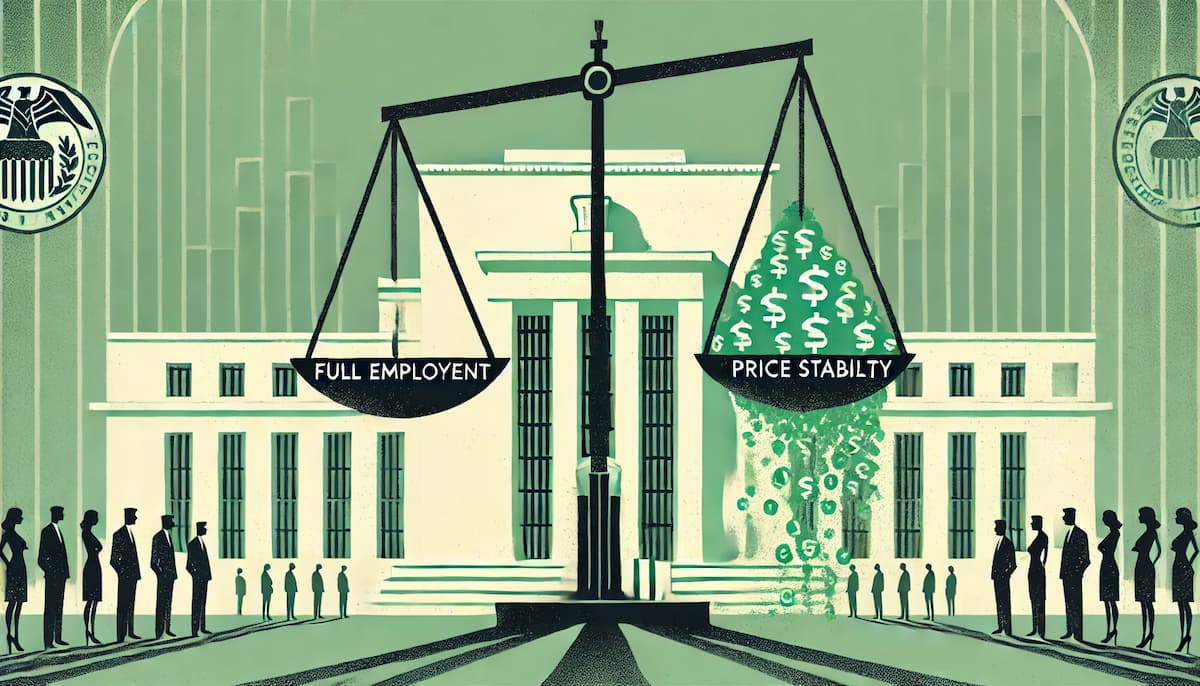
The first reform Winfree advocates is the elimination of “full employment” from the Fed’s mandate, requiring it to focus on price stability alone.
“I am sympathetic to that proposal,” Bordo said. “I think the dual mandate has become problematic.”
“The dual mandate is political,” he said. “The main purpose of a central bank is to provide price stability. And when you do that, generally, the real economy becomes more stable, but of course, it doesn't always happen, so you have to be flexible.”
“My argument would be that the price stability goal should dominate the real economy unemployment goal. What's happened in Fed history is Greenspan did buy that, as did Bernanke, but it changed with Yellen. She attached much more weight to the labor market, and some of the problems that came out, and why we had that slow recovery after the [global financial crisis], was because of that shift in the weights attached to the dual mandate.”
“You can do better,” he added. “The ECB has one mandate, and I think the ECB does pretty well. The BoE does not have a dual mandate either.”
“Yes,” agreed Cochrane on the elimination of the employment mandate. “One tool cannot hit two targets, and the best way to stabilize employment with the tools at the Fed’s disposal is to keep prices steady, so it doesn’t have to go raising interest rates to stop inflation. On the other hand, a pure price stability mandate hasn’t stopped the ECB from wandering off to other policy goals, so enforcing the mandate is important too.”
“I'm not saying that the federal government should not worry about unemployment,” Bordo said. “But it's the way the dual mandate has been operated in the United States in the past 30 years that's the problem. It worked fine with Volcker, it worked fine with Greenspan, it worked fine with Bernanke. The game changed with Janet Yellen, she put much more weight on unemployment, and that led to some problems. And the Powell Fed also attaches a lot of weight, more weight than I would, to unemployment.”
“Abolishing the dual mandate is not saying the Fed is not going to focus on the real economy, because they are,” he added. “The ECB worries about the real economy, as does the Bank of England. The Bank of Canada, in terms of operations in the past 20 or 25 years, has been better on average in the Fed, and they do not have a dual mandate. A dual mandate, in a sense, because it's explicit, hobbles the Fed's ability to conduct monetary policy. In that sense, I agree with [Winfree’s] statement.”
“The mandate says what the Fed must NOT pay attention to, not just what it should pay attention to,” Cochrane said. “If Congress cares about employment, deregulate labor markets and stop paying people not to work with social programs that take away a dollar for each dollar earned. These are far more powerful than whether the overnight interest rate is 2% or 3%.”
Explicit targets for mature economies
The second reform proposed in Project 2025 is to have elected officials demand that the Fed specify its target range for inflation and inform the public of a concrete intended growth path. “There should be no more ‘flexible average inflation targeting,’ which amounts to ex post justification for bad policy,” Winfree writes.
“I agree with that too, but I think the way the BoE does it is great,” Bordo said. “The Treasury mandates what the inflation target is, then they have a monetary policy commission, and they're the ones that decide whether the BOE should raise or lower rates to follow this mandate. I think the U.S. should have that. I agree with that.”
“The mandate should be set by Congress, and then the central bank should pursue policies consistent with the mandate, and they should report back,” he added. “This was really put forth by the Reserve Bank of New Zealand in the 1980s. They were the first to talk about inflation targeting, and that's exactly what they want.”
“The dirty little secret is that the Fed doesn’t really have any idea how or if interest rates control inflation,” Cochrane said. “Remember the Fed’s hilarious inflation forecasts from 2020-2023, utterly missing inflation? Nobody knows what the future will bring, so all these forecasts plus dot plots are a waste of time.”
“Yes, give an inflation target, or better yet a price level target,” Cochrane said. “Do more and talk less.”
No more Mr. Nice Fed
The third proposed reform is that the Fed limit its regulatory activities to maintaining bank capital adequacy. “Elected officials must clamp down on the Fed’s incorporation of environmental, social, and governance factors into its mandate, including by amending its financial stability mandate,” Project 2025 states.
Bordo supported this proposal as well, on the principle that the Fed should really be focusing on price stability and nothing else.
“But it's not as simple as that, because the Fed is operating in a political environment,” he said. “Too-big-to-fail does not come from the Fed, it comes from pressure from the government and from the population. Why didn't they allow [Silicon Valley Bank] to fail? It's because of pressure, political pressure. And what would have happened if they had actually let the non-insured depositors fail? There would have been such a squawk! It would have come through the political process. The Fed is, in a sense, part of a bigger problem.”
Bordo said the Project 2025 reform proposal gets these issues right, but it can’t pin them all on the Federal Reserve. “It's not just the Fed that deals with financial stability,” he said. “It's the FDIC, it’s part of the Treasury, all of the regulatory agencies in the U.S. and the financial sector, they are part of the government. There are basic flaws in the U.S. financial stability, financial regulatory workspace. They're big, they're historic, and they go back to the beginning of time.”
Cochrane agreed that the Federal Reserve is not the source of the problem when it comes to tacked-on political goals, but rather it’s the lawmakers and the American people who bear responsibility.
“You get the government you elect,” he said. “The Biden Administration announced a ‘whole of government’ crusade for DEI and climate change, and even the Fed went along. Elected officials are the ones telling the Fed to do it!”
Financial regulation, on the other hand, is a bigger problem for Cochrane. “The SVB affair showed the armies of regulators are utterly unable to spot basic risks,” he said. “Yes, capital, and much, much more of it. Run-prone deposits should be backed 100% by reserves or Treasuries, risky banking should be funded 100% by equity and long-term debt. Then we really would need next to no regulation, and we would never have crises again.”
“‘Free banking,’ yes,” Cochrane said, “But not free banking financed by printing money, free banking financed by issuing stock.”
Too-big-to-bail
The fourth of Project 2025’s minimum effective reforms is to dramatically scale back the Federal Reserve's last-resort lending practices. “These practices are directly responsible for ‘too big to fail’ and the institutionalization of moral hazard in our financial system,” Winfree writes.
“Easy to say but hard to do,” Cochrane answered. “Yes, talk tough. But then the next crisis comes, some large bank is teetering, all the president’s campaign contributors are on the phone saying if they lose money it will be the end of the world, and the Fed will bail out again.”
“The ‘too big to fail’ problem isn't just the Fed,” said Bordo. “Every government thinks that. Once a government gets in power, they do not want to have a financial crisis. They do not want to have people being thrown out of work or losing their wealth. And so they will do anything they can to prevent the market from working.”
“Since 1913, the Fed has been on a never-ending circle,” he added. “We promise to only lend last resort so much/bail out so much; a big loss happens, the Fed lends more and bails out more, but now here is the line in the sand, and around we go.”
“SVB saw uninsured depositors bailed out by the FDIC, which it promised never to do,” Cochrane said. “So big promises of toughness just aren’t credible anymore. Banks, and more importantly, people who fund them, know that.”
“The Fed is just an agent,” Bordo said. “A lot of us think that they should have just let the non-insured depositors at SVB take the loss. Again, that was the purpose of the regulations that we had that distinguished between insured and noninsured depositors. The fact that there were depositors who were not insured, that would act as a disciplining device on the banks. But once you cave in and do not allow them to take the losses, then you create the moral hazard. And then that leads to activity by other institutions and individuals that make things worse in the future.”
“The answer is, banks that take risks must get their money by issuing stock and long-term debt, whose price the government can allow to fall,” Cochrane said. “Then the temptation to bail out will not be there.”
“So, yes, if it is an ironclad rule, we really cannot bail out or lend, no matter how bad it looks,” he added. “But after 2008, it’s hard to think of such rules, and not clear if it’s really wise. Tie yourself to the mast yes, but not so tightly that you can’t wriggle free if the ship sinks. Better to have a sturdy ship.”
Commissions and omissions
The fifth proposed reform is to “Appoint a commission to explore the mission of the Federal Reserve, alternatives to the Federal Reserve system, and the nation’s financial regulatory apparatus.”
“I've always thought that what the U.S. needs is something like what Canada and the UK do with Royal Commissions,” Bordo said. “You have a big problem, you have a commission. In the UK, it's the House of Lords, in Canada, it's the Senate. You have a commission, and you have independent experts study the problem, bring in witnesses, be as completely open as possible, let the public know what's going on. Come up with a report that says ‘These are the problems of the U.S. financial and monetary system, and this is what we suggest we do.’”
Bordo thinks this would be a wonderful thing. “The last time they did something that grandiose and good was the National Monetary Commission back in 1912, and that did lead to the Federal Reserve,” he said. “But that's never going to happen. It was a special event that occurred in the face of all the banking crises in the 19th century.”
The key, he said, would be how you define the commission’s mandate. “It has to be apolitical,” Bordo said. “If it's not apolitical, it's not going to work. And like with the Gold Commission, it was sponsored by the Republican Congress, but they had to have equal number of Democrats and Republicans on the commission. You have to have a clear mandate, and it cannot be interfered with while it's operating, then it gives its report. The report is debated in Congress, it's debated by the public, and then based on the debate and the feedback, you come up with legislation, and you go through all of the stuff with legislation.”
While Bordo thinks the commission is a great idea whose time will never come, Cochrane takes a more pessimistic view on what the commission could ever achieve even if it did.
“Since most thinking about the Fed comes from inside the bubble, or the industry that feeds off its protection from competition and subsidies from occasional bailouts, that is in general a good idea,” Cochrane said. “Alas, most of the insiders who will be invited to such a commission are not me and not Winfree, so I doubt it will produce more than just ratifying the status quo: huge regulation, huge protection, lots of crony capitalism.”
No Central Bank Digital Currency
Project 2025’s final proposal is to forbid the Fed from issuing any kind of central bank digital currency (CBDC). “A CBDC would provide unprecedented surveillance and potential control of financial transactions without providing added benefits available through existing technologies,” Winfree writes.
“It depends what kind of CBDC we’re talking about,” Cochrane responded. “A CBDC in which the government has a record of every transaction you make is a terrible idea, I agree. And the Fed is not a great candidate to run a consumer facing website. ‘Jay, I lost my password!’”
Bordo has written a great deal about CBDCs, and he believes the arguments against them, from the Republican party in general and in Project 2025 in particular, are disingenuous.
“I'm in favor of [CBDC], because I see it as a technological improvement,” he said. “And you can design the CBDC so that it doesn't do these things. But what's happened, it happened in Canada, it happened in Sweden, it happened in the UK, it's happened in the U.S., is the banks are worried about losing ‘rents’, because it's the banking system that gives people access to the payment system. And the amount that they charge for access, it's huge. A BoE staff researcher estimated it at four percent of GDP for the U. S. economy.”
“There's a damn good reason why CBDC is being blocked,” Bordo said. “It's being blocked by the banks.”
“The argument that's coming out of this platform reflects the capture of the party by the banking system,” he said. “They bring up all this crap about privacy. You can program the money, you can have safeguards in place, which can prevent that.”
“You can also do lots of good things with CBDC,” he added. “For example, during the pandemic when the Treasury was trying to give people subsidies, they couldn't find them, because they didn't have banks. 10 percent of the population are unbanked. With CBDC, you could actually come up with electronic ways of getting funds to people when they need them. There's a lot of things that could also make monetary policy much more efficient.”
“CBDC would come up with a way of getting the public access without paying these monopoly prices. That's all. That's the argument,” he said. “And that argument has been thrown out the window. They don't listen to it. They're focusing on a lot of other issues, the privacy issue, the issue of the banks being disintermediated by CBDC. The arguments against it are second order to the main question: Is there a social saving from having electronic money, digital money, and having it operated by the central bank? Those are the questions. And that question has been totally thrown out the window.”
For his part, Cochrane believes the Federal Reserve can address the problem of the banking system’s monopoly rents in other ways.
“More accessible reserves at Fed or Treasury that 100% backed [which] intermediaries can use to give us better and cheaper transactions services is I think the right balance,” he said. “And government needs a subpoena to look at my account.”
Rebalancing the balance sheet
Winfree also raises concerns about the Fed's balance sheet, suggesting that it should be wound down to pre-2008 levels and limited to Treasuries going forward.
“I think interest on reserves and whatever size balance sheet to provide all the reserves we want are a great idea,” Cochrane said. “We can live the Friedman optimal quantity of money. In the US, yes, all treasuries and no more propping up housing markets.”
“It would help a lot, on both this and CBDC, if the Treasury were to issue fixed value floating rate overnight electronically transferable debt, essentially reserves, open to all,” he added. “The Fed cannot legally transact with anyone other than banks, and already stretches this with repo operations. The Treasury at treasury.gov can offer the same security as reserves or CBDC. And it should.”
“Then we wouldn’t have this insane system where the Treasury issues 5-year debt, the Fed buys it up and issues overnight debt instead,” Cochrane said. “The treasury should just issue overnight debt.”
Will the Fed lose interest?
But Cochrane completely disagrees that the Fed should stop paying interest on excess reserves to force financial institutions to lend more proactively.
“That is a terrible idea,” he said. “Interest on reserves is great. Going back to lots of cash management to get by on a small quantity of reserves is a waste and introduces a lot of instability. Money is oil in the car. Why try to use one quart? Just fill it up.”
“Eliminating interest on reserves would lead to instant inflation as banks did in fact try to lend them out,” Cochrane added. “The Fed would have to cut down the quantity of reserves dramatically. Lending would not change. Lending = saving, and monetary machination cannot create credit. Banks hold reserves now; if the Fed stopped paying interest, then banks would hold lots less reserves and lots more Treasury debt. Whether banks hold treasury debt by holding reserves which funnel into treasury debt or by holding the same debt directly makes no difference. That’s the choice.”
2025 problems require 2025 solutions
On the overarching idea of a gold-backed U.S. dollar, Bordo was emphatic that today’s monetary policy tools are far better, and even the lowest points of recent history bear this out.
“I’ve been totally against the gold standard since I was a graduate student,” he said. “[Milton] Friedman was my professor, and he wrote a famous paper called ‘Real versus Pseudo Gold Standards, and he made a case. He was not a gold standard advocate. What he wanted was fiat money with a rule. His rule, the money growth rule, wasn't that great.”
“But today we have much better rules,” Bordo added. “We have the Taylor rule, we follow price, inflation targeting. With the exception of the period after the global financial crisis and the recent pandemic, we've done pretty well. Central banks [in general], not just the Fed. We've done pretty well.”
Flawed means, worthy goals
Asked what Project 2025 gets right about the issues with the Federal Reserve system and fiat currency, Cochrane said that outside of the free banking and gold standard proposals, he sees many of the same problems and agrees with much of what Winfree laid out.
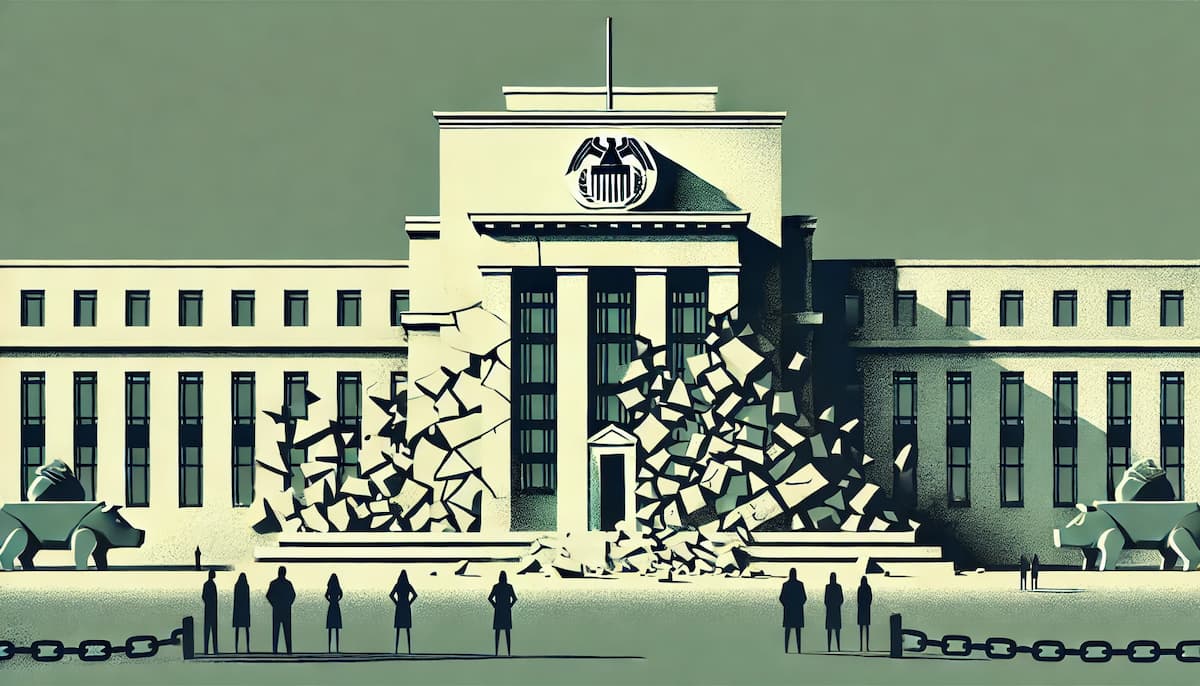
“The heart of this essay is in the right place,” he said. “Dramatic reduction of Fed regulatory authority, dramatic reduction of its discretionary micromanagement of the financial system and monetary affairs, focusing on one price level target only, and behaving as close to a ‘rule’ as possible are all the right goals. We disagree on small details.”
