

(Kitco News) – Public debt levels around the world are even worse than current projections, and the measures being undertaken by governments won't be enough, according to economists at the International Monetary Fund (IMF).
“Global public debt is very high,” wrote Era Dabla-Norris, Davide Furceri, Raphael Lam, and Jeta Menkulasi in an Oct. 15 blog post. “It is expected to exceed $100 trillion, or about 93 percent of global gross domestic product by the end of this year and will approach 100 percent of GDP by 2030. They pointed out that this is 10 percentage points of GDP above the 2019 level, “that is, before the pandemic.”
“While the picture is not homogeneous—public debt is expected to stabilize or decline for two thirds of countries—the October 2024 Fiscal Monitor shows that future debt levels could be even higher than projected, and much larger fiscal adjustments than currently projected are required to stabilize or reduce it with a high probability,” they said. “The report argues that countries should confront debt risks now with carefully designed fiscal policies that protect growth and vulnerable households, while taking advantage of the monetary policy easing cycle.”
The IMF economists give three reasons why the fiscal outlook of many countries could be even worse than the already dire projections: “[L]arge spending pressures, optimism bias of debt projections, and sizable unidentified debt.”
“Previous IMF research has shown that fiscal discourse across the political spectrum has increasingly tilted toward higher spending,” they noted. “And countries will need to increasingly spend more to cope with aging and healthcare; with the green transition and climate adaptation; and with defense and energy security, due to growing geopolitical tensions.”
On the other hand, history suggests countries’ future debt projections often underestimate actual totals by a significant margin. “Realized debt-to-GDP ratios five-years ahead can be 10 percentage points of GDP higher than projected on average,” they said.
The IMF’s Fiscal Monitor “presents a novel ‘debt-at-risk’ framework linking current macro-financial and political conditions to the entire spectrum of possible future debt outcomes,” the economists wrote. “This approach goes beyond the typical focus on the point estimates of debt forecasts and helps policymakers quantify risks to the debt outlook and identify their sources.”
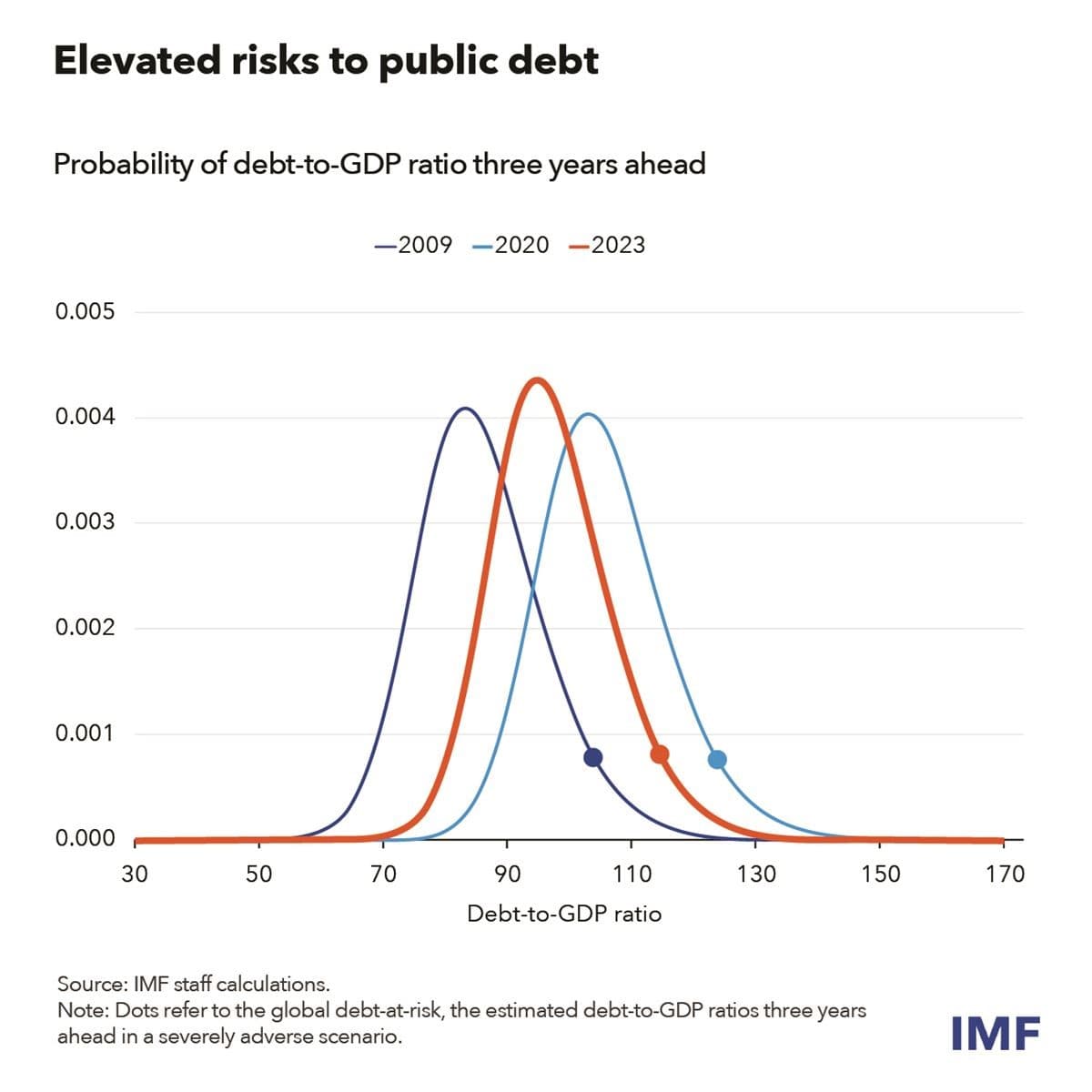
According to this framework, the IMF believes that “in a severely adverse scenario global public debt could reach 115 percent of GDP in three years—nearly 20 percentage points higher than currently projected. This could be due to several reasons: weaker growth, tighter financing conditions, fiscal slippages, and greater economic and policy uncertainty.”
“Importantly, countries are increasingly vulnerable to global factors affecting their borrowing costs, including spillovers from greater policy uncertainty in systematically important countries, such as the United States,” they added.
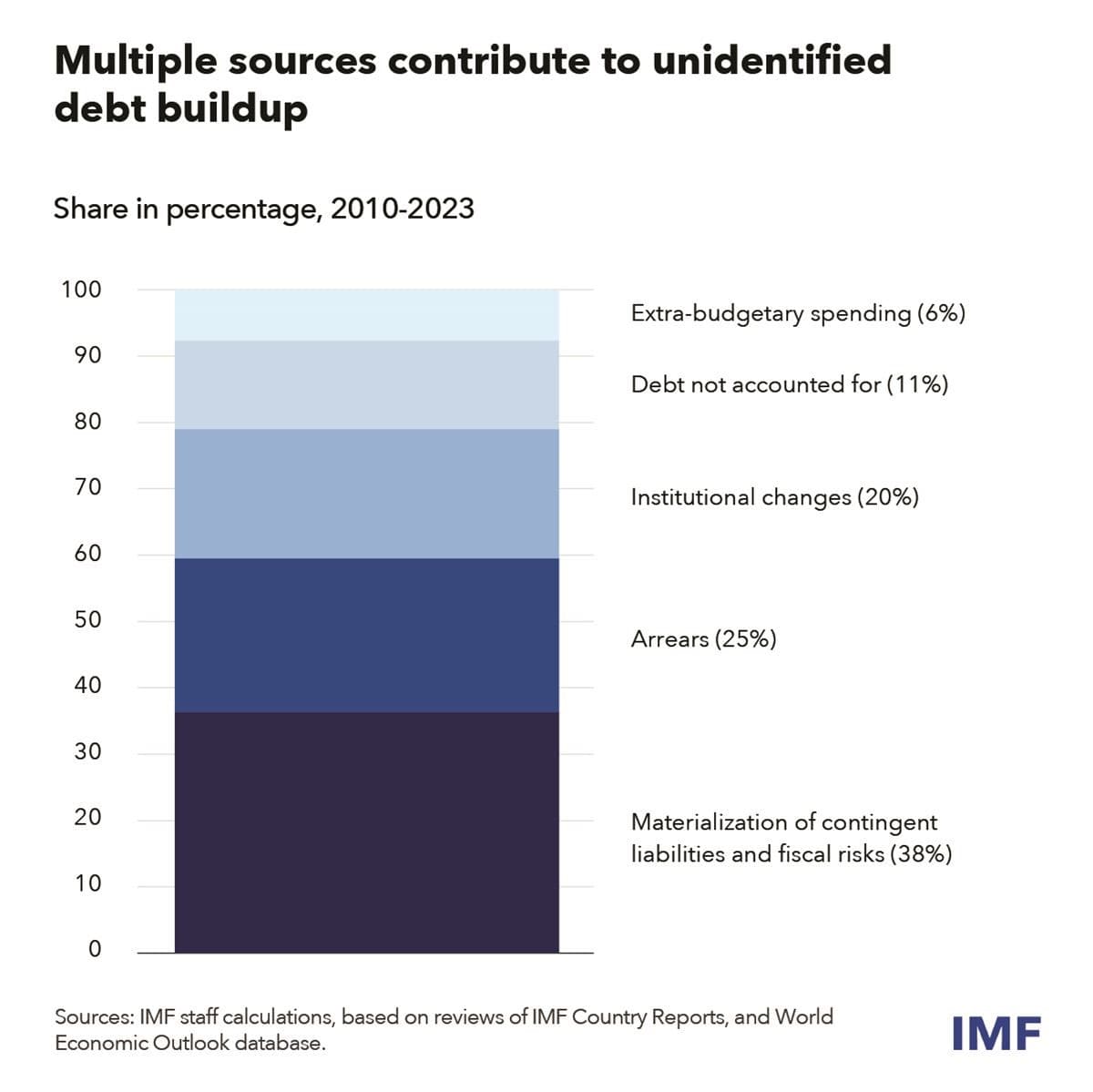
Another reason the economists believe that public debt could end up being significantly higher than current projections is the large amount of unidentified debt. “An analysis of more than 30 countries finds that 40 percent of unidentified debt stems from contingent liabilities and fiscal risks governments face, of which most are related to losses in state-owned enterprises,” they wrote. “Historically, unidentified debt has been large, ranging from 1 to 1.5 percent of GDP on average, and it increases sharply during periods of financial stress.”
The economists warned that while public debt is actually higher than it looks, the current fiscal efforts to tackle it are likely smaller than what’s needed.
“Fiscal adjustment plays a crucial role in containing debt risks,” they said. “With inflation moderating and central banks lowering policy rates, economies are better positioned now to absorb the economic effects of fiscal tightening. Delaying would be both costly and risky, as the required correction grows as time goes by; and experience shows that high debt and lack of credible fiscal plans can trigger adverse market reaction, constraining room to maneuver in the face of turbulence.
“Our analysis, accounting for country-specific risks surrounding the debt outlook, suggests that current fiscal adjustments—on average, of 1 percent of GDP over six years by 2029—even if implemented in full, are not enough to significantly reduce or stabilize debt with a high probability,” the economists wrote. “A cumulative tightening of about 3.8 percent of GDP over the same period would be needed for an average economy to ensure a high likelihood of debt stabilization. In countries where debt is not projected to stabilize, such as China and the United States, the required effort is substantially greater. But these two largest economies have a much richer set of policy choices than other countries.”
The IMF said that massive fiscal adjustments like these, if not properly calibrated, “will entail large output losses as aggregate demand falls and can harm vulnerable groups and lead to higher inequality. A careful design is thus needed to mitigate the costs of the adjustment and to garner public support for needed fiscal adjustment.”
“The choice of fiscal measures matters because the impacts are not alike and involve trade-offs,” they warned. “For example, cuts in public investment have the largest output losses and hurt long-term growth prospects, while reducing social transfers hurts vulnerable households and raises inequality.”
To address these issues, the economists advocate a mix of people-focused and growth-focused fiscal measures, which will necessarily vary from country to country.
“Advanced economies should advance entitlement reforms, reprioritize expenditures, and increase revenues where taxation is low,” they said. “Emerging market and developing economies have greater potential to mobilize tax revenues—by broadening tax bases and enhancing revenue administration capacity—while strengthening social safety nets and safeguarding public investment to support long-term growth.”
Speed is also a factor. “Our analysis suggests that a measured and sustained pace of adjustment would alleviate fiscal risks, while limiting the negative impact on output and inequality by about 40 percent less than a more abrupt tightening,” they wrote. “That said, some countries with high risk of debt distress will need front-loaded adjustments.”
And these adjustments will need to be accompanied by “stronger fiscal governance, including credible medium-term frameworks, independent fiscal councils, and sound risk management,” they added. “Enhancing fiscal risk assessment, monitoring closely contingent liabilities in state-owned enterprises, and publishing granular and timely debt statistics can reduce unidentified debt.”
“High public debt is a concern,” the IMF economists concluded. “Even for some countries where the public debt levels seem manageable [...] risks are elevated, and actual debt outcomes in coming years may be worse than projected. Current adjustment plans are not enough to stabilize or reduce debt confidently.”
“[W]ell-designed fiscal adjustments can help reduce debt risks, improve public debt outlooks, and mitigate the adverse impact on society.”
