
(Kitco News) – The price of silver has finally managed to meaningfully break above resistance at $30 after stymying attempts by bulls to rally higher for years. Now, the gray metal’s soaring price stands to make the most valuable hoard of coins ever found in Britain even more impressive.
“The largest-known coin hoard dating to the period immediately after the Norman Conquest has been unveiled at the British Museum,” according to a report from archaeology website The Past. The treasure trove contains more than “2,500 coins of Harold Godwinson (Harold II, the last crowned Anglo-Saxon king of England, r.1066) and William the Conqueror (William I, r.1066-1086).”
Source: Pippa Pearce, copyright Trustees of the British Museum
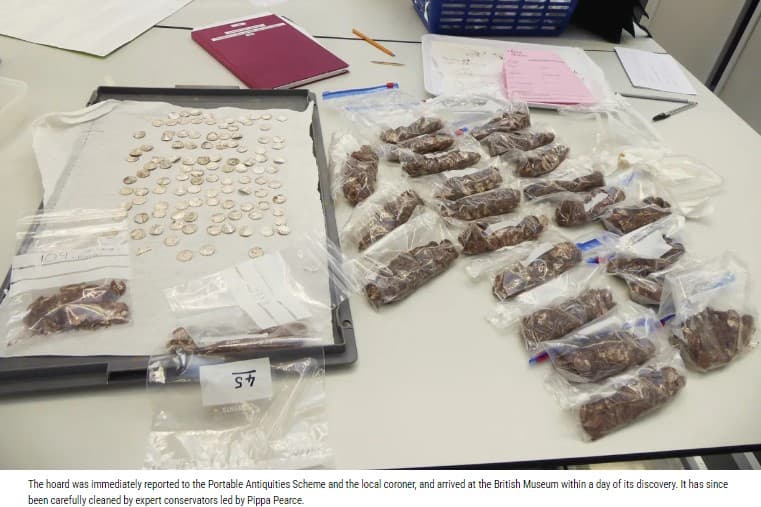
The stash of coins was found by a group of seven metal detectorists in 2019. They discovered the hoard scattered around a small area of ploughsoil in the Chew Valley, Bath, and North-East Somerset. The find is significant because it is twice the size of all the previous discoveries of Harold II coins combined and five times larger than all the known discoveries of William I coins.
The discovery was determined to be treasure by the Portable Antiquities Scheme shortly after being unearthed, and within a day, the coins were sent to the British Museum. Expert conservators, the curator, and volunteers have since carefully cleaned and cataloged the collection in preparation for a report for its upcoming coroner’s inquest under the Treasure Act 1996.
Source: Pippa Pearce, copyright Trustees of the British Museum
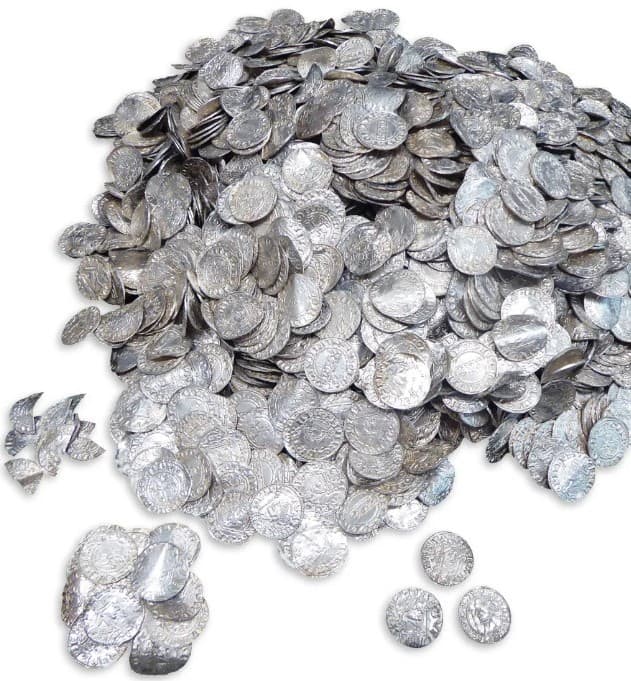
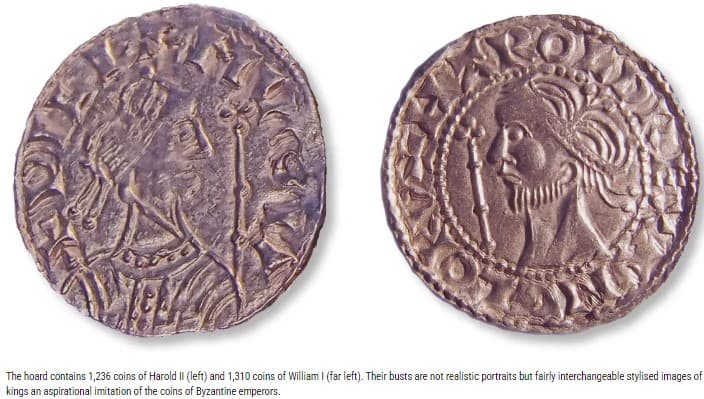
A total of 1,236 silver pennies of Harold II and 1,310 of William I were found, along with fragments that cannot be clearly attributed. The find also included a number of cut halfpennies, which was a common practice at the time to create smaller denominations.
“Five complete pennies would be enough to buy you a sheep, so half a penny was still a considerable amount,” said Gareth Williams, Curator of Early Medieval Coinage at the British Museum. “The entire hoard represents a flock of 500-plus sheep or the annual income of a large estate. It probably didn’t belong to someone from the very top level of society, but this is within the range of a wealthy landowner or a merchant.”

Source: Pippa Pearce, copyright Trustees of the British Museum
Evidence that concerns about fraud have existed for thousands of years was seen in some of the coins, which were deliberately bent by cautious individuals checking that their silver had not been mixed with lead. Many were also worn or cracked – an indication that they were in circulation before being buried – but the majority of coins were still in good condition, which allowed the British Museum team to read the names of the moneyers who issued them and their mints.

Source: Pippa Pearce, copyright Trustees of the British Museum
The oldest coin of the bunch depicts King Edward the Confessor, who died childless in January 1066. His death triggered a period of instability since he had promised the throne to three claimants: Harold Godwinson, Earl of Wessex; Harald Hardrada, King of Norway; and William, Duke of Normandy.
On his deathbed, Edward named Harold Godwinson as his successor, but King Harold II faced challenges from the other two claimants to the throne and was eventually defeated by William at the Battle of Hastings in October 1066.
This timeline is depicted in the collection, with Harold II appearing on less than half of the collection while William the Conquer is featured on the rest.
Source: Pippa Pearce, copyright Trustees of the British Museum
Amal Khreisheh, curator of archaeology at South West Heritage Trust, said in a video on the organization’s website that the collection “comes from a turning point in English history, and it encapsulates the change from Saxon to Norman rule. The hoard was buried in around 1067-1068 on an estate in Chew Valley, which later belonged to Giso, the Bishop of Wells. We think it was probably buried for safekeeping during the time of rebellions against William in the South West.”
“We know that in 1068, the people of Exeter rebelled against William,” she added. “At around this time, Harold’s sons returned from exile in Ireland, and their forces mounted attacks around the River Avon and then down into Somerset and the Chew Valley.”
A local heritage trust purchased the collection for £4.3 million ($5.6 million) using money from the charitable arm of Britain’s national lottery, making it the most valuable silver coin treasure found in the country’s history. The group that discovered the coins will receive half of the proceeds from the sale, while the landowner on whose property the coins were found will receive the other half.
The coins will be publicly displayed at the British Museum in London starting November 26 before being sent to their permanent home at the Museum of Somerset in Taunton, 130 miles southwest of London.
