
(Kitco News) – As was widely expected, the markets this week were dominated by the U.S. presidential election, and precious metals were no exception. What was surprising was the speed with which the contest was resolved, and the sharp sell-off in gold prices left market participants wondering about the yellow metal’s direction going forward.
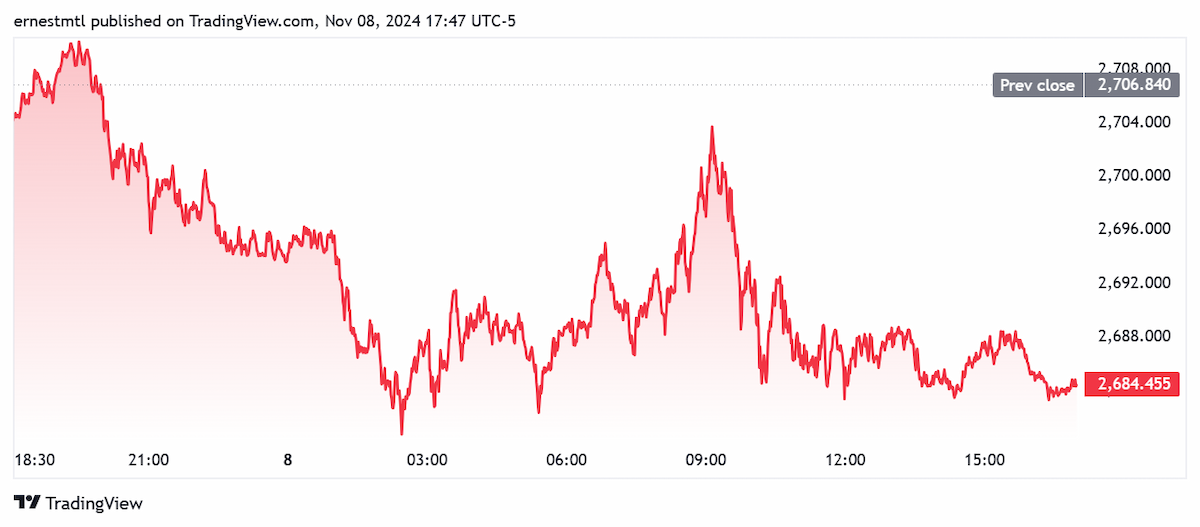
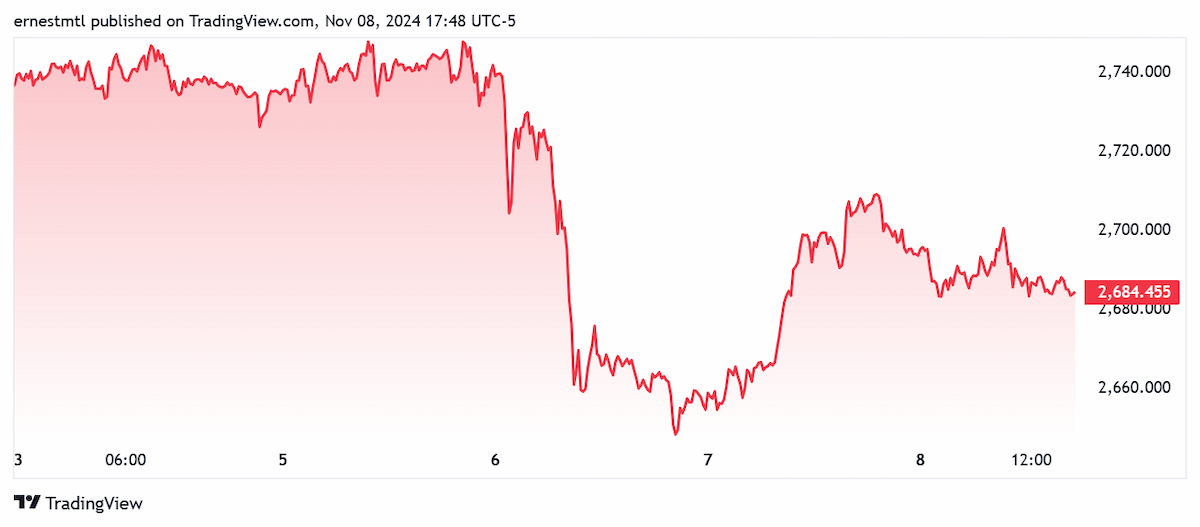
Spot gold kicked off the week trading at $2739.34 per ounce, and it spent the early part of the week oscillating within a narrow $20 range between a low of $2,726 at 9:30 pm EST Monday evening and a high just below $2,748 on the morning of Election Day.
This was one of the narrowest and least volatile multi-day stretches for gold in some time, and it was clear that traders didn't want to make a move in either direction until the polls gave them good reason.
That reason arrived shortly before 1:00 a.m. Eastern on Wednesday, when critical swing states began to be called in favor of Republican candidate Donald Trump, making Vice President Kamala Harris' bid for the presidency virtually impossible. Spot gold responded by falling from $2,739 per ounce at 12:45 a.m. to test the $2,700 level by 1:30 a.m., and after a relatively brief bounce back up to $2,730 per ounce by 3:30 a.m., it finally broke decisively through support just after 6:30 a.m. Eastern, falling all the way to $2,659 per ounce by the North American market open on Wednesday morning.
Gold prices attempted to stage another recovery later in the morning, rising as high as $2,676 per ounce just before 11:00 a.m., but the yellow metal weakened once again as the day progressed, and by 8:30 pm EST it had set the weekly low around $2,648 per ounce.
From there, it began a steady climb higher on Thursday as the U.S. dollar and treasury yields pulled back from their post-election highs, with gold testing the $2,700 per ounce resistance level twice during the North American session before sliding back to $2,690 after the Federal Reserve announced the expected 25 basis point rate cut.
But the week's drama was not yet over, as a testy exchange between Fed chair Powell and reporters during the post-FOMC press conference saw gold shoot up to $2,707 in minutes. After two attempts to break through $2,710 failed in the early evening, gold slid back down into the $2,680s, where, apart from a brief spike back to $2,700 at 9:00 a.m. EST, it traded for the remainder of the Friday session.
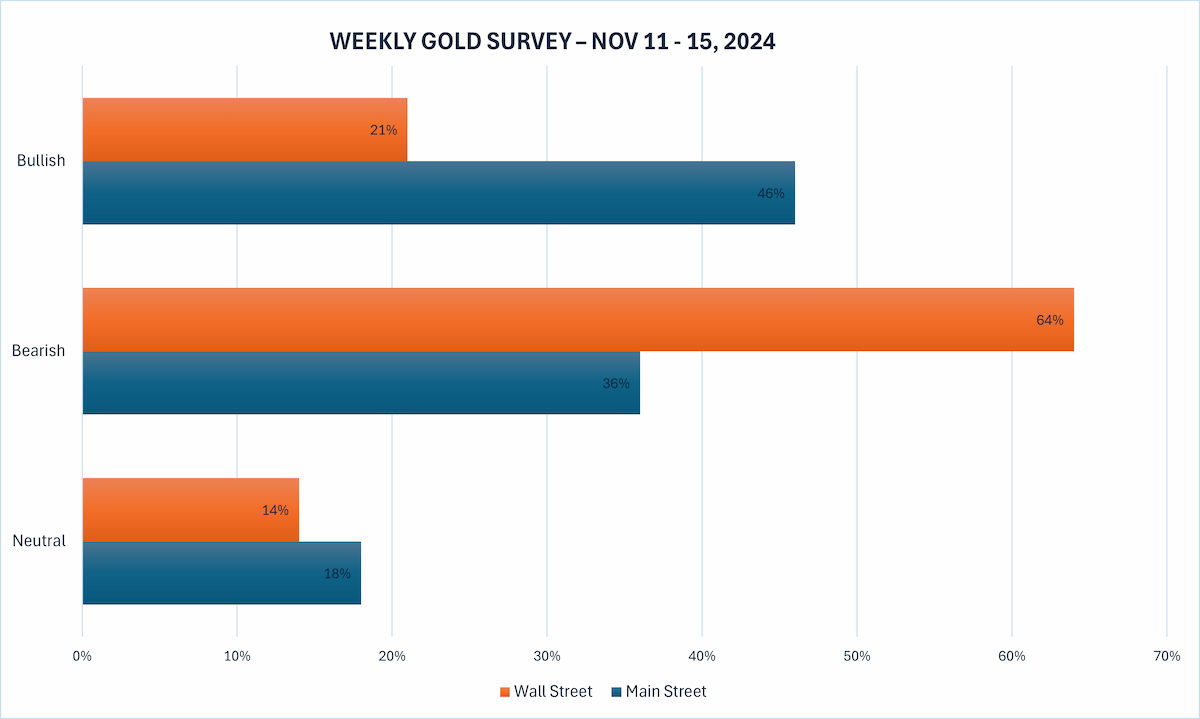
The latest Kitco News Weekly Gold Survey showed overwhelmingly bearish sentiment from industry experts, while the bullish contingent of retail traders also slipped into the minority for the first time in months.
“Down,” said Darin Newsom, senior market analyst at Barchart.com. “While I think the market will uncover new investor long hedging interest, the December futures contract has not finished off the short-term downtrend on its daily close-only chart. This leaves the door open to renewed selling early next week. It’s interesting to note Dec found some support near a previous high daily close of $2,676.30 (October 11) this week as it posted a low daily close at exactly $2,676.30. Maybe that was just a technical anomaly, but interesting nonetheless.”
David Morrison, senior market analyst at Trade Nation, said the technical picture suggests further declines for gold prices.
“Gold slumped on Wednesday as it became clear that Trump had won a second term as US President. Much of the sell-off could be blamed on the US dollar which soared on the news. And this, in turn, could be blamed on the sharp jump in bond yields as investors feared that Trump’s promised tariffs and tax cuts would lead to a resurgence of inflation.”
Morrison said that since then, the dollar and yields have returned to more reasonable levels. “This helped gold find a floor and put in a bit of a rally yesterday. But the rally ran out of puff earlier this morning, and gold is once again succumbing to selling pressure,” he said. “Support for the metal continues to hold between $2,635-$2,675. This is an area that acted as resistance in the last week of September and the first of October. Gold managed to break back above $2,700 yesterday evening, but was unable to hold it as support. Instead, it drifted lower in the Asian Pacific session until it found some support around $2,680.”
“Silver is also under pressure, although it has managed to push back above $31,” Morrison noted. “It will be interesting to see how both behave going into the weekend. Will the bullish trend reestablish itself, or should traders expect further weakness? Looking at the daily MACD on both suggests that the momentum is to the downside. This won’t change until areas of significant support are established.”
“Lower, said Adam Button, head of currency strategy at Forexlive.com. “I think some consolidation is in order following the election, but I’ll be closely watching for signs of who will be the next Treasury Secretary. Trump announced Mnuchin on Nov 29 and Biden picked Yellen on Nov 23, so it’s probably not next week but will be soon. If the pick is John Paulson – a major gold bull – then I expect a gold rally.”
“Up,” said James Stanley, senior market strategist at Forex.com. “It looked dicey after the election but the response since then has been pretty positive, with bulls defending 2650 on spot and pushing back up to 2700. Normally with price action of that nature, I’d start leaning towards a bearish bias but given how strong gold has been this year I’m not quite ready to reverse yet, so sticking with bullish.”
“Down,” said Adrian Day, president of Adrian Day Asset Management. “A continued breather in gold would not be untoward, as some investors lock in profits even as both central bank and China consumer buying declines from earlier highs. However, the drivers for all the different buyers remain: neither the desire of some central banks to diversify away from dependence on the dollar nor Chinese concern about the economy and banks has diminished, while it is clear that the Federal Reserve and other central banks will continue to ease policy amid slowing economies, even before inflation is firmly quashed, amid high fiscal deficits that are not likely to come under control.”
“Recall that gold has a similar reaction with the election of Donald Trump in 2016 on, just as now, optimism of economic growth, a strong dollar and strong equity markets,” Day added. “That pullback that lasted about six weeks.”
Frank Sohlleder, analyst at ActivTrades, also believes gold likely has further to fall in the near term. “Despite its upward movement, gold has not yet been able to avert the danger of a major correction,” he said. “Even the further lowering of the key interest rate in the USA could not ensure that gold would have experienced strong demand. It must therefore still be assumed that it is possible that the gold price will continue to fall. Gold is currently trading at around USD 2,680 per troy ounce.”
“Down,” said Mark Leibovit, publisher of the VR Metals/Resource Letter. “Trump's potential success in the Mideast may put a damper on the run on gold which ran up because of the conflict. Yes, there are other reasons, and overall, my next big target of $3700 remains unchanged, but I have no timing on that at this time.”
“Bottom line, we are due for a retracement,” he added. “Best strategy I've been using is to keep core long positions and hedging with inverse gold and silver ETFs such as GLL and ZSL.”
Colin Cieszynski, chief market strategist at SIA Wealth Management, was unpacking the implications of the election on gold in the short and medium term. He said much of gold’s Tuesday night slide was just the threat of election unrest exiting the market.
“I think what happened was gold was pricing in a 2000 scenario,” he said. “Then, when you got a decisive win – to a certain extent, it didn't matter who, just that there was a winner – a certain amount of the event risk got peeled back off. Less than a month ago, gold was at $2,600. It's currently at $2,680 and the peak was around $2,780, so essentially that run-up from, let's call it $2,600 to $2,780, and we're back about half of it.”
“That last part was most likely ‘October surprise, election-turns-into-a-cluster,’ and all the rest of it, which did not materialize, so now gold is going back to where it was a month ago.”
The second factor Cieszynski cited was the U.S. dollar, which strengthened dramatically in the wake of Trump’s win, magnifying the gold-specific selloff.
“The U.S. dollar is up huge,” he said. “The U.S. dollar is gold's nemesis, and the U.S. dollar also has had a run, but that could also be the same underlying cause. The removal of election uncertainty has caused the U.S. dollar to rally and gold to go down. So it's ‘not gold is down brecause the dollar is up,’ it's ‘gold is down AND the dollar is up,’ because of this other event.”
“The inflation scenario probably doesn't change a bit,” he added, “especially if [Trump] really is going to bring in tariffs, which have the potential to be inflationary.”
The third factor that Cieszynski believes could change gold’s recent trajectory is that the Fed is once again dialing back rate cuts.
“To look to the medium term, one of the things that was underlying this gold rally is central banks are starting to cut,” he said. “They're cutting regularly, and in some cases, they're cutting quite aggressively. That could slow. This is the first week where we're starting to see talk that the Fed might skip a meeting. There was no talk of that even as recently as last week. The Bank of Canada is still going full-bore and some of the others are still, cut-cut-cut.”
This has been depressing the value of paper money and lifting the value of gold. “But if it starts to become a situation where the central banks start to cut back the pace of cuts, then that also is a headwind for gold,” he said. “I think gold may go into kind of a sideways range for a while, which is normal and long overdue considering just how much it's moved.”
“I'm, not totally convinced it'll have a big correction,” Cieszynski added. “I don't think it's going to go back to $2,000 or anything like that. Maybe $2,500 though, it could retest $2,500.”
Moving to the near term, Cieszynski thinks gold will slide further next week.
“I'm going to actually go bearish for next week,” he said. “And the reason I'm going to say that is gold's had a big run and technically it's due for a correction. It might not be a huge correction, but I think gold could struggle for another week. As it is, Monday’s already a partial holiday.
“I haven't changed my long-term outlook,” he added. “I just think in the short term that gold's probably due for a correction, especially now that we're past all the big events. We're past the election. We're past the Fed. The one thing is maybe you get some choppiness around inflation numbers.”
This week, 14 analysts participated in the Kitco News Gold Survey, and this week’s sharp selloff pushed the preponderance of Wall Street into a bearish outlook. Only three experts, or 21%, expected to see gold prices rise during the week ahead, while nine analysts, or 64%, predicted a price decline for the precious metal. The remaining two analysts, representing 14% of the total, expected a period of consolidation for gold.
Meanwhile, 249 votes were cast in Kitco’s online poll, with the unsinkable optimism of Main Street investors finally succumbing to doubt. 114 retail traders, or 46%, looked for gold prices to rise next week, while another 91, or 36%, expected the yellow metal to trade lower. The remaining 44 investors, representing 18% of the total, expected gold to trend sideways in the near term.
Next week’s economic calendar is on the light side, especially compared to this past week’s fireworks. The main economic news events to watch will be the Wednesday release of U.S. core CPI for October, which the Fed will closely monitor for indications that consumer inflation is continuing on the path toward 2 percent, Thursday’s U.S. PPI report and weekly jobless claims data, and the Friday morning release of U.S. retail sales for October, which should provide concrete evidence of Americans’ spending power in the current high-cost environment.
Federal Reserve Chair Jerome Powell will also be speaking on Thursday, which will be his first opportunity to contextualize his press conference comments about the incoming administration and the central bank's independence.
Marc Chandler, managing director at Bannockburn Global Forex, sees a period of consolidation ahead for gold but thinks any pullback is a good buying opportunity.
“Gold hit an air pocket in the middle of last week as US interest rates and the dollar surged in the immediate aftermath of the election,” he said. “The yellow metal tumbled a little more than 3%, and by the weekend, had recouped about half of it. Separately, it appears that the PBOC extended its halt of gold purchases.”
“The market seems to be in need of consolidation,” Chandler added. “A pullback toward $2600 in the spot market may be an attractive entry or re-entry area.”
Daniel Pavilonis, senior commodities broker at RJO Futures, agreed that relief over the resolved election was the near-term catalyst for gold’s selloff, but thinks this could be the start of a broader rebalancing of risks which could drive the yellow metal lower in the medium term.
“I think I think the market's reaction is almost deflationary, where you see rates have sold off and gold has come off at $2,800,” he said. “I think maybe we're in the beginnings of a mean reversion where we can see gold sell off into the 200-day moving average before it starts to move higher again.”
“I think another big portion of what would weigh on metals and even the 10-year yield would be slowing down or stopping these wars,” he added. “Ukraine-Russia, how do they make amends and what kind of effect would that have on precious metals? Because now we're looking at creating a relationship where there's not so much geopolitical risk.”
“And the other thing is, Putin came out and said that they're not trying to get away from the dollar,” Pavilonis said. “If you look at gold being bought up by BRICS and stuff like that, now you have a regime change in the White House.”
“It's been a great run to the upside,” he added. “You may see some major profit taking and then this washout moment, and then you start to see movement back into the market.”
The main reason why Pavilonis expects gold prices to continue higher once the correction plays out is that inflation is still very much in the cards.
“I don't think the inflation scenario is over,” he said. “I think it's just pausing, and we start to see rates move up again without the Fed funds rate, you start to see yields in tens, fives, and twos start to move higher, and the Fed is lowering interest rates. That's going to be extremely problematic too.”
“I think this is just a pause, and the market is just reevaluating what was supposed to happen, and maybe what will happen. I think that's what we're seeing here.”
For the near term, Pavilonis thinks gold will hover near its recent lows before climbing higher later in the week.
“I don't think this thing is going to be a new high, unless something dramatic happens, like Iran-Israel or something like that,” he said. “Barring geopolitical events really spiraling out of control, I think this is done for the time being. If we get a rally, the rally fails around the highs, and then I think you can come in and sell it, looking for a move down to [the 200-day MA]. Then from there, the trend is still to the upside.”
Alex Kuptsikevich, senior market analyst at FxPro, sees further downside risk to gold prices.
“Although gold rebounded encouragingly on Thursday, we doubt further gains in the coming weeks,” he said. “We attribute Thursday's recovery to gold bugs attempting to join the general pullback into risk assets, reinforced by the temporary pullback in the dollar that day. We do not rule out a deeper decline in price, correcting more than 50% of the rise from the lows of last October. Some capital parked in gold in recent months while the dollar strengthened, as it was a drag from risk. Now, gold may be in for a reversal.”
“The start of the corrective movement is confirmed by the return of the RSI on weekly timeframes from extreme overbought with values above 80,” he added. “The growth of the dollar may accelerate the global correction, but even without it, precious metals may face challenges.”
Kuptsikevich sees potential for a multi-stage decline in gold prices. “A consolidation under $2640 will mark the break of support in the form of the 50-day moving average and the deepening of the correction under the traditional 61.8% retracement from the August lows,” he wrote. “The next leg of the decline is seen as a correction to the $2400 area, where the 200-day moving average and the starting point of the last growth phase are centered.”
“From a more distant perspective, we see impressive chances of price pullback in the $2000 area,” he warned. “In this case, the previous area of highs may act as a global support.”
“A sharp return to growth will allow us to discuss the imminent renewal of historical highs,” Kuptsikevich concluded. “That is a real but alternative scenario. It seems to us that there is now more chance that gold will leave the top role for a while.”
“I see gold headed down,” said Michael Moor, Founder of Moor Analytics. “In a higher timeframe, we are still in an overall bull trend from November 2015, and likely in the later stages. Part of this is a prediction I made of $151 minimum, $954 (+) maximum from $2,148.4 – of which we have attained $653.4 so far. These are ON HOLD. In a lower time frame, the trade below 27730 (+4 tics per/hour) warned of decent pressure — we have seen $120.0. The trade below 27539 (+2 tics per/hour) has brought in $103.6 of pressure. The trade below 27141 (+2 per/hour) projects this downward $29 minimum, $100 (+) maximum — we have attained $64.1.
“We also left a medium bearish reversal above, which warns of pressure for days (in general, perhaps after a pullback),” he added. “Decent trade back above 28804 (+2 per/hour starting at 8:00 am) should bring in decent strength for days, and a good likelihood of a run for the highs (+) again.”
And Kitco Senior Analyst Jim Wyckoff expects to see gold prices head back up in the near term. “Steady-higher as charts still overall bullish and geopolitics still in play,” he said.
At the time of writing, spot gold last traded at $2,684.45 per ounce for a loss of 0.83% on the day and 1.74% on the week.