
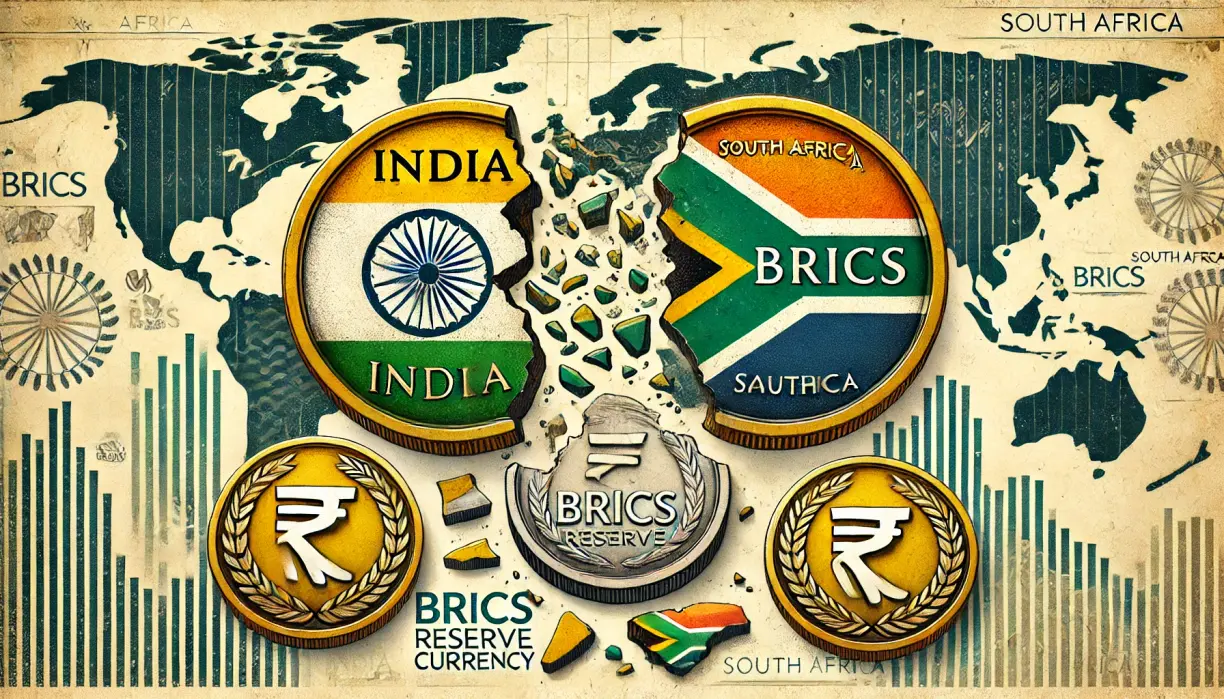
(Kitco News) – India has added itself to the list of core BRICS nations that have categorically ruled out participation in any process to create a reserve currency for the bloc to challenge the U.S. dollar following threats from President-elect Donald Trump to impose 100% tariffs on any country that pursues de-dollarization.
“The idea that the BRICS Countries are trying to move away from the dollar while we stand by and watch is OVER,” Trump said in an X post on Nov. 30. “We require a commitment from these Countries that they will neither create a new BRICS Currency, nor back any other Currency to replace the mighty U.S. Dollar or, they will face 100% Tariffs, and should expect to say goodbye to selling into the wonderful U.S. Economy.”
The BRICS trade bloc includes Brazil, Russia, India, China, and South Africa, as well as other developing nations.
South Africa was the first BRICS nation to respond to the threat, wasting no time issuing an official response the following day.
“Recent misreporting has led to the incorrect narrative that BRICS is planning to create a new currency,” South Africa’s Department of International Relations and Cooperation (DIRCO), said in a statement on Dec. 1. “This is not the case. The discussions within BRICS focus on trading among member countries using their own national currencies.”
DIRCO pointed out that the BRICS bloc’s New Development Bank continues to rely on the dollar for its investments in member states and other developing economies, which have exceeded $30 billion.
“South Africa supports the increased use of national currencies in international trade and financial transactions to mitigate the impact of foreign exchange fluctuations, rather than focusing on de-dollarisation,” it said. “The strengthening of correspondent banking networks and the development of infrastructure for settlements in national currencies could further this aim.”
Most recently, India’s External Affairs Minister (EAM) S Jaishankar responded to Trump's threat on Friday, saying that his country’s government has no intention of weakening the U.S. dollar.
“I am not exactly sure what was the trigger for it, but we've always said that India has never been for de-dollarisation,” Jaishankar said while addressing a panel discussion at the Doha Forum in Qatar. “Right now, there is no proposal to have a BRICS currency.”
The minister also insisted that the BRICS member states do not have a unified position on the issue, and the incoming President and current Indian Prime Minister have a good relationship.
“There is a personal relationship between PM Modi and Trump,” said Jaishankar. “Where the BRICS remarks were concerned, we have said that India has never been for de-dollarization. Right now, there is no proposal to have a BRICS currency. The BRICS do discuss financial transactions. The U.S. is our largest trade partner; we have no interest in weakening the U.S. dollar at all.
“We had a good relationship, a very solid relationship with the first Trump administration,” he added. “Yes, there were some issues, mostly trade-related issues, but there were a whole lot of issues on which Trump was very international.”
Trump threats could drive nations to gold
While Trump’s tariff threats may be considered empty by some economists, others note that his comments on social media are further examples of how the U.S. government continues to weaponize the dollar, compelling many nations to diversify their foreign reserves and buy gold.
BRICS nations, in particular, have been significant gold buyers in the last two years after the U.S. and its Western allies imposed economic sanctions on Russia following its invasion of Ukraine.
In a recent interview with Kitco News, Chantelle Schieven, Head of Research at Capitalight Research, noted that a global trade war caused by tit-for-tat tariffs should continue to support gold as a hedge against economic uncertainty and because of its role as an important reserve asset.
“The U.S. dollar isn’t going anywhere anytime soon, but these threats will encourage central banks to continue to buy more gold and diversify away from the U.S. dollar,” she said.
Schieven said she doesn’t expect Trump to follow through on his tariff threats if a trade war impacts the U.S. economy.
“The further he pushes towards that, the faster the rest of the world is going to question the role of the U.S. dollar,” she said. “Gold remains the only real alternative to the U.S. dollar.”
However, not all analysts are optimistic that gold will be the winner in a global trade war. Ricardo Evangelista, Senior Analyst at ActivTrades, said that anything that could impact the Federal Reserve’s easing cycle could weigh on the precious metal.
“The prospect of the incoming Trump administration triggering a trade war that could reignite inflation, combined with the robust performance of the US economy, further reinforces expectations that the central bank will slow the pace of rate cuts,” he said.
