

(Kitco News) – Following recent reports that surging gold shipments to the United States have led to a shortage in London and a new $82 billion stockpile in New York, the London Bullion Market Association (LBMA) said on Thursday it is coordinating with CME Group and U.S. authorities to address the significant price premium of COMEX gold compared to the London market price.
“The US gold market has been trading at a premium to the London market since the US presidential election result in late 2024,” the LBMA said. “This happens from time to time in markets around the world.”
The LBMA added that the physical gold stocks and liquidity of the London market remain strong. The CME Group and US Commodity Futures Trading Commission did not immediately respond to a Reuters request for comment.
The threat of wide-ranging tariffs on imports – and the fear that these could apply to precious metals – have set off a mad dash across metals markets to secure physical bullion stocks on U.S. soil in recent weeks, creating doubt about present stockpiles and future prices.
On Wednesday, the Financial Times reported that the added demand for gold from the United States has led to a shortage in London. “The wait to withdraw bullion stored in the Bank of England’s vaults has risen from a few days to between four and eight weeks, according to people familiar with the process, as the central bank struggles to keep up with demand,” the report said.
In the weeks since the U.S. election in early November, “gold traders and financial institutions have moved 393 metric tonnes into the vaults of the Comex commodity exchange in New York, driving its inventory levels up nearly 75 per cent to 926 tonnes — the highest level since August 2022.” The FT report cited market participants to pointed out that the real total could be far higher than the Comex numbers, “because there are likely to have been additional shipments to private vaults in New York owned by HSBC and JPMorgan.”
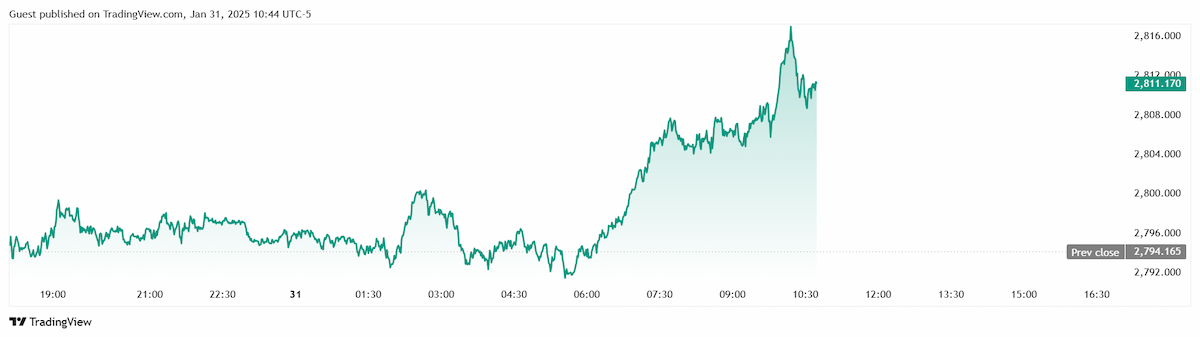
Precious metals prices were already enjoying a bid due to concerns over the inflationary impact of the Trump administration’s proposed tariffs. But the possibility that gold could be tariffed as a commodity – rather than exempted as a currency – helped drive spot gold to a new all-time high of $ 2,798.60 per ounce on Thursday.
On Friday morning, the yellow metal extended its gains to set a fresh all-time high of $2,817.21 at 10:12 am EST.
Kevin Grady, president of Phoenix Futures and Options, told Kitco News just before Trump’s inauguration that the uncertainty surrounding tariffs is definitely affecting the physical market.
“I think that's something we have to really keep an eye on,” Grady said. “We don't know how it's going to play out yet, because we don't know exactly what the tariffs are going to be, so the problem is you don't have all the information that you're supposed to be trading off of.”
“The marketplace is definitely aware of this,” he added, “but right now, it's very difficult to gauge it because we don't know exactly what [Trump] is going to do. What exactly are they looking for? Are there going to be any exemptions?”
“Everybody's watching this. I think that's the big story of Q1, Q2 of 2025.”
Asked how long before gold contracts seize up based on physical stocks located elsewhere and unavailable for delivery, Grady said it’s likely a question of weeks, or months at the most.
“I don't think it can go that long,” he said. “There's a difference between metal being out there, and getting deliverable metal. If you're taking delivery of a metal, it has to be in the exact specifics of the contract.”
The other major bottleneck facing the physical market – and the paper market that requires physical certainty – is the uncertainty surrounding the refining process.
“There may be a ton of gold out there, but it has to be refined,” Grady said. “We saw in 2020, during COVID, once they started ramping up again, you're getting in line at MKS or one of these refiners to say, ‘here I am, I want you to refine my gold so I can deliver it.’ So finding it is not just the answer; you have to have it refined, and it's a process, and it takes a long time. So it could seize up markets for a little while.”
“We've seen a lot of uncertainty in the OTC markets right now,” he added. “Even following the spread, it was like, squeeze, no squeeze, squeeze… the markets are all over the place.”
Grady believes the biggest financial firms are likely lobbying the new administration frantically behind the scenes, even as they do all they can to project calm and confidence in the broader marketplace.
“Right now, I think a lot of the bigger players are going to be speaking to Trump's transition team,” he said. “They're going to be saying, ‘Listen, you want the U.S. to be the marketplace; you want the U.S. to be the hub for everything, right? So, if you want that, you have to have seamless, calm markets.’ That's what you have to portray. They're not portraying that.”
“No one's going to hold metal in New York and have to ship it to London, or ship it to other places,” he added. “They're not going to want to do it. You're going to have a segregated market. A New York market, a London market, segregated markets.”
