

(Kitco News) – The threat of wide-ranging tariffs on imports – and the fear that these could apply to precious metals – has set off a mad dash across metals markets to secure physical bullion stocks on U.S. soil, creating doubt about present stockpiles and future prices.
The Financial Times reported on Wednesday evening that surging gold shipments to the United States have led to a shortage in London, with traders now amassing an $82 billion stockpile in New York. “The wait to withdraw bullion stored in the Bank of England’s vaults has risen from a few days to between four and eight weeks, according to people familiar with the process, as the central bank struggles to keep up with demand,” the report said.
In the weeks since the U.S. election in early November, “gold traders and financial institutions have moved 393 metric tonnes into the vaults of the Comex commodity exchange in New York, driving its inventory levels up nearly 75 per cent to 926 tonnes — the highest level since August 2022.” The FT report cited market participants to pointed out that the real total could be far higher than the Comex numbers, “because there are likely to have been additional shipments to private vaults in New York owned by HSBC and JPMorgan.”
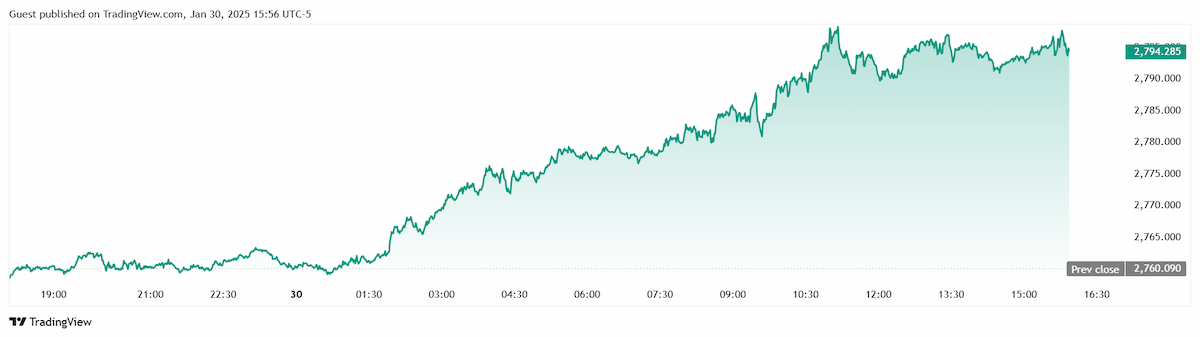
Precious metals prices were already enjoying a bid due to concerns over the inflationary impact of the Trump administration’s proposed tariffs. But the possibility that gold and silver could themselves be tariffed as commodities – rather than exempted as currencies – has helped drive spot gold to a fresh all-time high of $ 2,798.60 per ounce on Thursday.
Kevin Grady, president of Phoenix Futures and Options, told Kitco News just before Trump’s inauguration that the uncertainty surrounding tariffs is definitely affecting the physical market.
“I think that that's something we have to really keep an eye on,” Grady said. “We don't know how it's going to play out yet, because we don't know exactly what the tariffs are going to be, so the problem is you don't have all the information that you're supposed to be trading off of.”
“The marketplace is definitely aware of this,” he added, “but right now, it's very difficult to gauge it because we don't know exactly what [Trump] is going to do. What exactly are they looking for? Are there going to be any exemptions?”
“Everybody's watching this. I think that's the big story of Q1, Q2 of 2025.”
Asked how long before all of these contracts seize up based on physical stocks located elsewhere and unavailable for delivery, Grady said it’s likely a question of weeks, or months at the most.
“I don't think it can go that long,” he said. “There's a difference between metal being out there, and getting deliverable metal. If you're taking delivery of a metal, it has to be in the exact specifics of the contract.”
The other major bottleneck facing the physical market – and the paper market that requires physical certainty – is the uncertainty surrounding the refining process.
“There may be a ton of gold out there, but it has to be refined,” Grady said. “We saw in 2020, during COVID, once they started ramping up again, you're getting in line at MKS or one of these refiners to say, ‘here I am, I want you to refine my gold so I can deliver it.’ So, finding it is not just the answer, you have to have it refined, and it's a process, and it takes a long time. So it could seize up markets for a little while.”
“We've seen a lot of uncertainty in the OTC markets right now,” he added. “Even following the spread, it was like, squeeze, no squeeze, squeeze… the markets are all over the place.”
Grady believes the biggest financial firms are likely lobbying the new administration frantically behind the scenes, even as they do all they can to project calm and confidence in the broader marketplace.
“Right now, I think a lot of the bigger players are going to be speaking to Trump's transition team, and they're going to be saying, ‘Listen, you want the U.S. to be the marketplace, you want the U.S. to be the hub for everything, right? So, if you want that, you have to have seamless, calm markets.’ That's what you have to portray. They're not portraying that. “
“‘We're going to get the tariffs, whatever it takes,’ but they also want to be the global market,” Grady noted. “They're not going to want to push that market off to London or Singapore. They're going to want to keep it in the U.S., so I think they're going to have to figure something out where they can have a direct policy that accommodates the marketplace and makes it a smooth transition where people understand what's going on.”
“You have to price that in,” he added. “Right now, no one knows how to price it in. How much is the tariff going to be? We don't know, but now you have to factor that into every contract traded and delivered. It's very hard to quantify that.”
As for how long precious metals markets can operate under this degree of uncertainty, Grady said it's going to take at least a few delivery cycles before it becomes a full-on crisis.
“I don't know exactly what it's going to take, or how long,” he said. “They keep that stuff pretty tight-knit. And the banks are obviously not talking about it. The banks don't want to talk against their position, but at some point, they're going to be going to the politicians and saying, ‘Listen, we have an issue here, and you guys have to give us some clarity. And if you're not giving clarity, what's happening is you're starting to move the market off from the U.S., and people are going to start holding their metal in Europe. No one's going to hold metal in New York and have to ship it to London, or ship it to other places. They're not going to want to do it. You're going to have a segregated market. A New York market, a London market, segregated markets.”
John Weyer, director of the commercial hedge division at Walsh Trading, said the situation in the physical silver market, which is where the alarm bells first began sounding in mid-January, is even more fraught, because physical demand for the gray metal is much higher.
“There's always been these outlier thoughts on ‘do the reserves actually have this silver that they say they do, that represents all these contracts?’” Weyer told Kitco News on January 17. “There's been different, I won't call them conspiracy theories, but people have different theories that they don't have it all and they're going to have to go get it. The big difference between gold and silver is silver has a much greater industrial demand, usage-wise, versus gold.”
“I can see, if you were concerned about tariffs on imports, and you are the buyer of silver, regularly, for industrial use, maybe you're going to take the physical this time.”
Weyer also cautioned that even though the Trump administration has a very different attitude toward renewable energy than Biden, the massive infrastructure bills passed under the previous administration are still going to happen, and Republican lawmakers will have no qualms about spending the money.
“That money is going to be sent, that's a government project,” he said. “There's a lot of bridge and road work and other construction involved. And those things happen because it's been allocated, no matter who's in charge. The one thing about politicians is, they might not like the guy who passed or voted for that bill, but it's going to go in their district, so they're going to make sure those jobs and everything continue to be there as promised.”
And this means the demand for silver to support this massive industrial buildout isn’t going down, even as the chaos and uncertainty surrounding its availability and cost ramps up.
“If I'm one of those people involved with those [projects], and I know I need X, X, and X to get those projects done, and all of a sudden I’ve got a little fear that now the price over there is going to change, that may be one of the reasons people are taking the physical.”
