
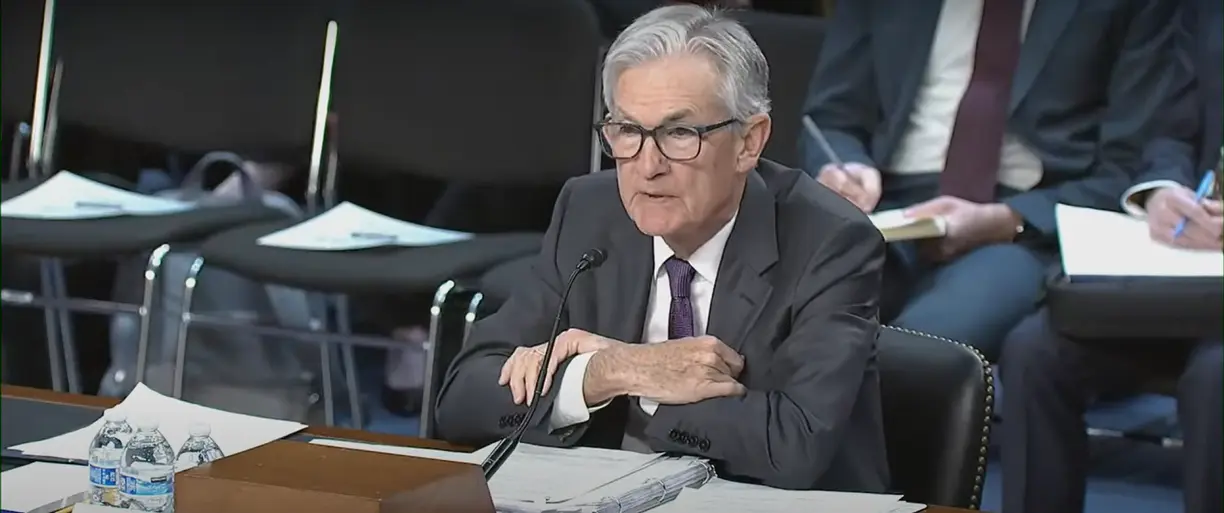
(Kitco News) – If Federal Reserve chair Jerome Powell found it challenging to avoid being cornered by journalists for his views on President Trump’s economic policies at his own press conferences, this week’s testimony before the Senate and House would demand Olympic-level agility: While the Powell calls upon journalists one by one and answers them as his discretion at the Fed, when he appears before congressional committees, he does so as a witness answering to the demands of another branch of government.
Trump’s proposed tariffs figured prominently in the questions from the Senate Banking, Housing, and Urban Affairs Committee on Tuesday, with Senator Chris Van Hollen (D-Maryland) attempting to coax out Powell’s views on their potential impacts.
“My question to you is simple: all things being equal, do big increases in tariffs, and increasing the deficit and debt, put upward pressure on inflation?” he asked. “Isn't that simple math?”
“It really does remain to be seen what tariff policies will be implemented,” Powell replied. “I just think it would be unwise to speculate when we really don't know. We see proposals, but it's so hard to say what's going to happen.”
“Well, last time the Trump administration was in office, the Fed took actions because they were concerned about the impact of increasing tariffs?” Van Hollen countered.
“We wound up cutting rates,” Powell conceded, “but it really was because growth slowed and confidence was weak, and the global economy was weakening, so the net effect of all that is what we look at.”
“It's really not just tariffs,” Powell continued. “It's tariffs, immigration, fiscal policy, and regulatory policy. Those will all go into a mix, and we'll try to make sense of it and do what's right for monetary policy.”
Senator John Warner (R-Virginia) questioned the implications of the United States government choosing to invalidate some of its treasury debt.
“Yesterday the President mentioned how he was ‘examining Treasury debt payments for possible fraud’ and suggested that our debt might not be as high,” Warner said. “We all understand the full faith and credit of the United States is based upon our reputation. If this President were to suddenly say ‘I'm wiping off X amount of debt because I don't believe we owe it’, what kind of effect would that have on both the stability of the dollar and the stability of our economy?”
As he has done at his post-FOMC press conferences, Powell refused to address Trump’s remarks. “It will probably not surprise you that I will defer to you on that question,” he said. “I'm not going to comment on things that the President says.”
Senator Warner also asked how Powell’s Fed would approach the stablecoin legislation that’s currently being formulated in Congress, and if he agrees that they should be treated similarly to other comparable financial instruments.
“We definitely support these efforts to create a regulatory framework around stablecoins,” Powell replied. “Stablecoins may have a big future with consumers and businesses… we can't know that now, but it is important for the development of stablecoins in a safe and sound manner, and manner that protects consumers and savers, that there be a regulatory framework. We see these bills and we're in contact – as we were in the last Congress and trying to add our technical thoughts on how to do this. We think it's a very constructive exercise.”
Senator Bernie Moreno (R-Ohio) did manage to get a categoric statement out of the central bank head when he asked about Powell’s position on a U.S. dollar CBDC. “Can I have your commitment that as long as you're the chairman of the Federal Reserve System, that we will never have a central bank digital currency?” he asked.
“Yes,” Powell replied.
The Fed chair will appear before the House Financial Services Committee on Wednesday.
