
(Kitco News) – While gold prices didn't face a singular negative catalyst, traders and investors still drove the yellow metal steadily lower to deliver its first weekly decline in over two months.
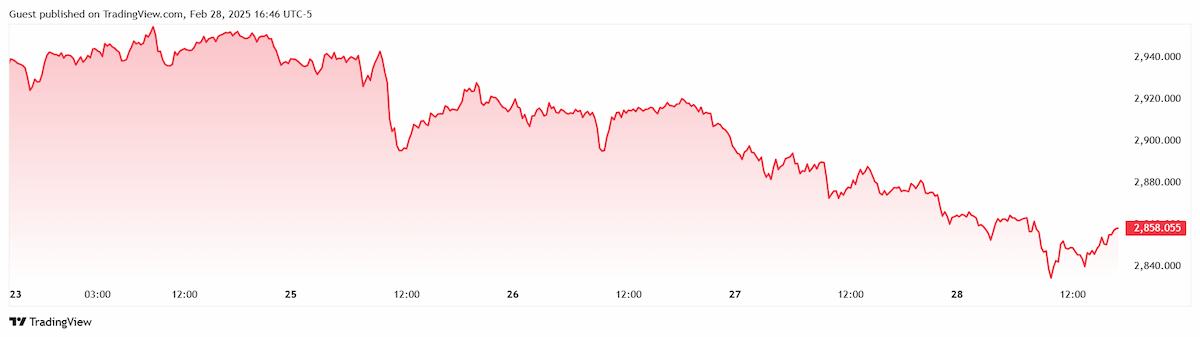
Spot gold kicked off the week trading at $2,939.10 per ounce, and after a brief dip down to $2,924, the yellow metal looked poised to challenge last week's all-time highs, topping out at $2,955 shortly after 8:45 a.m. EST on Monday morning.
But this proved to be the high point for gold this week, as a series of attempts to hold $2,950 failed on Monday evening. Still, 15 minutes before the North American market open on Tuesday, gold was still trading at $2,943 per ounce, but American traders quickly drove the spot price below $2,900 by 11:30 a.m. for its sharpest decline of the week.
From there, prices settled into a relatively narrow trading range between $2,895 and $2,920, but early Thursday morning saw spot gold break definitively below $2,890 per ounce, and after European traders failed to reclaim support, North American markets rode the yellow metal to fresh weekly lows.
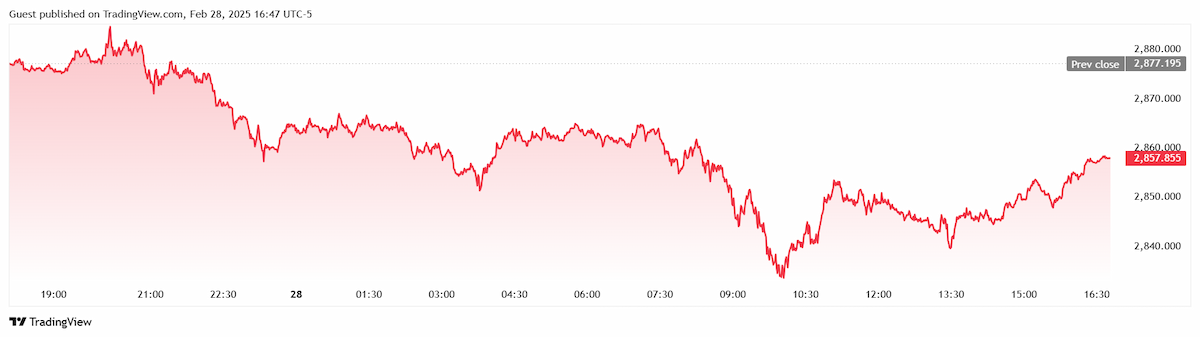
Gold prices then broke below $2,870 per ounce shortly after 10:00 p.m. Eastern on Thursday evening, with European markets trading the yellow metal to $2,850. By the time North American markets opened on Friday morning, gold was in the midst of its second steepest leg downward, hitting the weekly low of $2,834 per ounce 15 minutes later.
This time, it was American traders who pulled gold prices back from the brink, and while the yellow metal was unable to break back above $2,860, spot gold finished the week trading in the high $2,850s.
The latest Kitco News Weekly Gold Survey showed bullishness among both industry experts and retail traders becoming a minority viewpoint as gold prices slid steadily lower during each session.
“Down,” said Adrian Day, president of Adrian Day Asset Management. “There is no reason to think that this profit-taking correction will not continue for a little while, but we should remember that, so far, gold has dropped less than 4% from the top after running 12% this year.”
“At some point, the New York premium over London will evaporate which could see further declines,” Day cautioned. “But the fundamental reasons that have driven gold buying over the past two years remain, so any further pullback – perhaps down to the low $2600s – will be relatively short-lived.”
Marc Chandler, managing director at Bannockburn Global Forex, thinks the gold price correction is likely to continue in the near term.
“Gold set a record on Feb 24 near $2956. Profit-taking has kicked in in recent days,” he said. “Ironically, the precious yellow metal has acted more like a risk asset than a haven. It is poised to settle below its 20-day moving average for the second consecutive session. And the five-day moving average is poised to move below the 20-day moving average for the first time since early January. Moreover, gold’s drop has coincided with a sharp drop in US rates.”
“Initial support now may be near $2814, and a break could see $2770,” Chandler added. “The momentum indicators are turning down. Traders may want to be cautious about picking a bottom until there is some technical sign of an upside reversal.”
“Up,” said Rich Checkan, president and COO of Asset Strategies International, though he acknowledged that “it’s been a real bloodbath this week” in precious metals.
“The sell-off in both gold and silver for profit-taking – while healthy – was completely overdone,” he said. “Expect gold to come charging back next week as it builds support to assault $3,000.”
“Down,” said Darin Newsom, senior market analyst at Barchart.com. “No, I don’t think the situation has changed as the US administration continues to create global chaos. From a technical point of view, though, gold is in position to complete a bearish reversal pattern on its weekly chart. Does this mean anything in today’s algorithm-driven and safe-haven market? Probably not. But even the most bullish markets take a breather occasionally, and it could be gold’s turn next week.”
Daniel Pavilonis, senior commodities broker at RJO Futures, was looking at gold’s recent slide in the context of the economic data and the broader market pullback.
“Obviously, the tariffs are causing some inflation on, inflation off, risk-off appetite across the market. We’re seeing the metals peel back at the same time equities peel back, so it's more of a risk-off type of situation, which could be very short term, versus any kind of fundamentals that are driving this thing higher long-term. I think that's what we're seeing right now.”
“Maybe equities start to move higher from here, and then gold starts to get a little bit of a reprieve,” he suggested. “We saw this panic across the market, but now I think you'll start to see some buying come in, which usually comes in at the beginning of the month, though lately it's been coming in towards the end of the month and the beginning of the month. I think that will be supportive for gold prices.”
Pavilonis said some of gold’s near-term weakness is reflected in technical levels and correlations with other assets. “We got close to $3,000, $2,974, and now we're backing off,” he said. “It can really start to be $2,600 in the cards, the 200-day moving average. Bitcoin, another risk asset, sold off below $80,000. You can overlay every single one of these charts, and it's all the same. Bitcoin, gold, S&P, they all started selling off at the same time. They all made a very similar move, and interest rates also backed off.”
“I think it's just risk-off right now, and this might be short-term,” he added. “If you see equities start to turn around, I think you'll see gold turn around, and then risk appetite come back. Gold's had a very good year, so probably the same reasons why you're seeing equities sell off.”
Looking ahead to Friday’s non-farm payrolls report for January, Pavilonis said he expects it will likely be a non-event for gold and the broader market.
“I don't think there's going to be any movement on rates, or equities being liquidated on worse-than-expected payrolls, he said. “Look, you can see what happened in 2006 – I remember that like yesterday – here there were massive layoffs, but at the same time stocks just kept on going higher, and I think that the perception was, ‘Hey, these companies are more profitable, they're trimming the fat, and they're leaner.’ Eventually, it’s just less jobs; nobody's buying your product now.”
Pavilonis doesn’t see that kind of job destruction right now. “We’re shedding jobs, but a lot of them are these government-funded jobs, and they weren't extremely productive anyway,” he said. “I'd be really surprised if we see a huge move off of this. If it is a big move, it'll just be the initial overreaction, and then I think we'll continue to see stocks climb higher and gold climb higher, too.”
“If we do start to have a risk-off scenario where equities do start to break, [if they] close below, let's say 5,700 on the S&P, I think that would give gold the move down to the 200-day moving average around $2,600,” he cautioned. “Maybe you're a little bit below that, but I think ultimately that would be a buying opportunity there.”
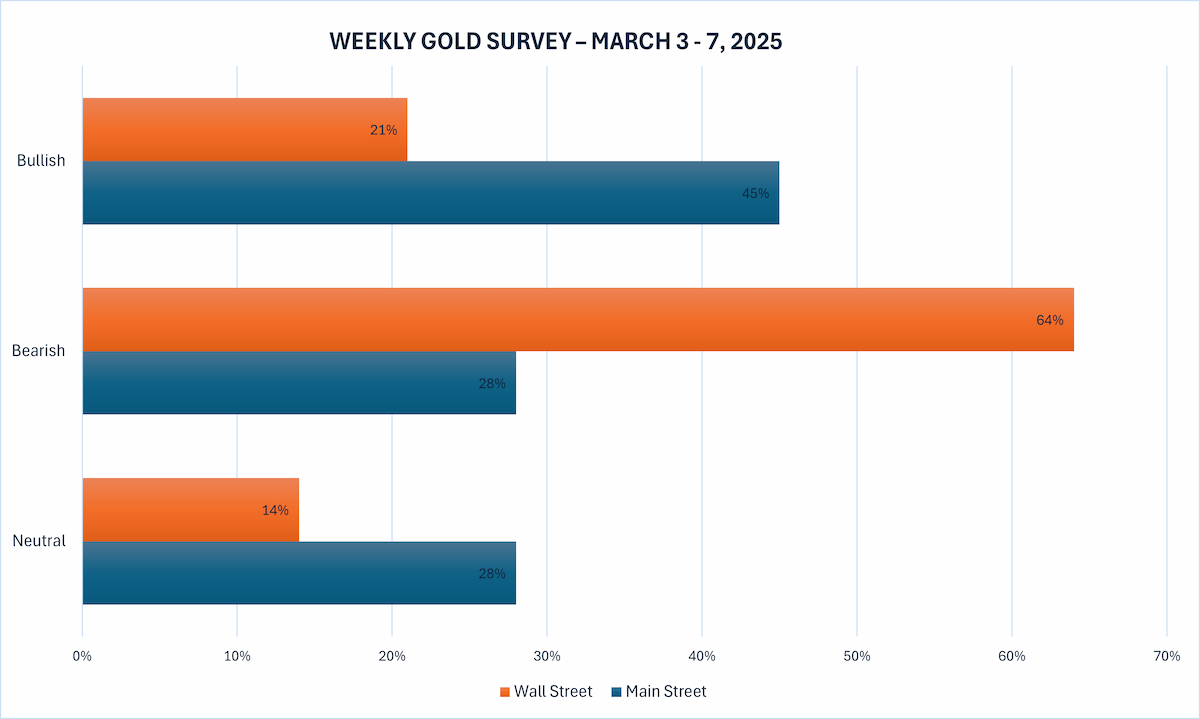
This week, 14 analysts participated in the Kitco News Gold Survey, with Wall Street’s near-term bullish sentiment all but evaporating. Only three experts, or 21%, expect to see gold prices rise during the week ahead, while nine analysts, or 64%, predicted a price decline for the precious metal. The remaining two experts, representing 14% of the total, saw sideways trading for gold next week.
Meanwhile, 138 votes were cast in Kitco’s online poll, with Main Street bulls sliding into the minority for the first time in a while. 62 retail traders, or 45%, looked for gold prices to rise higher next week, while another 38, or 28%, expected the yellow metal to trade lower. The remaining 38 investors, representing 28% of the total, saw gold consolidating in the near term.
Employment will once again be the focus of the economic news calendar next week, as market participants will be eagerly awaiting the release of February’s nonfarm payrolls report on Friday morning. Other highlights will include the Monday release of Euro flash CPI estimates and U.S. ISM Manufacturing PMI, Wednesday’s ADP employment report and U.S. ISM Services PMI, and Thursday’s weekly jobless claims data.
The other major event next week is the European Central Bank’s monetary policy decision on Thursday, with economists expecting another interest rate cut.
Adam Button, head of currency strategy at Forexlive.com, sees gold trending lower during the coming week.
“Eyes will be on the possibility of fiscal stimulus at the National People’s Congress in China next week,” he said. “With growth prospects improving, Chinese investors are shifting to equities from gold.”
Everett Millman, chief market analyst at Gainesville Coins, wasn’t hitting the panic button on Friday despite gold’s weeklong slide.
“I think it's part of a general trend of investment dollars racing to the sidelines right now, given all of the uncertainty with global trade, the U. S. economy, everything going on in Washington,” Millman said. “I think it's just investors converting their assets to cash, waiting for a better entry point or opportunity.”
“It also strikes me as a garden-variety correction for gold,” he added. “If you look at the year-to-date chart for gold, it's just up and to the right, almost at a perfect 45-degree angle, prior to this week. That's a lot of gains in a short span of time for the gold market, and even though the underlying fundamentals support this kind of unprecedented rally for gold, it is still the gold market. It may not be your father's or grandfather's gold market, but almost inevitably, when there is a strong run-up in the gold price, we tend to see these kinds of pullbacks and corrections to let off some of the steam. Maybe, some hot money that jumped on the gold bandwagon is now taking profits and getting out. I think it's a very normal and expected correction.”
Millman said that he’s still very comfortable projecting gold prices above $3,000 per ounce in the not-too-distant future, and believes the yellow metal has a good chance of converting this level into support.
“If and when that happens, that is what I would expect, just based off of the recent price action,” he said. “Every time gold has crossed one of these new all-time high milestones – above $2,700, $2,800, $2,900 – that has generally turned into a floor of support.”
“I know that we're back below $2,900 now, but it does seem unavoidable that gold is going to, in short order, break the $3,000 level,” he added. “It's in the headlines; finally, the mainstream news is taking notice. The price targets for virtually all of the Wall Street banks are meaningfully above $3,000 an ounce at some point this year. There's clearly quite a bit of momentum behind the gold trade right now.”
“There seems to be a broader inflation trade that is driving the entire commodities complex higher, and gold fits right in there with that.”
Turning to gold’s geopolitical drivers, Millman offered a nuanced take on the potential impacts of the Trump administration's attempts to end the conflicts in Ukraine and Gaza.
“I think the best way to think about whether the resolution that we're potentially going to see in Gaza and in Ukraine, whether or not that is supportive of gold, is based on how the rest of the world views those resolutions,” he said. “Even though an end, or at least a temporary pause, to hostilities in those two hotbed regions would seem to be something that would normally drive gold lower as people feel less inclined to park their money in a safe haven, I think it's fair to say that there's quite a bit of dissatisfaction with those outcomes. Even with an end to the immediate fighting, they are still broadly speaking unpopular resolutions to much of Europe, to much of North America.”
“I think that it actually makes it supportive of gold prices, because even if there is a settlement between Russia and Ukraine, and between Palestine and Israel, if those resolutions are not actually popular among the constituencies who want to see a certain outcome, then it is going to continue to exacerbate those anxieties about the instability of the geopolitical order,” Millman said.
“I do think that is still supportive of higher gold prices.”
Alex Kuptsikevich, senior market analyst at FxPro, was unpacking the implications of gold’s first real setback after its eight-week rally.
“After starting the week with an attempt to renew its highs, the precious metal has been hit by a more intense sell-off,” he noted. “We saw a similar dynamic at the beginning of February, suggesting that sellers are very active at current levels. The increased push into US government bonds well explains this momentum. Investors moved into long-term US Treasuries in response to the many initiatives by the current President's administration to reduce the national budget. The market reaction is not a measure of the effectiveness of these initiatives, but it is sufficiently focused at this stage.”
“The potential pullback in gold allows us to consider the $2800 area as a potential target for the current downside momentum from 2955. This is the area of the peak at the end of October last year and the 61.8% Fibonacci retracement level,” Kuptsikevich added. “A break below would signal the beginning of a reversal to the downside.”
“Flat gold and silver,” said Mark Leibovit, publisher of the VR Metals/Resource Letter.
And Kitco Senior Analyst Jim Wyckoff still expects to see gold prices pull back in the near term. “Steady lower,” he said. “Near-term technical damage inflicted.”
“Also, there’s an old trading adage that goes like this: ‘A bull market needs to be fed fresh, bullish fundamental news often to continue its run higher.’ Lately, fresh bullish news for gold has been lacking,” Wyckoff added. “However, I do expect existing bullish elements like U.S. trade tariff threats will continue to keep a floor under gold prices.”
At the time of writing, spot gold last traded at $2,858.05 per ounce for a loss of 0.67% on the day and 2.78% on the week.