
(Kitco News) – The U.S. housing market showed signs of improvement after the number of potential home buyers rose beyond expectations last month, according to the latest data from the National Association of Realtors (NAR).
The U.S. pending home sales index rose 2.0% in February to 72 after last month’s all-time low reading of 70.6, the NAR announced on Thursday. The data was better than forecasts, as economists expected a 1.5% gain. January’s 4.6% decrease was unrevised.
Pending home sales declined in the Northeast and West, while the Midwest and the South saw increases.
For the year, pending home sales fell 3.6% in February against expectations for a 3.7% decline, and following the unrevised 5.2% decline in January. All four regions posted losses year-over-year, with the Midwest showing the biggest decline.
“Despite the modest monthly increase, contract signings remain well below normal historical levels,” said NAR Chief Economist Lawrence Yun. “A meaningful decline in mortgage rates would help both demand and supply – demand by boosting affordability, and supply by lessening the power of the mortgage rate lock-in effect.”
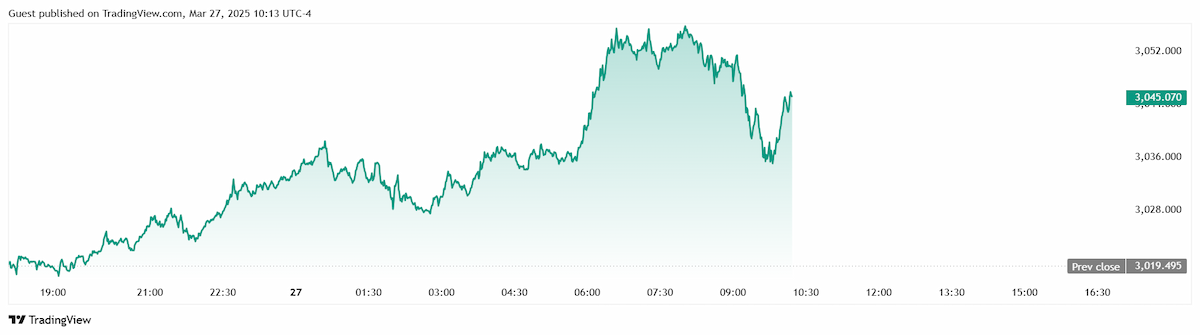
Spot gold was rising once again in the minutes following the housing data after pulling back to support near $3,035 after the North American equity open. It last traded at $3,045.11 per ounce for a gain of 0.85% on the day.
The NAR also shared its Quarterly Economic Forecast, which includes the latest projections for the U.S. housing market in 2025 and 2026.
“Considering the Federal Reserve's recent forecast for slower economic growth, we expect mortgage rates to slide moderately lower,” said Yun. “But the current high national debt will prevent mortgage rates from falling drastically – and certainly not to the 4%-to-5% range seen during President Trump's first term.”
The NAR forecasts mortgage rates will average 6.4% in 2025 and 6.1% in 2026. The association expects existing-home sales will rise by 6% in 2025 and accelerate another 11% in 2026. They added that the new-home sales market has plenty of inventory and they anticipate it will rise by 10% in 2025 and an additional 5% in 2026, with the national median home price increasing by 3% in 2025 and 4% in 2026.
“Home price growth will moderate due to more supply coming onto the market,” Yun added. “Having income and wages rise faster than home prices are welcome to improve affordability.”
Economists pay close attention to pending home sales because the report is a leading indicator of existing home sales given that contracts are signed a few months before homes are actually sold.
The U.S. housing market has been trying to stabilize after seeing significant weakness through most of 2023 and early 2024. Many potential home buyers have been priced out of the market due to rising prices and higher mortgage rates.
