

(Kitco News) – The U.S. service sector largely held its ground last month, with employment and new orders improving while prices and business activity worsened, according to the latest data from the Institute for Supply Management (ISM).
The ISM announced on Monday morning that its Services Purchasing Managers Index rose to 51.6 in April, up from March’s reading of 50.8. The data was better than expected, as economists were looking for a reading of 50.6.
Readings above 50 in such diffusion indexes signify economic growth and vice versa. The farther an indicator is above or below 50, the greater or smaller the rate of change.
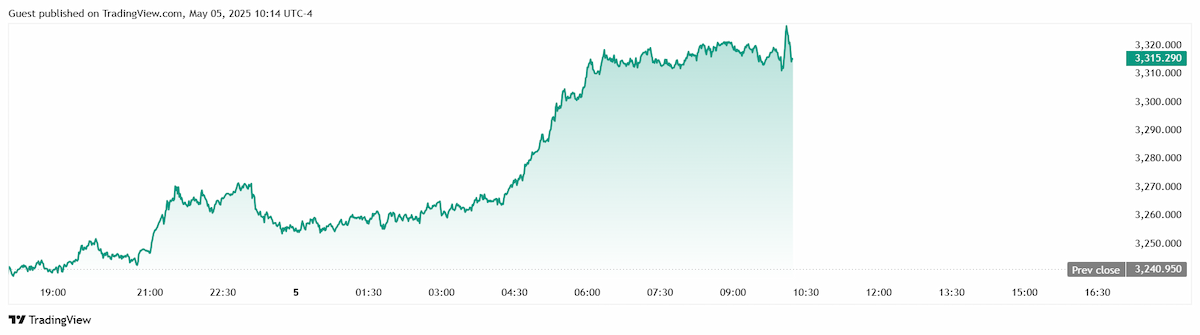
Gold spiked to a fresh session high of $3,328.85 per ounce following the 10 am EDT release. Spot gold last traded at $3,316.19 for a gain of 2.32% on the daily chart.
The components of the report showed the sector worsening in some areas while improving in others. The New Orders Index rose to 52.3, up from 50.4 in March, and the Supplier Deliveries Index rose to 51.3 from 50.64 recorded the prior month. The Employment index also rose to 49 from the 46.2 reading the prior month.
At the same time, the Business Activity Index fell to 53.7, compared to March’s reading of 55.9, and inflation pressures rose sharply in the sector, with the Prices Index coming in at 65.1, up from 60.9 in March.
“Eleven industries reported growth in April, a drop of three from the 14 industries reported in January and February,” said Steve Miller, chair of the Institute for Supply Management Services Business Survey Committee. “ The Services PMI has expanded in 55 of the last 58 months dating back to June 2020. The April reading of 51.6 percent is 1 percentage point below the 12-month average reading of 52.6 percent.”
“April’s change in indexes was a reversal of March’s direction, with increases in three (New Orders, Employment and Supplier Deliveries) of the four subindexes that directly factor into the Services PMI,” Miller said. “Of those four, only the Business Activity Index had a lower reading compared to March. Employment continues to be the only one of these subindexes in contraction territory, with two straight months of contraction. From December through February, all four subindexes were in expansion.”
“Regarding tariffs, respondents cited actual pricing impacts as concerns, more so than uncertainty and future pressures,” he added. “Respondents continue to mention federal agency budget cuts as a drag on business, but overall, results are improving.”
