
(Kitco News) – While this week’s economic news focused on inflation and the health of the American consumer, next week the spotlight centers once again on the Federal Reserve.
The U.S. Bureau of Labor Statistics reported on Tuesday that the Consumer Price Index rose 0.2% last month after June’s 0.3% increase, in line with expectations, and 2.7% over the past 12 months, which was slightly below expectations for a 2.8% increase.
At the same time, core inflation, which strips out volatile food and energy prices, rose 0.3% last month, matching June’s increase of 0.3% and aligning with consensus forecasts. But annual core inflation rose 3.1%, slightly hotter than the expected 3.0% increase.
Then a sharp rise in the U.S. Producer Price Index on Thursday created further volatility for gold prices. The headline PPI jumped 0.9% in July, much hotter than expected, as the consensus forecast had called for a 0.2% increase. Annual PPI also rose 3.3% in July, the largest 12-month increase since a 3.4% rise in February 2025.
Core PPI, which strips out volatile food and energy costs, rose 0.9% last month, following June’s unchanged reading. In the past 12 months, core PPI increased 2.8%.
Friday was all about the U.S. consumer, with the market receiving both good and bad news.
The July U.S. retail sales report showed a rise of 0.5% following a reading of 0.6% in June, in line with expectations. The annual number was even better, as retail sales increased 3.9% against expectations for a 3.5% increase, while core sales were up 0.3% last month, matching the consensus, and June’s print was revised up to 0.8%.
Then later in the morning, the preliminary University of Michigan Consumer Sentiment survey for August came in at 58.6, well below July’s final reading of 61.7. The data was also well below expectations for an improvement to 62.
“Consumer sentiment fell back about 5% in August, declining for the first time in four months,” said Surveys of Consumers Director Joanne Hsu. “This deterioration largely stems from rising worries about inflation.”
Bill Adams, Chief Economist for Comerica Bank, told Kitco News that the U.S. consumer looks mixed at the start of the third quarter following a wobbly second quarter.
“On spending, sales rose solidly across many discretionary categories, with solid increases in motor vehicles and parts, furniture and home furnishings, clothing and clothing accessories, and sporting goods, hobby, musical instrument, and bookstores,” he wrote. “Consumers took advantage of EV subsidies in July before their phase-out, online spending was solid during Prime Day promotions, and back-to-school shopping was pretty good, too.”
Adams said the retail sales report also had decent news about services spending. “Americans hit the road in the peak of summer vacation season: Gasoline station sales rose 0.7% on the month, indicating a solid increase in volumes since gas prices were down 2.2% in the CPI report. Restaurant spending dipped 0.4% on the month, suggesting the mass market consumer was still looking to economize amid ongoing pocketbook pressures. Even so, the July data indicate much more gasoline consumption than in July 2024, since the 2.9% drop in sales was much smaller than the 9.5% drop in gasoline prices. Spending on food services and drinking places rose 5.6% on the year, outpacing the 3.9% increase in prices of food away from home.”
“Building material, garden equipment and supply store sales fell 1.0% on the month and 2.6% on the year,” he cautioned. “This confirms ongoing headwinds to consumer spending on residential repairs and improvements, a component of real private residential investment in the GDP report.”
“In short, the U.S. consumer is in okay shape,” Adams said. “Sentiment is sour, but actual behavior looks okay. Consumer spending will likely grow moderately in the second half of 2025, then get an incremental boost in 2026 as tax cuts bolster disposable incomes.”
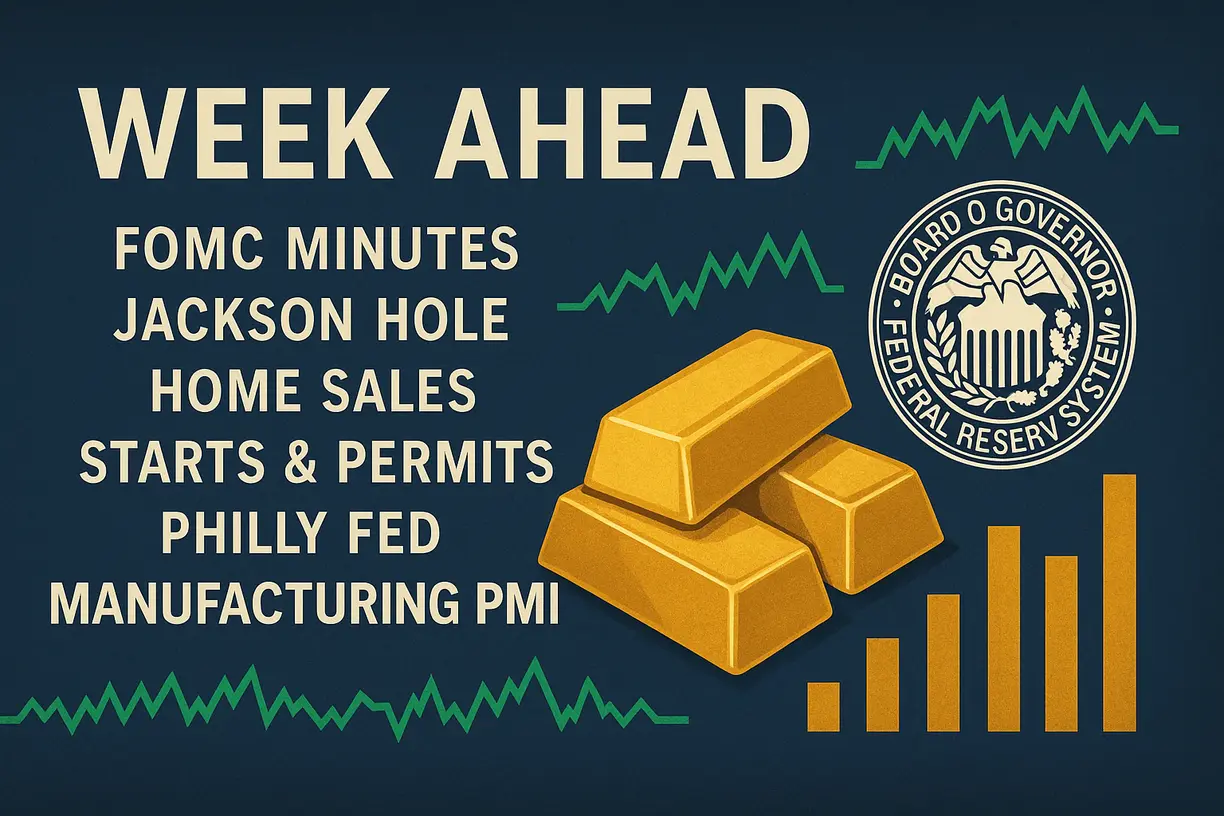
Next week is a slower one for economic data, so markets will focus on two in-depth looks into the Federal Reserve – one past and one future.
Tuesday morning will see the release of housing starts and building permits for July, before a Fed-heavy Wednesday featuring the FOMC minutes from the July meeting, speeches from Fed governors Waller and Bostic, and the start of the central bank's annual Jackson Hole Symposium.
Thursday morning features a full slate of data, including the Philly Fed manufacturing index, weekly jobless claims, the S&P Global flash PMI for August, and existing home sales for July.
The week wraps up with all eyes on Federal Reserve chair Jerome Powell when he delivers his annual speech from Jackson Hole on Friday morning.
Economic data to watch next week:
Tuesday: Housing Starts and Building Permits for July, Fed’s Bowman speaks
Wednesday: FOMC Minutes from July, Fed’s Waller and Bostic speak, Jackson Hole Symposium begins
Thursday: Philly Fed Manufacturing Index, Weekly Jobless Claims, S&P Global Composite PMI Flash, Existing Home Sales for July
Friday: Fed Chair Powell Speech from Jackson Hole
