
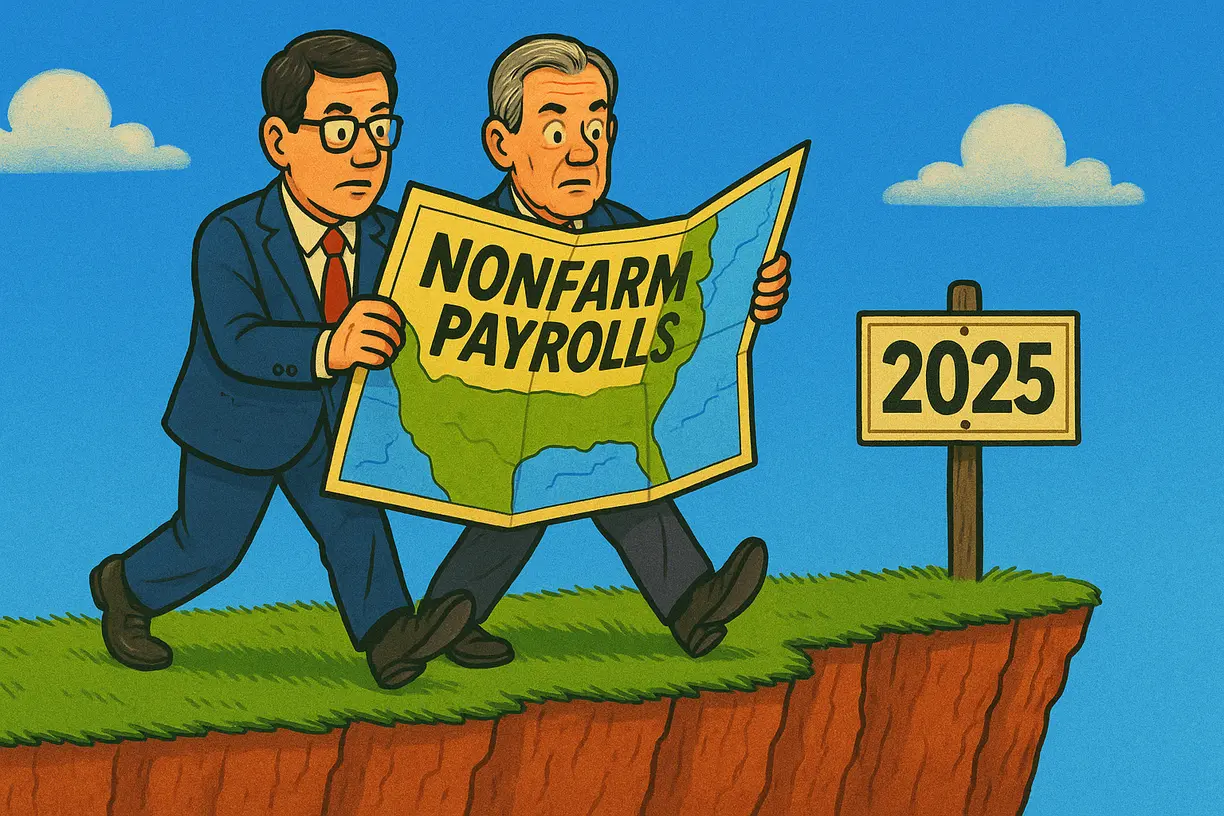
(Kitco News) – The U.S. government shutdown means Wednesday’s ADP employment report – which undershot expectations by over 50,000 jobs – may be the only national snapshot of American jobs that markets receive for some time.
But according to a growing number of economists and market analysts, the government’s premier measure of U.S. employment is antiquated, inaccurate, and serves only to mislead markets and policymakers rather than informing them – and recent policy changes have made nonfarm payrolls less meaningful than ever before.
BLS takes the L
Kevin Grady, president of Phoenix Futures and Options, told Kitco News in a recent interview that serious market participants have very good reasons to discount the jobs data.
“What's happening now is that people are starting to say, ‘I have to look at the trend, I can't look at the specific jobs data that's coming out,’ because we know the next job number that's coming out is not going to be correct. It's not going to be accurate,” he said. “We can't take that like, ‘This is the number, we agree, this is it.’ Everybody has to take the numbers with a grain of salt.”
The markets were salty indeed when the Bureau of Labor Statistics (BLS) announced on Sept. 9 that the preliminary revisions to U.S. employment subtracted 911,000 jobs – three times more than the 10-year average and the worst print on record.
President Trump had already fired BLS commissioner Erika McEntarfer on August 1, hours after the nonfarm payrolls report showed 33,000 fewer jobs than markets anticipated, along with downward revisions totaling 258,000 to the data for May and June.
When the annual revisions came out five weeks later, White House Press Secretary Karoline Leavitt referred to the BLS as “broken.”
“This is exactly why we need new leadership to restore trust and confidence in the BLS's data on behalf of the financial markets, businesses, policymakers, and families that rely on this data to make major decisions,” Leavitt said in a release.
1970s metrics for 2020s markets
Grady said the Trump administration’s criticisms on this front are well-founded. “They're using 1970s metrics to get this data,” he said. “You can't run an economy based on that. It just doesn't work.”
He compares the BLS data to the draconian position the brokers and the exchanges are in regarding the accuracy of their own disclosures.
“We have to have all this data, we have to give it to the exchange, to the CFTC,” he said. “Everybody wants to know your data, based on real-time, because the markets depend on it. But when it comes to the government, they can come back and give you a revision like that. If the private sector ever did that, we'd be in jail. If the FDMs are off by one contract, one lot, certain things for deliveries, things like that…”
“They have to be perfect, all the data that goes into the system, because the markets are trading on it,” Grady said. “But when it comes to the government, they don't have the same criteria. It's just wrong.”
Real-world impacts
Grady said he’s certain that if the Federal Reserve had had the correct data, if they had known about the 911,000 decrease in net jobs, they would have cut rates earlier.
“How many people lost a home because of mortgage rates, or they had to foreclose on a car because their car rate was too high, or because they didn't cut rates?” he said. “The trickle-down effect is too dramatic. People don't look at that, but look at the everyday person. How much more interest did people have to pay on credit cards, on mortgage rates, and all these different things? You're crushing people. Even the U.S. debt, how much extra do we pay in U.S. debt, because the numbers aren't correct? This is 2025, get the numbers correct.”
Representation matters
And as if the speed and accuracy issues weren’t enough, the most important employment report in the country is also less representative than ever.
“It's based on a voluntary survey, voluntary participation,” he said. “It used to be 60% [participation rate] and now it's 40%. The trading is with algorithms; they're trading numbers in the milliseconds, but you're trading based off year-old data. Who does that like this? It's just wrong. There has to be a better way to calculate this data, because it's too important. You can't run an economy on it."
America: A nation of migrants?
Adam Button, head of currency strategy at Forexlive.com, also believes traders and Fed officials are being led astray by the monthly jobs report, but he thinks it’s the Trump administration’s immigration policies that have rendered it all but useless.
“We may have entered the post-payrolls era,” he said.
In a Sept. 26 interview with Kitco News, Button said the fundamental assumptions on which the health of the jobs market is built no longer apply.
“I think the market has realized, or will soon realize, that low employment growth in the headline non-farm payrolls number in the United States is no longer really indicative of anything, because of immigration changes,” he said. “Ken Griffin was talking about it this week, and [Richmond Fed president Thomas] Barkin today mentioned it, that flat U.S. jobs growth may be enough to keep the unemployment rate low.”
Ignore the headline, trade the rate
The reason is that the United States, for the first time in decades, is actually subtracting people from the labor force. “For traders and Federal Reserve officials, we're entering a really difficult period, because if the Fed sees six months of negligible job growth, there is overwhelming pressure to cut rates – but it may be something of an illusion, and the unemployment rate may stay relatively low,” Button said.
“I think the Fed and the market are really struggling to get a handle on the impacts of immigration, and what it means for benchmarking around non-farm payrolls,” he added. “We may be in a period where the headline doesn't matter, and only the unemployment rate matters.”
Button said that because there's so much noise around immigration, this is going to be a major pitfall for the foreseeable future. “If you tell me right now there's going to be a whole bunch of really bad – zero to 20K – jobs reports, you know that nine traders out of 10 are going to say ‘recession.’ But that might not be the case right now.”
Outdated data and mangled models
Button said all the models currently in use – whether by the government, the Federal Reserve, or the private sector banks and hedge funds – are built around a set of parameters about demographics and population growth that can’t account for mass immigration OUT of the United States.
“So much is model-driven in markets right now,” he said, “and the models get all out of whack. Whatever rule they have around jobs, or correlation, or anything else like that, it looks like a recession. And [the impact of net migration] might not come all at once; this might unfold over a number of years.”
Button said all this adds up to a very challenging situation for the Fed and other policymakers – and a very risky situation for investors and traders. “I just think you need to be really cautious with the headline jobs number right now.”
