

(Kitco News) - Gold prices fell into negative territory after the latest data showed U.S. consumer sentiment declining more than expected this month.
The Consumer Confidence Index fell to 89.1 in December, below economists’ consensus forecast for a 91 reading and also down from the upwardly revised 92.9 print from November, the Conference Board announced on Tuesday.
The Present Situation Index, based on consumers' assessment of current business and labor market conditions, plummeted by 9.5 points to 116.8 in December, the report noted. The Expectations Index, based on consumers' short-term outlook for income, business, and labor market conditions, held steady at 70.7. The Expectations Index has now tracked under 80 for 11 consecutive months, the threshold below which the gauge signals recession ahead.
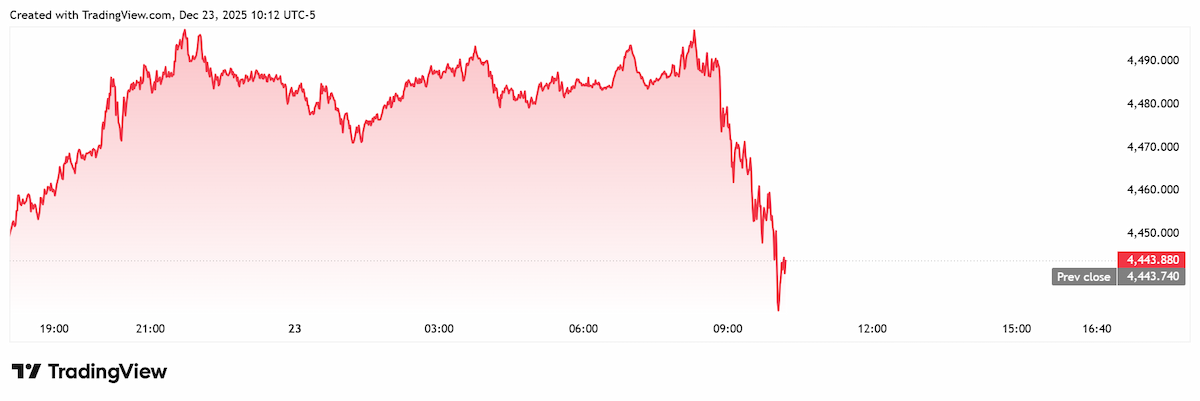
Gold prices fell to session lows following the 10 am EST data release, with spot gold turning negative on the session and last trading at $4,443.88 per ounce at the time of writing for a slight loss of 0.01% on the daily chart.
"Despite an upward revision in November related to the end of the shutdown, consumer confidence fell again in December and remained well below this year's January peak," said Dana M Peterson, Chief Economist at The Conference Board. “Four of five components of the overall index fell, while one was at a level signaling notable weakness.”
“The Present Situation Index declined as net views on current business conditions were negative for the first time since September 2024, a month that included a labor market scare and deadly hurricanes,” the report noted. “Perceptions of employment conditions edged lower as the labor market differential—the share of consumers saying jobs are 'plentiful' minus the share saying jobs are 'hard to get'—continued to flag. Two of the three Expectations Index components dipped in December. November's nosedive in expectations for business conditions six months from now mostly reversed in December but remained negative. Expectations for labor market conditions were gloomier, and the outlook for household incomes was less positive.”
“Among demographic groups, on a six-month moving average basis, confidence dipped among all age groups in December, although consumers under 35 continued to be more confident than consumers age 35 and older,” the Conference Board said. “There were few generational differences, as confidence among all generations trended downward in the month, with only the Silent Generation becoming more hopeful.” Millennials and Gen Z remained the most optimistic of all generations surveyed.
By income, confidence (on a six-month moving average basis) fell for nearly all brackets, except for those earning less than $15K and more than $125K. “Still, consumers earning less than $15K remained the least optimistic among all income groups,” the report added. Confidence continued to fall in December among all political affiliations (Democrats, Republicans, and Independents).
"Consumers' write-in responses on factors affecting the economy continued to be led by references to prices and inflation, tariffs and trade, and politics,” Peterson said. “However, December saw increases in mentions of immigration, war, and topics related to personal finances—including interest rates, taxes and income, banks, and insurance. The responses continued to skew pessimistic but less so than November, potentially due to fewer negative comments about prices and inflation, politics, as well as a rebound in positive responses about interest rates. Notably, the Federal Reserve Board cut monetary policy rates on December 10 for a third time in 2025, which landed in the second half of the survey sample interval."
