
(Kitco News) - Silver may not be seen as a monetary metal anymore, but analysts expect it to play an integral role in the evolution of the global economy and, therefore, it will be a critical asset in global financial markets.
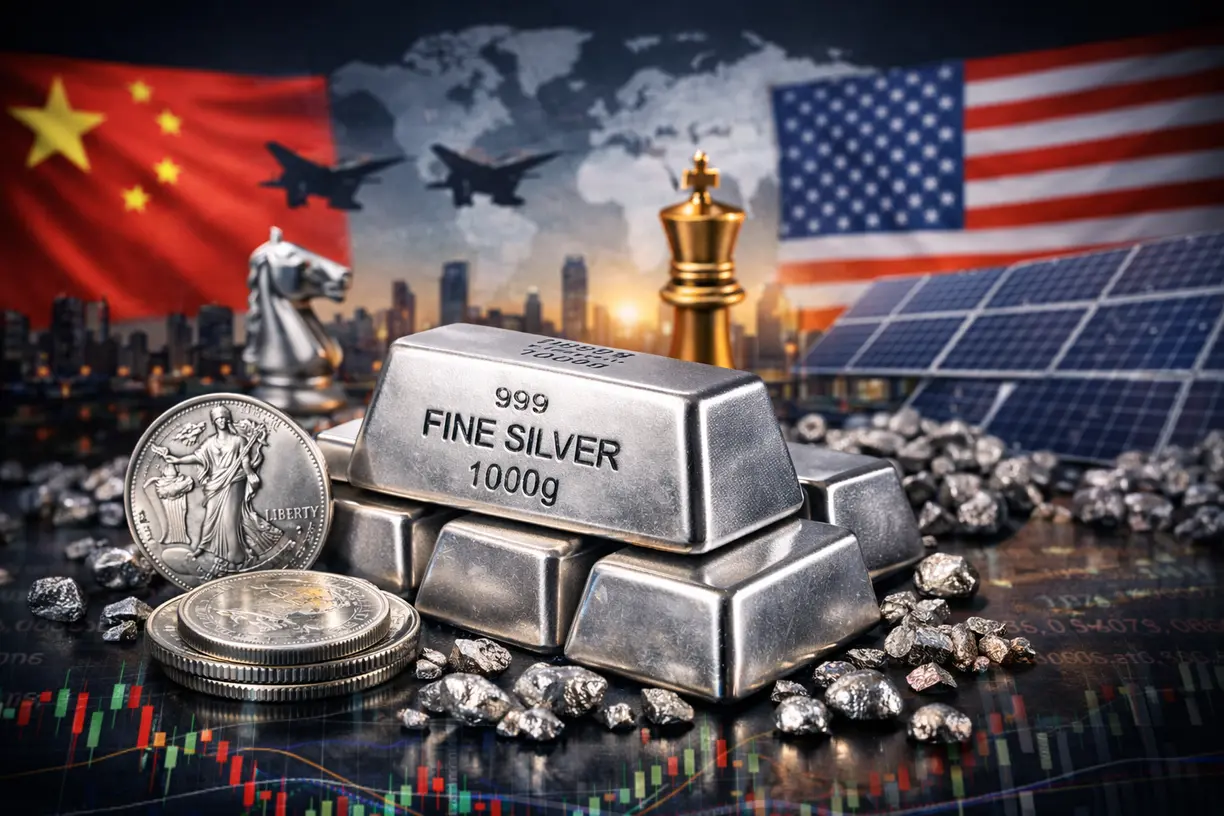
Mining legend Frank Giustra is warning investors in his latest commentary that a “bare-knuckle fight” is brewing in the commodity sector between Western and Eastern markets, with silver emerging as the latest weapon of choice. He added that the result of this tug-of-war will be a significant repricing of the precious metal.
Giustra’s comments come as silver prices look set to close the year above $71 an ounce, up nearly 150% in 2025. And while silver is posting its best annual gains since 1979, Giustra took a much longer historical view, pointing to a period when demand for the precious metal sparked a major conflict between Great Britain and China.
Giustra noted that from the mid-1500s to the early 1800s, China was the world’s largest economy, absorbing an astonishing 30% to 50% of the planet’s total silver production.
“This metal wasn’t just a commodity; it was the very backbone of the Middle Kingdom’s monetary system, its taxation, and its unparalleled commercial growth,” Giustra said.
British demand for Chinese goods such as porcelain, silk, and tea created a significant trade imbalance with China, with Britain’s silver flowing steadily eastward. To address this imbalance, British officials began selling opium into China from their Indian colonies, ultimately resulting in an entire nation addicted to the drug.
In the mid-1800s, the two nations went to war over the opium trade and silver demand, a conflict that resulted in Hong Kong becoming a U.K. colony.
“Thus began what Beijing today calls the ‘Century of Humiliation,’” Giustra said.
While history may not repeat itself, Giustra said it can sometimes rhyme, as China now looks to control the silver supply chain by restricting exports in the new year.
China is currently the world’s second-largest silver producer; however, Giustra noted that it is also a pivotal refiner and exporter. He added that the key difference between today and the 1800s is that China has established itself as both an economic and military powerhouse.
“This isn’t a weak Qing dynasty helpless before foreign cannons. This is a modern superpower, economically muscular and strategically patient,” said Giustra. “This silver move is a policy of strength, not desperation.”
China’s import restrictions come as the silver market has experienced several supply-chain and liquidity issues over the past year. For the last five years, robust industrial demand for silver has created large supply deficits, significantly depleting above-ground inventories.
“Forget the 19th-century tea trade. Today’s silver demand is powered by the inexorable forces of electrification and artificial intelligence,” said Giustra. “Industrial demand hit a record ~680 million ounces in 2024. Solar is the undisputed king, consuming over 200 million ounces annually—a figure projected to soar past 450 million ounces by 2030. Why? Because every AI query needs electrons, and the marginal electron is increasingly solar. Silver’s conductivity is unmatched, and substitution is neither easy nor quick.”
At the same time, renewed investment demand—particularly from India—has further depleted physical silver supplies.
Giustra noted that it is unlikely silver supply will catch up with demand anytime soon.
“72% of global silver supply comes as a by-product of mining for copper, lead, zinc, and gold,” he said. “You cannot simply ‘decide’ to produce more silver. The market has seen essentially no net supply growth for 25 years. Meanwhile, truly ‘primary’ silver deposits are geological unicorns.”
Looking ahead, Giustra issued a word of caution for the silver market. He said that in this environment, prices are likely to remain in backwardation, with spot prices higher than futures prices as investors and market participants pay a premium for immediate supply.
“The paper markets on the COMEX can nap in complacent contango, but the real physical market—the London OTC—is screaming. We are witnessing the deepest backwardation in decades,” he said. “It’s the market paying a panic premium for metal right now because later might be too late. The ‘Great Silver Squeeze’ of October 2025, which saw lease rates spike to 40%, was a warning shot. China’s export restriction is the next, much larger, volley.”
Giustra said the stars are aligning for silver in 2026 and beyond: “Multi-decade backwardation in London, inelastic solar demand, by-product-dominated supply, a sleeping speculative crowd, and now, a net-exporting superpower strategically hoarding its stash.”
