
(Kitco News) – After gaining nearly 65% in 2025 – outperforming every major commodity except silver and the PGMs and crushing most other assets – many industry experts see further gains for gold prices in the coming year, while the overwhelming majority of retail traders see the yellow metal setting fresh record highs above $5,000 per ounce in 2026.
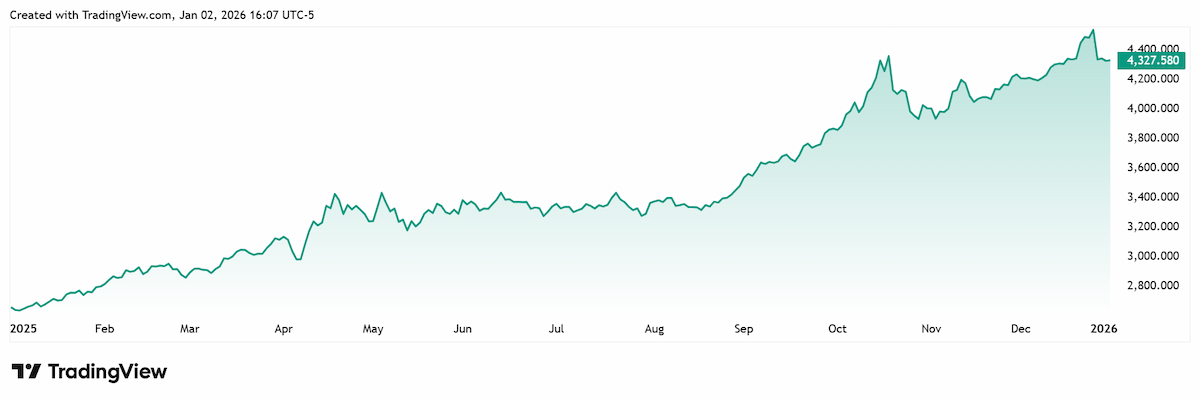
Gold began last year on somewhat shaky footing. The gold price had already risen to the very edge of $2,800 per ounce in late October of 2024, but the election of Donald Trump to his second term ignited a rally in risk assets, driving gold all the way back down to the low $2,500s by mid-November.
Spot gold kicked off 2025 trading at $2,622 per ounce, and the early part of the year saw the yellow metal steadily clawing back its November losses. Gold began February trading back above $2,800, before topping out just above $2,950 on the 25th.
March opened with the yellow metal trading nearly $100 below its February high, but it wasted a little time making up lost ground. By March 13th spot gold had reached $2,990 per ounce, and in the first days of April, it set a new all-time high above $3,166 per ounce.
This time, it was the announcement of global trade tariffs on Trump's 'Liberation Day' that stalled gold's momentum – though not for long. While spot gold fell all the way back to $2,955 per ounce by April 7th, only two days later it set a fresh all-time high above $3,175, and by April 22nd the new high was $3,500 per ounce.
Gold then entered its first period of sustained consolidation in 2025, with the yellow metal trading between $3,435 and $3,120 through May, June, July and August.
September 1st saw gold break decisively out of consolidation to set a fresh all-time high of $3,540 per ounce, and September through mid-October was a period of precipitous growth for the yellow metal as rate cut optimism combined with positive market sentiment to reignite the precious metal's momentum.
But on October 20th, gold stalled once again, one day after setting a new all-time high of $4,381.44. This time, gold prices experienced one of their sharpest single-day drops on record, with spot gold hitting a low of $4,080 per ounce after trading as high as $4,375 earlier in the day. By October 27th, gold had bottomed out at $3,886 per ounce, and November began on a positive note with the yellow metal once again breaking above $4,000 per ounce.
The price ceiling was now capped at $4,200, however, and it would take until December 10th before spot prices broke decisively through that level. After claiming $4,300 and taking a few days to consolidate, gold saw its final big push of 2025, breaking through $4,400 to a high of $4,449 on December 21st, and ultimately topping out at the new all-time high of $4,550 on Christmas Eve.
When markets reopened on the 28th, gold saw another sharp sell-off, this time losing $240 in a single session to hit a low of $4,302 per ounce. And while gold would fall as low as $4,274 per ounce in the final days of trading, the $4,300 level would prove a firm foundation for the yellow metal to close out its year.
The Kitco News Annual Gold Survey showed very strong belief in the yellow metal’s bullish potential on the part of retail traders, while the big banks and industry experts also expect continued gains from gold prices on balance in 2026.
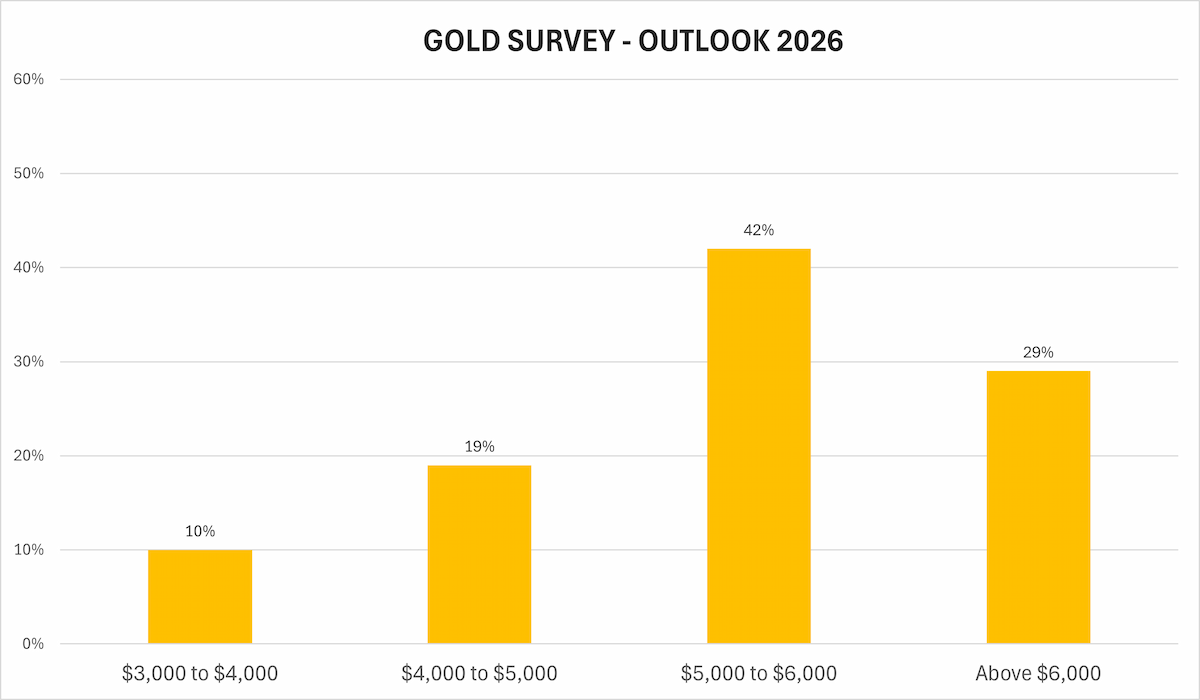
475 retail investors participated in the Kitco News Annual Gold Survey, with a strong majority of Main Street predicting the yellow metal will set a new all-time high as it trades above $5,000 per ounce in 2025, while only one in 10 saw it dipping back below $4,000.
138 retail traders, representing 29% of total responses, expect gold to trade above $6,000 per ounce level next year, with the current all-time high above $4,550 set on December 26, 2025. The largest proportion of Main Street, 42%, or 197 investors, predicted gold prices will trade between $5,000 and $6,000 in 2025, while 19%, or 92 participants, expect gold to top out somewhere within its current range between $4,000 and $5,000. The remaining 49 retail traders, representing 10% of the total, think gold prices will drop back into the $3,000 to $4,000 per ounce range seen in spring through early fall of 2025.
Wall Street banks have shown themselves bullish on 2026 even after two years of standout performances, but none project a repeat of the percentage gains seen in 2025.
Goldman Sachs sees gold as the best bet in the entire commodities complex for 2026, and if private investors join central banks in their diversification, the price could well exceed its $4,900 per ounce base case.
Of all the commodities they reviewed, Goldman Sachs is most bullish on gold – and central bank demand is a big reason why.
“We expect central bank gold buying to remain strong in 2026, averaging 70 tonnes per month (close to its 66 tonnes 12-month average, but 4 times above the 17 tonnes pre-2022 monthly average), and contribute about 14pp to our predicted price increase by Dec 26 for three reasons,” they said. “First, the freezing of Russia’s reserves in 2022 was a sea change in how EM reserve managers perceive geopolitical risks. Second, the estimated gold reserve share of EM central banks such as the PBoC remains relatively low vs. global peers (Exhibit 1, left panel), especially given China’s ambition to internationalize the RMB. Third, surveys show record high central bank gold appetite.”
The analysts also see upside risk to their gold price forecast due to a further broadening of this diversification to private investors - a trend that has already resulted in competition for bullion between investors and central banks, and which has contributed to the multi-year bull market.
“Gold ETFs account for just 0.17% of US private financial portfolios, 6 basis points below its 2012 peak,” they noted. “We estimate that every 1bp increase in the gold share of US financial portfolios—driven by incremental investor purchases rather than price appreciation—raises the gold price by 1.4%.”
Goldman Sachs expects the gold price to pull back to the low $4,200s in the first quarter of 2026, and rising back to current levels above $4,400 per ounce in Q2, before setting a new all-time high near $4,630 by the third quarter, and rising as high as $4,900 by the end of Q4.
J.P. Morgan’s 2026 outlook calls for gold’s bull market to continue as the key drivers remain strong, while new demand from Chinese insurance giants and the crypto community could help the yellow metal break above $5,055 by year-end.
“While this rally in gold has not, and will not, be linear, we believe the trends driving this rebasing higher in gold prices are not exhausted,” said Natasha Kaneva, head of Global Commodities Strategy at J.P. Morgan. “The long-term trend of official reserve and investor diversification into gold has further to run. We expect gold demand to push prices toward $5,000/oz by year-end 2026.”
The bank’s price forecasts are based on strong ongoing investor demand, along with continued central bank demand, which they project to average 585 tonnes per quarter in 2026.
J.P. Morgan also sees further potential for gold’s ownership pool to grow next year, with Chinese insurance companies and the crypto industry potential sources of new demand.
“While precisely timing the catalysts and inflows that will push prices higher remains difficult, we continue to have strong conviction that gold demand will have enough firepower to continue to push prices toward $5,000/oz in 2026,” said Gregory Shearer, head of Base and Precious Metals Strategy at J.P. Morgan. “If anything, we think our investor demand assumptions are potentially on the conservative side. We have laid out a scenario where if diversification of just 0.5% of foreign U.S. asset holdings into gold took place, it would be enough new demand to drive prices to $6,000/oz.”
“With gold mine supply relatively inelastic and slow to respond to these higher prices and demand expected to remain robust, risk continues to skew toward reaching this multi-year target much quicker than expected,” Shearer added.
J.P. Morgan Global Research is forecasting the gold price to average $5,055 per ounce by the final quarter of 2026, and they see the yellow metal reaching $5,400 by the end of 2027.

Commodity strategists at UBS predict gold prices will reach $5,000 per ounce by September 2026, and any increase in political or economic turmoil surrounding the U.S. midterm elections could push the yellow metal to $5,400.
The Swiss banking giant announced that it was raising its gold price target to $5,000 per ounce for the first three quarters of 2026. UBS strategists then expect the gold price to pull back to $4,800 per ounce by the end of 2026 – $500 higher than the previous forecast of $4,300 per ounce.
UBS expects demand for gold will steadily increase in 2026, supported by low real yields, ongoing global economic concerns, and domestic policy uncertainties in the United States – particularly those related to the midterm elections and mounting fiscal pressures.
“If political or financial risks increase, the gold price could climb to $5,400 per ounce (previously expected at $4,900 per ounce),” the strategists wrote in the report.
TD Securities said in its 2026 commodities outlook that it doesn’t predict a rout for gold in 2026, and instead expect to see new all-time highs.
TD believes gold's new long-term range will be between $3,500-4,400 per ounce. “For prices to stay below the lower end of that range, it would take a shift in investor attention back to rising US risk asset prices, or a view change that the US job market will not weaken and no further Federal Reserve rate cuts are on the way,” the analysts said.
TD expects central banks, ETF investors and traders will all place strong bids on gold. “Consequently, we project the average quarterly price to hit a record $4,400/oz in the first six months of 2026, with trading peaks considerably above those levels,” they said.
Wells Fargo analysts wrote in their 2026 Outlook that gold will be among the few standout performers in the commodities complex.
“We remain constructive on gold’s (and Precious Metals’) uptrend through 2026,” they wrote. “Recent conditions have been ripe for gold outperformance as global demand growth has been fueled by heightened central-bank purchases, U.S. dollar depreciation, Fed interest-rate cuts, and geopolitical uncertainty.”
Wells Fargo analysts expect many of these tailwinds will continue in 2026, which in turn will enable gold prices to continue their outperformance, though at a slower pace than in 2025.
Among their key investment ideas for 2026, they suggest investors adjust their portfolio positions to take advantage of lower near-term interest rates.
“Overall, the monetary backdrop supports income generation and selective risk-taking with implementation focused on quality across asset classes to preserve capital while positioning for a growth recovery,” they said. “Commodities, especially gold and precious metals, may offer capital preservation, in our view, amid ongoing geopolitical and inflation risks and given our outlook for a stable U.S. dollar and unrelenting central-bank demand.”
Wells Fargo commodity analysts project gold prices finishing 2026 between $4,500 and $4,700 per ounce.
Commodity strategists at RBC expect gold to trade predominantly in a $4,500 to $5,000 per ounce range in 2026, with prices gravitating toward the upper end of that band in the second half of the year. While a repeat of 2025’s explosive gains is unlikely, the analysts said downside risk appears limited, with strong support emerging well above pre-2024 levels.
“If there is any key takeaway from 2025 that should apply to 2026, it is that, while uncertainty may take many forms, persistent uncertainty around tariffs, geopolitics, conflict, politics, government shutdowns, legislation, etc., have left investors feeling underexposed to gold. When coupled with gold’s strong price performance and lower correlations, we think it’s now more accepted as a strategic part of portfolios,” said Christopher Louney, gold strategist at RBC Capital Markets.
Bank of America’s head of metals research Michael Widmer said that gold bull rallies typically peak only when the underlying drivers that initially triggered the rally fade and do not end simply because prices rise.
And analysts at Société Générale said they are maintaining a 10% allocation to gold in their multi-asset portfolio, and reiterated their call for gold prices to hit $5,000 an ounce by the end of 2026.
“Retail investors have continued to diversify their assets and pile into gold, through bars, coins and ETFs. We recommend buying the dips as non-aligned central banks will continue to diversify away from USD assets and because gold offers efficient protection against many risks (including a more dovish Fed after the change in top personnel),” the analysts said.
Compared to Main Street sentiment, most precious metals analysts have adopted a somewhat more cautious stance, though the majority are still bullish on gold for the year, and most independent analysts’ projections are more optimistic than those of the big banks.
World Gold Council Global Head of Research Juan Carlos Artigas noted that gold has outperformed the broader market in 2025, and two macro drivers were the key to its success.
“First, a supercharged geopolitical and geoeconomic environment, and also a generalized weakness in the US dollar and marginally lower interest rates,” he said. “If we combine these two things with the positive price momentum, then investment demand has been particularly supporting performance.”
When asked what investors can expect from gold in 2026, Artigas pointed to the confluence and the interaction between the two macro drivers.
“Concretely, the gold price right now reflects macro consensus expectations,” he explained. “What this means is that if the economy plays out in the way that economists and market participants are anticipating, then gold prices may remain somewhat rangebound. The reality, however, is that this rarely ever happens. It's not very likely for the economy to play out exactly as anticipated. So, it is more interesting to understand what are the factors that could push gold prices higher or lower from here.”
Among the factors that could boost prices, Artigas said that economic data in the U.S. and internationally has been mixed. “But if we start to see a shallow slip into the US economy, which would prompt the Fed to cut rates and the dollar to further weaken, this could support gold prices,” he said. “Now, depending on the speed and the magnitude of those rate cuts by the Fed, gold prices may increase anywhere from five to 15%. But if economic conditions deteriorate significantly more – whether it is because there's worsening geoeconomic conditions or because of the aftermath of some of the current economic policies – then we could see investment demand significantly increase.”
And even though investment demand has surged in 2026, Artigas sees far more capacity for growth.
“Since May 2024 to date, gold ETFs have amassed about 800 tons of gold,” he said. “And that sounds like a lot, but in reality, putting things into perspective, that's not even half of what we've seen in previous periods of risk. So again, if conditions get significantly worse, then we could see much more demand not only from gold ETFs, but also OTC markets, derivatives markets, and central banks. And the gold price in those conditions could even go above $5,000 an ounce.”
Artigas was asked about the price impact of a potential pullback in investment demand, and he didn’t rule one out. “To a degree, gold's risk premium reflects some of the current conditions,” he said. “If U.S. economic policies actually have a positive effect and we start to see growth, whether it is because of resolution of trade negotiations or more friendly fiscal policies, then part of that premium will go away, and gold prices could start to come down – we estimate anywhere from 5 to 20% depending on the specifics of those conditions.”
Eric Strand, founder and portfolio manager of AuAg Funds, told Kitco News that gold remains on track to hit their long-term target of $10,000, and that any price below that level in 2026 remains a bargain.
Looking ahead to the next 12 months, Strand said that he believes $5,000 is an achievable target – but the real gains will likely happen on the equity side. “This is no longer just a safety trade,” he said. “It’s a return play. And that means miners.”
Rajat Bhattacharya, senior investment strategist at Standard Chartered, noted in his 2026 outlook that this is the second consecutive year gold has outperformed both stocks and bonds, and it has outperformed bonds for 10 straight years.
“Gold’s record-breaking rally, fuelled by geopolitical uncertainty and concerns about easing fiscal policies worldwide, has lifted the price of the precious metal by over 50% this year and by more than 150% over the past three years,” he said. “We have a strong conviction that gold will outperform global stocks and bonds again in 2026.”
Bhattacharya expects gold prices to average $4,500 an ounce over the next 12 months.
Carsten Fritsch, commodity analyst at Commerzbank, noted that gold prices have doubled since February 2024, and said he believes that gold’s current pace is not sustainable. The German bank expects gold prices to rise to $4,400 an ounce next year.
Chantelle Schieven, head of research at Capitalight Research, remains bullish on gold through 2026 but added that questioning the trajectory and momentum is healthy.
“Gold’s had two really good years, so it’s reasonable to start asking if this momentum can last,” Schieven said. “Gold may be in bubble territory, but that doesn’t mean it’s going to pop next year. We continue to see a tectonic shift in global financial markets to support higher long-term gold prices. I think we could easily see $5,000 an ounce in 2026.”
Schieven added that one reason she remains bullish is that technical price action continues to build significant support at higher levels. After holding above $2,000 an ounce throughout 2024, gold established new support at $2,500 an ounce at the start of the year, which quickly rose to $2,800. By the summer, prices had formed a new support range between $3,000 and $3,500, which became the launching pad for October’s all-time high of $4,366 an ounce.
In an interview with Kitco News, Aakash Doshi, chief gold strategist at State Street Investment Management, said he sees gold prices consolidating between $4,400 and $4,500 an ounce next year, but added that risks are skewed to the upside.
“It’s pretty clear that $3,000 has become the new $2,000 level, and now we are starting to see $4,000 as the new $3,000,” he said. “With this strong support, I think gold’s next 25% move remains higher, not lower.”
And Kitco senior analyst Jim Wyckoff shared some trend-line gold price projections for different time periods in 2026 based on trend lines drawn from the weekly continuation chart for nearby Comex gold futures. “Keep in mind, this is more of an interesting analysis than it is actionable analysis for traders and investors,” he warned. “In other words, odds are not great that all these projected prices will actually occur at precisely the times mentioned. It’s more of a fun exercise.
Wyckoff’s projections have gold at an early February price of $4,475.00 before rising to $5,180.00 in early May. By early August, he sees the possibility of $5,857.00, and in late December, gold could trade as high as $6,893.00 per ounce.
Sponsored by Discovery Silver Corp. - Learn more about the company, its latest news, and investor materials.
Visit https://discoverysilver.com/

